


BTC drops to $55,000—a generational buying opportunity?

Original article from: "The Generational BTC Buy Point Is Near"
Compiled by Odaily (@OdailyChina)
Translator: Wenser (@wenser2010)

Editor's Note: Last weekend, BTC briefly fell to just above $55,000, a drop of over 60% from its all-time high of $126,000. What's even harder to stomach is that this isn't just BTC's situation—stocks, bonds, gold, and other major asset classes are all in decline. With the Fed's rate hikes looming and the AI industry's deleveraging narrative in play, capital markets are increasingly pricing in expectations of tightening liquidity. Gold, long regarded as a "safe-haven asset," fell nearly 10% in a single week, and BTC—which was co-opted into the mainstream in 2024—has been unable to escape unscathed. Nevertheless, many industry participants remain confident about BTC's future trajectory, and their reasoning, beyond BTC's "anti-fiat narrative," is also tied to the current state of the industry. Odaily has compiled and translated an article shared by Four Pillars research lead @100y_eth for readers' reference. In a bear market, confidence matters even more than gold—take this as encouragement. The following is the original content, with some details edited for clarity:
Eye-Popping BTC Price: $55,000—Crypto's Death Knell or a Generational Buying Opportunity?
Last Saturday, I woke up a bit late. After finishing my pasta and salmon breakfast, I opened my computer and for a moment I could hardly believe my eyes: BTC was trading at $55,000 (Odaily note: many people surely find this as hard to believe as he did).
Is the crypto market officially dead, or is this exactly a generational buying opportunity?
Here's my personal take:
- We are very close to a BTC bottom-fishing opportunity. Assuming BTC will eventually kick off another bull run, the $45,000 to $55,000 range looks like a very attractive entry point;
- That said, there's still a considerable chance we haven't seen the true bottom of this cycle. BTC's average price trajectory and technical and on-chain indicators such as MVRV suggest there may be further downside ahead; given what's happening in the AI industry, macro factors could push BTC prices even lower.
- My base case is that some crisis in the AI industry will trigger BTC's ultimate bottom at some point within the next year, followed by a trend reversal driven by US credit expansion and monetary easing.
Below I'll briefly outline why I believe these scenarios are the most likely to play out.
Reason One: The Crypto Industry Is Stronger Than Ever
Before diving into technical analysis, market cycles, and on-chain data, let's take a step back and look at the entire crypto industry in which BTC operates.
As I'll mention later, I've recently seen more and more posts on X arguing that compared to AI, the crypto industry has accomplished almost nothing and is essentially useless. I completely disagree with this view.
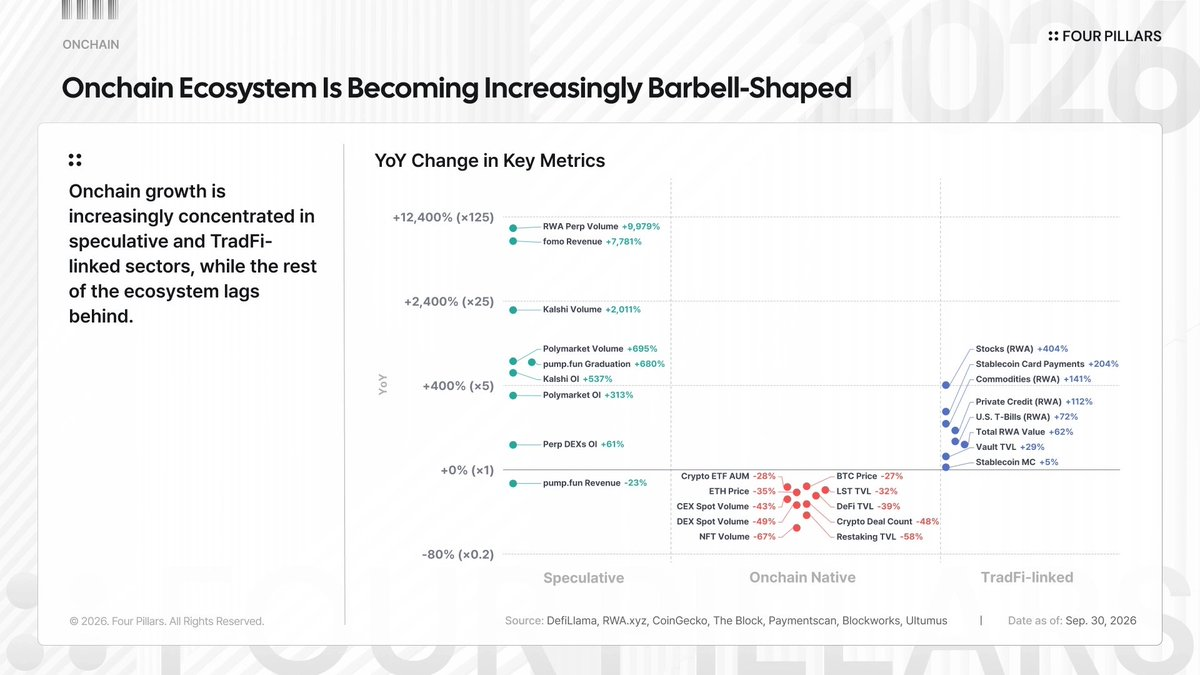
The on-chain ecosystem increasingly shows barbell-style differentiation and year-over-year changes in core metrics. Source: Four Pillars annual report
The chart above comes from Four Pillars' year-end report. My current assessment of the crypto industry is that several sectors have clearly found product-market fit (PMF). The problem is that crypto's actual adoption is concentrated in a very small number of areas.
The first category is speculative trading in crypto markets, including meme coins, perpetual contracts, and prediction markets. Regardless of overall crypto market conditions, these sectors continue to attract steady user activity. Perpetual contracts and prediction markets, in particular, represent entirely new ways of trading financial markets with enormous growth potential. There's a reason why Robinhood, Coinbase, and multiple traditional financial institutions are paying such close attention to these markets.
The second category is crypto projects related to next-generation financial infrastructure, primarily stablecoins and RWA assets. Traditional financial infrastructure is extremely fragmented—different asset classes and use cases often rely on completely siloed back-office systems—and blockchain is being viewed as one of the few technologies capable of connecting these fragmented systems. Just look at the Depository Trust & Clearing Corporation's (DTCC) tokenization initiatives, Intercontinental Exchange's (ICE) and New York Stock Exchange's (NYSE) plans for tokenized stock trading, and the stablecoin projects being explored by major banks such as Bank of America. Financial institutions large and small are pouring resources into stablecoins, RWAs, and blockchain infrastructure, and the reasons are obvious.
BTC may currently be sitting around $55,000 to $56,000, but the crypto industry has arguably found more genuine product-market fit than ever before and is accelerating its integration into the existing financial system. Regardless of market prices or sentiment, the crypto industry remains vibrant and functioning well. If you think about the future of financial infrastructure, it's hard to imagine a market without crypto technology involved.
Reason Two: The 300-Week Moving Average Has Been Broken
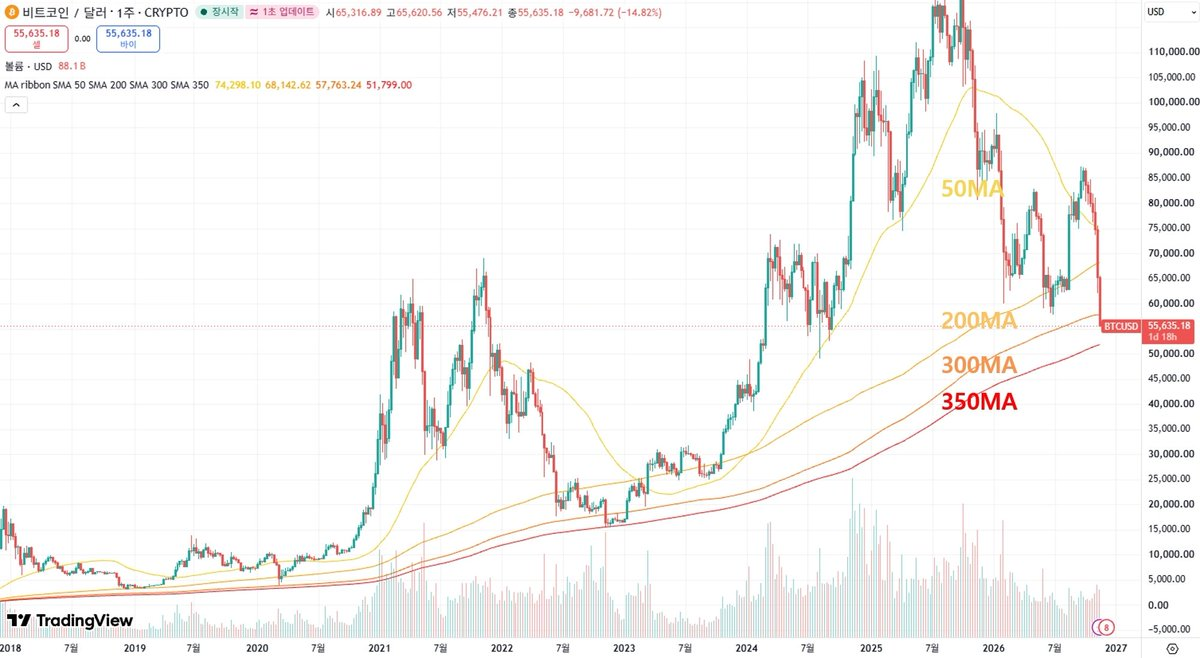
Bitcoin weekly chart with 50/200/300/350-week moving averages: TradingView
There's an old saying in crypto: "The 200-week moving average (200WMA) is the bottom."
Through every major market crash—including the 2018 bear market, the COVID crash, the Terra collapse, and the FTX bankruptcy—the 200-week moving average has been an extremely useful psychological reference point for identifying BTC bottoms.
But this time is different—the recent sell-off has not only broken below the 200-week moving average but also the 300-week moving average (300WMA). BTC is now approaching the 350-week moving average (350WMA), which has historically served as near-perfect bottom support. If BTC touches the 350-week moving average in the short term, the corresponding price would be around $52,000.
Regardless, BTC has already broken below one of the strongest psychological support levels in its history—the 200-week moving average. As long as another bull run eventually arrives, this fact means we may already be very close to the bottom.
We've seen similar situations before: in June 2022, after the Terra collapse and the subsequent downfall of Celsius and Three Arrows Capital (3AC), BTC briefly traded about 20% below its 200-week moving average. At the time, it took roughly 9 months for BTC to reclaim the 200-week moving average, and about another 14 months to decisively break away from that level and begin the next major rally.
Today, BTC is trading about 18% below its 200-week moving average, which means we're in a very similar position to that earlier situation. If history repeats, we could of course see another leg down. But we may also be entering a phase where BTC consolidates over the next year, slowly strengthening as the 200-week moving average rises, before the next major breakout.
Reason Three: The Start of a New Four-Year Cycle
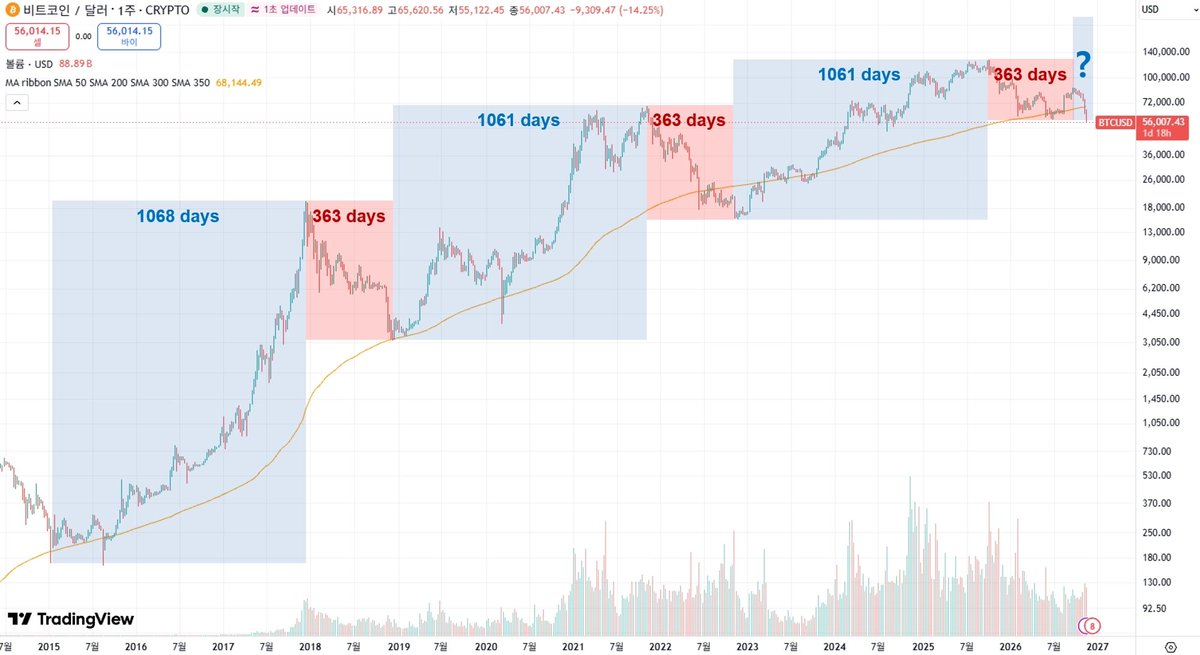
Comparison of the number of days in Bitcoin's historical cycle uptrends (approximately 1,061–1,068 days) and downtrends (approximately 363 days): TradingView
One of the narratives that I find least fundamentally convincing yet most influential is the Bitcoin four-year cycle theory.
I don't think there's any fundamental reason explaining why it repeats so reliably. Yet the time spans between each cycle's top and bottom are remarkably similar—so much so that it sometimes feels as if an Illuminati is secretly manipulating BTC's price behind the scenes.
Since the 2015 bottom, BTC has repeatedly experienced uptrend phases of roughly 1,061 to 1,068 days, followed by downtrend phases of about 363 days. Combined with Bitcoin's halving cycle, this pattern has become an extremely powerful narrative that profoundly shapes investor psychology.
This is particularly important for an asset like BTC: it generates no cash flow and is heavily influenced by macro conditions and market sentiment. For such assets, narrative itself matters enormously.
If historical patterns continue, we should now be nearing the end of this bear market and approaching the beginning of a new bull phase. However, there is a significant risk here. More than 363 days have passed since the last peak, and BTC's decline is continuing well beyond the historical time window.
I don't think this alone is enough to declare the four-year cycle dead. But if BTC continues to deviate from this pattern, we must seriously re-examine whether the theory still holds.
Reason Four: MVRV Is Approaching a Break Below 1
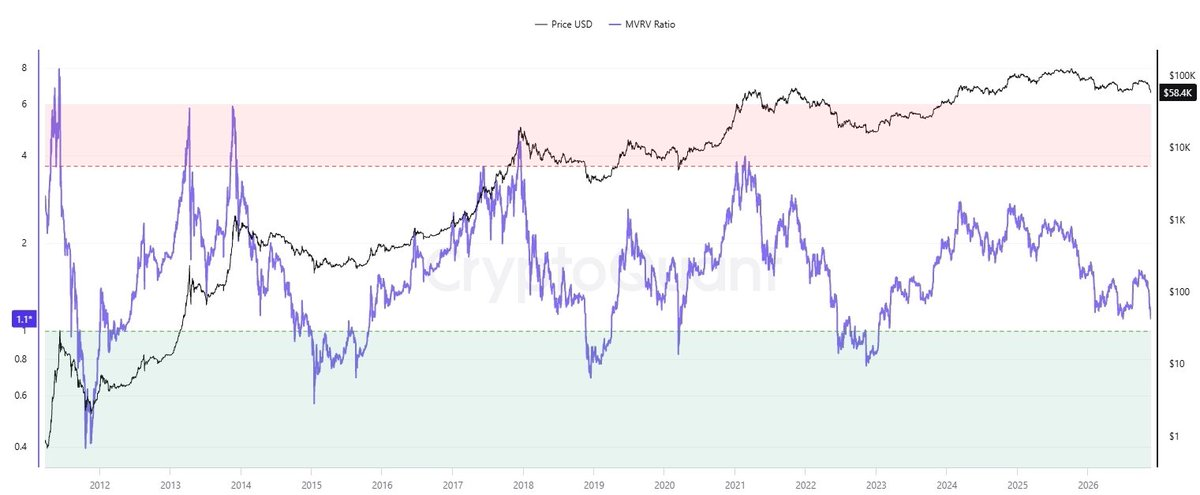
Historical trends of Bitcoin price (USD) and MVRV ratio: CryptoQuant
MVRV refers to the Market Value to Realized Value ratio. It's calculated by dividing BTC's current total market cap by its realized market cap, which estimates the value of each BTC based on the price at which it last moved on-chain.
Simply put, a lower MVRV means BTC's current market price is relatively low compared to investors' estimated overall cost basis. Historically, periods when MVRV fell below 1 have often provided attractive long-term buying opportunities.
In previous cycles, BTC typically hit its ultimate bottom about 1 to 6 months after MVRV fell below 1; it then often consolidated in the sub-1 MVRV range for roughly 6 to 12 months before finally resuming its uptrend. MVRV hasn't broken below 1 yet, but it's very close. This makes me increasingly optimistic that a strong long-term buying opportunity may be approaching.
Here's another encouraging detail: each cycle's MVRV bottom has been progressively higher. Since 2011, historical MVRV lows have been approximately 0.395 → 0.564 → 0.691 → 0.760. If this trend continues, this cycle's MVRV bottom likely won't fall as deep as in earlier cycles.
Assuming realized market cap remains unchanged and the next MVRV bottom lands around 0.8 in line with historical trends, we can estimate BTC's bottom at approximately $43,000.
Reason Five: BTC Is Trading Near Mining Cost
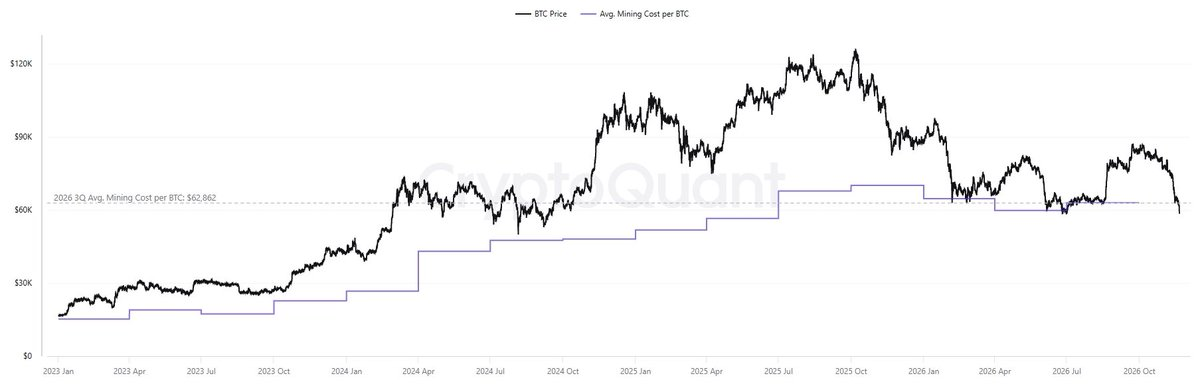
BTC price vs. average mining cost per coin (Q3 2026 average mining cost of approximately $62,862. Source: CryptoQuant)
CryptoQuant estimates the cost of mining one BTC by analyzing financial disclosures from Marathon Holdings, one of the major listed Bitcoin mining companies. As of Q3 2026, this cost was approximately $62,900 per BTC.
Historically, Bitcoin miners' production cost has been a useful signal for identifying potential market bottoms. When BTC trades below production cost, miners have less incentive to sell newly mined Bitcoin at a loss.
Of course, things have changed. The BTC halving has reduced new BTC issuance, and many Bitcoin mining companies are now diversifying into AI data center businesses. So I wouldn't treat mining cost as an absolute floor for BTC's price. Nevertheless, it remains a valid indicator worth watching when assessing potential market bottom levels.
Reason Six: BTC Has Decoupled from M2 Liquidity
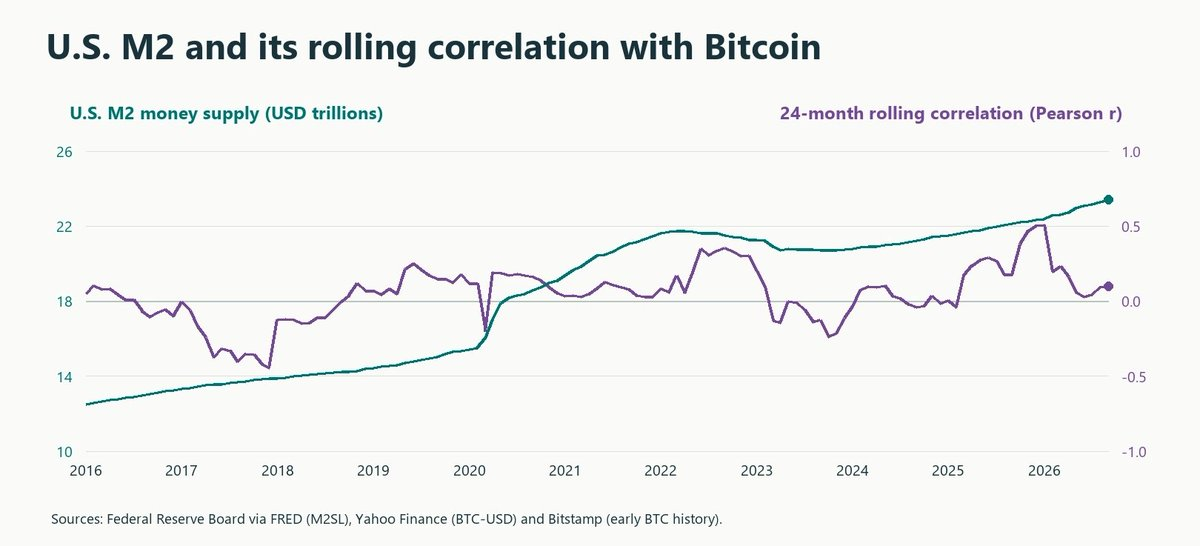
US M2 money supply and its 24-month rolling correlation with Bitcoin: Federal Reserve Board / Yahoo Finance, etc.
Many investors view BTC as digital gold with a fixed supply. Under this framework, when liquidity in the financial system expands, BTC's dollar-denominated price should typically benefit. Historically, we've indeed seen BTC rally rapidly during periods of US M2 money supply expansion.
But something thought-provoking happened recently—throughout 2026, US M2 liquidity has been re-expanding while BTC has continued to fall sharply. The correlation between BTC's price and M2 liquidity has dropped to near zero.
In my view, this suggests BTC may be significantly undervalued relative to the amount of liquidity actually present in the current financial system.
Reason Seven: Crypto Market Sentiment Has Hit Rock Bottom
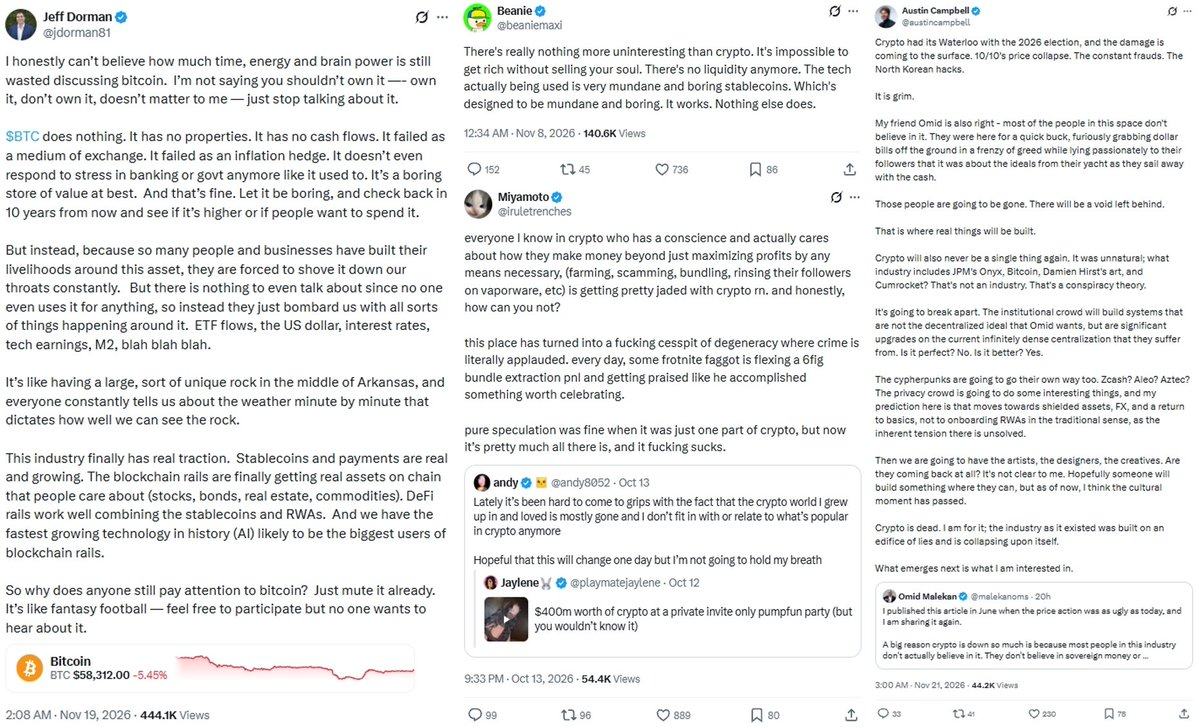
Compilation of screenshots of posts from some industry participants on X expressing bearish views on the crypto industry (Thanks to @jdorman81 @iruletrenches @beaniemaxi @austincampbell for their posts)
Extreme pessimism has historically been an effective signal that a market is nearing a bottom. And right now, crypto market sentiment is about as bad as it gets.
Over the past few weeks, X has been flooded with posts claiming the crypto industry has achieved nothing, the entire industry is meaningless, and virtually all tokens are garbage. More notably, such posts are receiving extremely high engagement and agreement from investors.
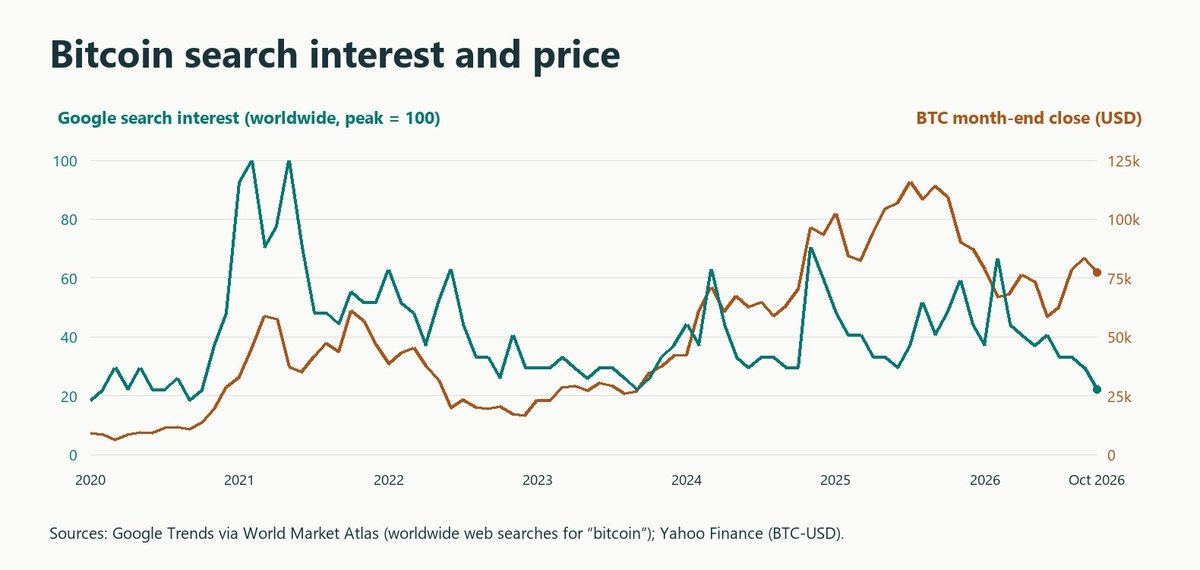
Bitcoin global Google search interest vs. month-end closing price: Google Trends / Yahoo Finance
Google Trends tells a similar story. Bitcoin's search interest has fallen back to levels last seen around 2020, near its lowest point since then. Historically, the moment when everyone has completely given up on crypto has often turned out to be one of the best buying opportunities.
Reason Eight: Monetary Expansion Is Inevitable
When thinking about market liquidity over the next three years, one thing I'm particularly certain of: AI will ultimately bring about a massive expansion of dollar liquidity.
This is broadly consistent with the argument Arthur Hayes made in his article "Situationship."
The logic is simple: if the AI bubble doesn't burst and the industry continues to expand, private credit creation—including bank credit—will continue to grow; if the AI bubble bursts, the US government will inevitably respond with credit expansion and monetary easing, just as it did during the 2008 financial crisis.
Watching recent developments, I'm increasingly leaning toward the second scenario. With the controversies surrounding Jensen Huang and his resignation as NVIDIA CEO, combined with the Democrats' landslide victory in the midterm elections and the resulting pressure on AI data center construction and development, investors have begun to gradually question the financing structures underpinning the AI industry.
Whether these developments will ultimately trigger a major correction in the AI bubble remains to be seen. But if the AI bubble does burst, I find it extremely hard to imagine the US government standing idly by. AI is no longer just an ordinary industry determined by market supply and demand—it is becoming a national strategic asset. In a world where people increasingly believe that whoever achieves AGI or ASI first will dominate the next era of global power, the US cannot afford to fall behind China.
In this situation, I believe the US has virtually no choice but to prop up the AI industry through aggressive credit creation and monetary expansion.