


Micron's Earnings Eve on Wednesday: Bulls and Bears Have Never Been So Divided

Micron Technology (MU) will release its fiscal 2026 fourth-quarter earnings after the U.S. market close on September 30 (early morning October 1 Beijing time). The company's prior revenue guidance was $50 billion (plus or minus $1 billion), with non-GAAP earnings per share of $31 (plus or minus $1); the Wall Street consensus expects revenue of approximately $51.07 billion and adjusted EPS of approximately $31.52, representing year-over-year increases of about 351% and 938%, respectively.
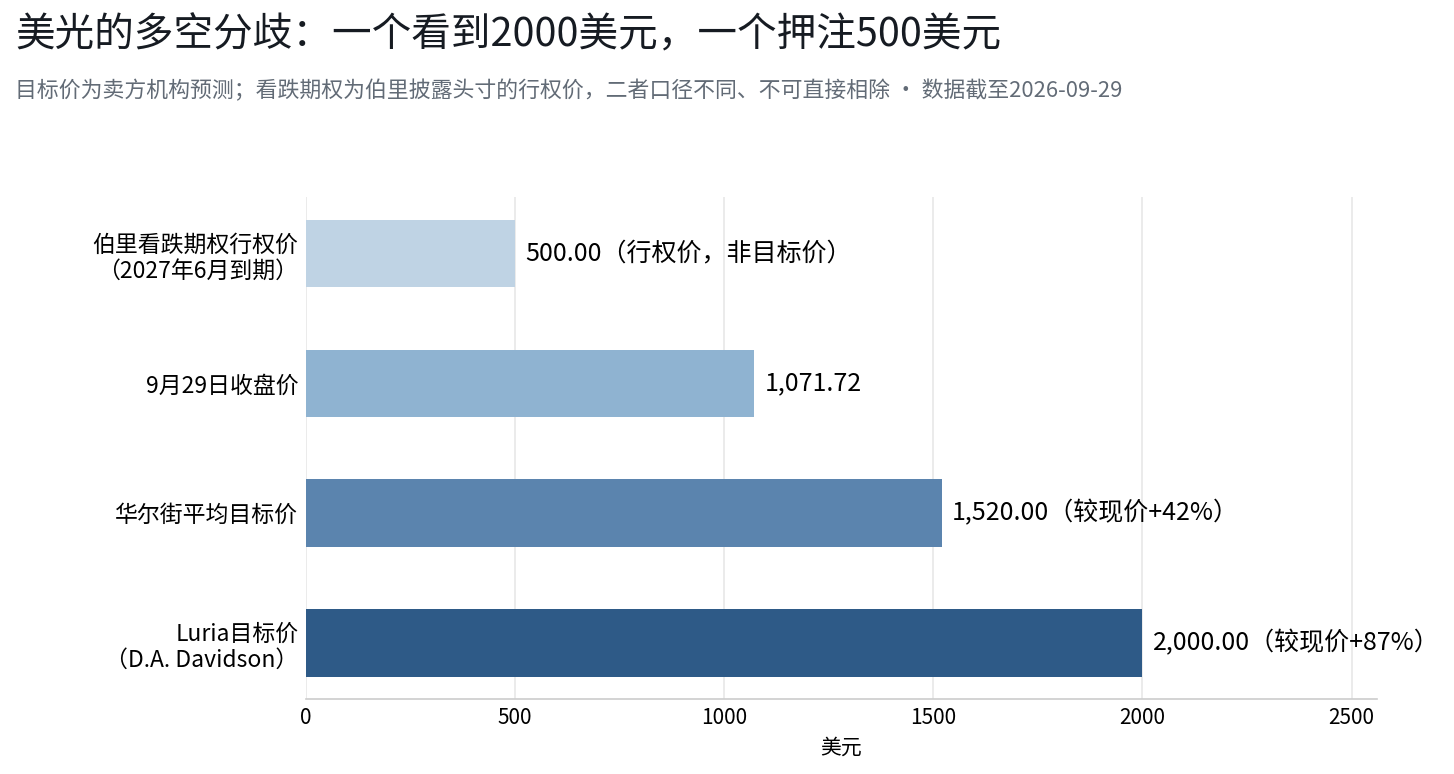
But the market's focus for this earnings report is not solely on the quarterly numbers themselves. Some market views hold that the earnings improvement has already been reflected in the stock price to some extent, and the market is also watching how long this memory cycle can last. D.A. Davidson analyst Gil Luria reiterated his $2,000 price target on the eve of the earnings release, implying roughly 87% upside from the September 29 closing price of $1,071.72; meanwhile, "Big Short" Michael Burry replaced his Micron short position with put options expiring next June with a $500 strike price. One side gives a $2,000 price target, while the other expresses a bearish view through put options with a strike price of around $500.
1. Quarterly Results: Market Expectations Are Generally Strong
Let's look at the numbers first. The company guided for revenue of $50 billion (±$1 billion) and non-GAAP EPS of $31 (±$1), but several institutions have offered more optimistic forecasts:
- Citi: revenue of $51 billion, EPS of $31.45;
- Goldman Sachs: revenue of $51.9 billion, EPS of $32.54;
- UBS: revenue of $52.4 billion, EPS of $32.50, the most aggressive;
- JPMorgan (Harlan Sur): revenue of $51.4 billion, gross margin of 86.2%, EPS of $31.73, all above the market consensus.
What does $50 billion in quarterly revenue mean? Micron's full-year fiscal 2025 revenue was approximately $37.1 billion—a single quarter's revenue exceeds the total of the entire previous year.
From realized results to structural variables, this earnings report has three layers of uncertainty: whether the guidance can exceed already-elevated market expectations, the timing of HBM4 mass production and its revenue contribution, and how conventional DRAM price trends and capital expenditure plans will provide evidence for the industry outlook.
Morgan Stanley's forecast for the quarter is relatively conservative: it expects revenue of $50.024 billion, up 342.1% year over year, gross margin of 86.4%, and earnings per share of $31.2, below the market expectation of $31.49. But Morgan Stanley also expects Micron to raise its earnings guidance, though by a smaller margin than in previous quarters.
2. The Underlying Logic of the Supercycle: HBM Is "Draining" DRAM
From the perspective of industry supply and demand, one structural factor currently in focus is that HBM capacity expansion may squeeze some conventional DRAM supply, while conventional DRAM still has market demand.
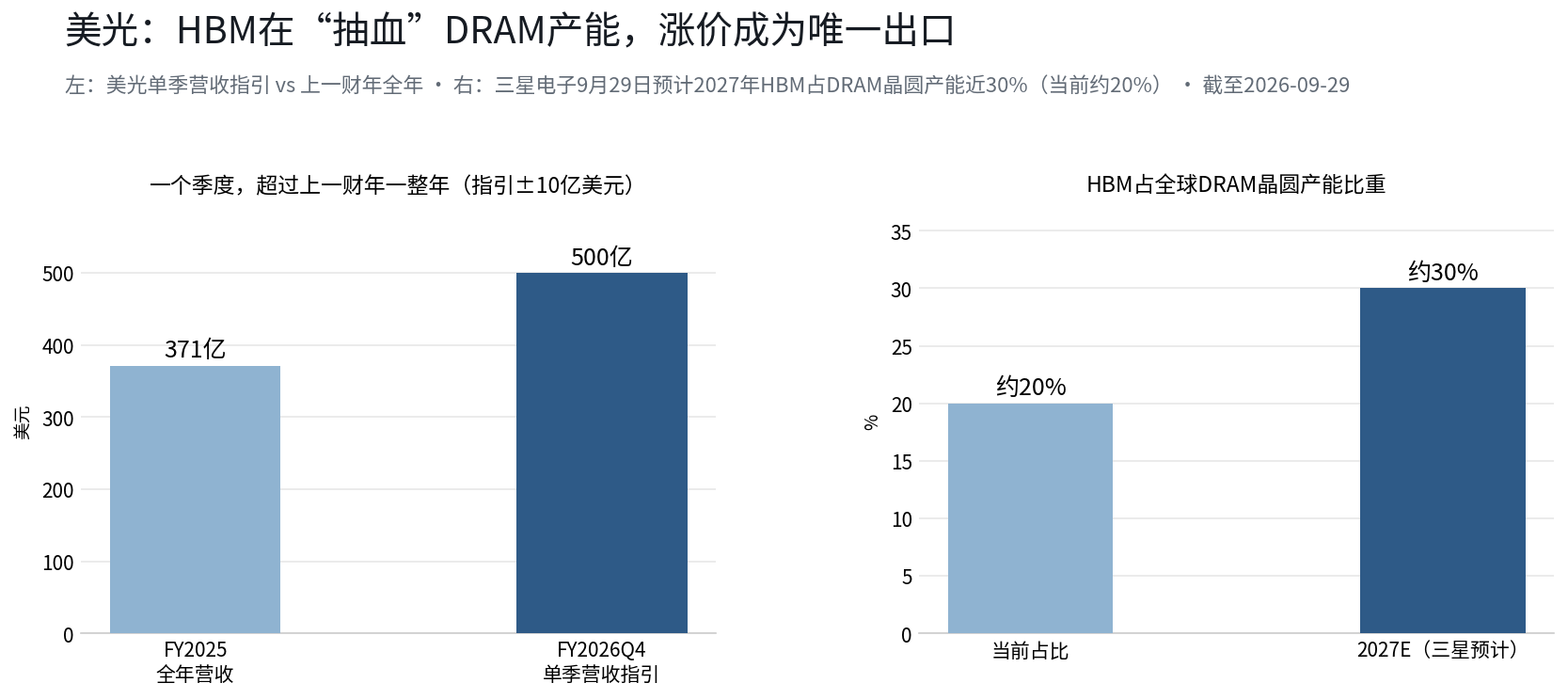
Samsung Electronics Executive Vice President Kim Taewoo provided a key figure in his latest remarks on September 29: HBM is expected to account for nearly 30% of total global DRAM wafer capacity by 2027, compared with about 20% currently. Soochow Securities' calculation path is clearer—HBM capacity as a share of total DRAM capacity rising from 12.3% in 2024 to 17.1% in 2025, 20.8% in 2026, and 22.5% in 2027. The wafer capacity required for HBM4 is roughly three times that of general-purpose DRAM, and a full-scale ramp-up of HBM4 will inevitably reduce the available capacity for conventional DRAM. Adata Technology Chairman Chen Li-Pai confirmed that the 2027 capacity of the three major original manufacturers has already sold out, with HBM and AI server applications consuming about 70% of DRAM output.
What makes Micron special is that it is the only one of the three major memory manufacturers with significant exposure to both HBM and conventional DRAM. Samsung and SK Hynix have a higher share of HBM in revenue, but Micron's conventional DRAM and NAND businesses are larger in scale, so its profitability may also be significantly affected by conventional DRAM price changes. BMO channel research shows that the earnings surprise potential from server DDR5 price increases is greater than that from HBM; HBM3E and HBM4 prices are likely to rise quarter over quarter, while consumer memory demand is relatively weak.
Micron's own progress is also accelerating: its 12-high HBM4 designed for Nvidia's Vera Rubin platform has been in mass production and shipping since the first quarter of 2026, with energy efficiency more than 20% higher than HBM3E, and cumulative shipment revenue has exceeded $1 billion. Micron CEO Mehrotra said at the June earnings call that the mass production ramp speed of 12-high HBM4 is about twice that of 12-high HBM3E. According to industry sources, Micron's monthly HBM capacity is expected to double to 100,000 wafers by the end of the year, and HBM4's share of its HBM output will rise from about 20%–30% at the beginning of the year to as high as 50% by year-end.
3. The $2,000 Price Target: Luria's Main Views and Rationale
Luria, who reiterated his $2,000 price target on the eve of the earnings release, is close to the highest level on Wall Street. He raised his target from $1,500 to $2,000 back in June, citing Micron's entry into a phase of "the best visibility in the semiconductor industry," with memory supply-demand tightness lasting at least through 2027.
His core argument has three layers:
- Luria believes that current HBM market pricing is heavily influenced by supply constraints, demand remains strong, and new supply still needs time to come online.
- Micron's earnings visibility is lengthening. HBM orders are typically locked in more than a year in advance, and a considerable portion of 2027 revenue can already be reasonably forecast.
- The valuation method is shifting. He wrote in his report: "This memory cycle is a complete cycle of the GPU, CPU, and memory trinity. AMD and Intel maintain P/E ratios of 40–60x, while Micron's P/E ratio is only 7x."
Luria also mentioned a recent change: the massive success of Meta's Muse has opened up entirely new application scenarios for consumers. "Just a few weeks ago, we were worried that memory demand from Meta would weaken, but now that possibility looks very low."
But the nearly $500 gap between Wall Street's average price target of $1,520 and $2,000 precisely shows that the market has no consensus on the question of "whether Micron is a cyclical stock or a growth stock." JPMorgan maintains an "Overweight" rating and a $1,540 price target, estimating that this quarter's revenue, gross margin, and EPS will beat market consensus, and says the slowdown in price increases is a sales cadence issue rather than weakening demand; UBS maintains a $1,625 price target, expects DRAM to remain in undersupply at least through the second quarter of 2028, and expects Micron to begin share buybacks starting in the second quarter of fiscal 2027, initially at about $20 billion per quarter.
4. The Bear Case: Views and Risks of a Cyclical Reversion
In sharp contrast to Luria is "Big Short" Michael Burry.
According to China Securities Overseas Information, Burry revealed in his latest weekly briefing to investors that he has largely replaced his original short positions in major AI stocks with put options, including replacing his Micron short position with put options expiring next June with a strike price in the $500 range. Burry's exact words were: "Because the timeline has shortened, I want greater leverage in my short positions."
He believes that the structural shortage of memory chips spawned by the current AI construction boom is temporary, and the industry will eventually return to the traditional boom-and-bust model: "Within the next two years, as production catches up with demand, this shortage will disappear, and memory chips will once again enter a downcycle."
Citi analysts also warned before the earnings release that DRAM and NAND prices will slow in the coming quarters; Bernstein expects the memory cycle may begin to "normalize" in 2028. Historically, some memory stocks have still experienced significant price volatility or pullbacks during periods of strong earnings, but historical performance does not represent future results.
5. Three Risks to Watch
- HBM4 yield ramp. HBM4 is still in the early stages of mass production, with yields below those of the previous-generation HBM3E, and the manufacturing process consumes more DRAM capacity. If yield improvement is slower than expected, Micron's HBM shipment pace could be affected. The market is also watching whether the capacity ramp meets expectations, customer certification progress, and the timing of revenue contribution—since large-scale shipments of downstream platforms may be concentrated in 2027, HBM4's significant revenue contribution may mainly fall in the next fiscal year.
- Conventional DRAM price elasticity and capital expenditure. According to Bank of America analysts, the key data the market really cares about is Micron's outlook for fiscal 2027 gross margin and capital expenditure: if gross margin can be maintained at around 85%, the forecast of $150–$200 in earnings per share for that fiscal year will be supported; capital expenditure is expected to be in the mid-to-high range of more than $40 billion, with a considerable portion used for cleanroom construction, which may not immediately translate into additional output. But if market expectations for the memory cycle outlook change, Micron's stock price could still fluctuate even if actual results exceed market expectations.
- Pressure from the macroeconomic rate environment. On September 28, Micron closed down 2.61%, while the Philadelphia Semiconductor Index fell 1.61% that day, as surging U.S. Treasury yields pressured all high-valuation tech stocks. If the Federal Reserve continues to raise rates in October, high-beta memory stocks could face additional valuation pressure in an environment of tightening liquidity.
Final Thoughts
The market has high expectations for Micron's upcoming earnings report. Factors such as HBM prices, conventional DRAM supply and demand, and AI capital expenditure are all key market focus areas, but actual results may still differ from market expectations. Beyond the earnings numbers themselves, the market will also focus on management's outlook for 2027 and how investors view the cyclicality and growth potential of Micron's future business.
Luria's $2,000 price target and Burry's put options reflect differing market views on Micron's future performance. The earnings report and management outlook will provide the market with more information.
Let's interact: For this earnings report, which factors are you more focused on—HBM supply and demand, conventional DRAM prices, capital expenditure, or management's outlook on the future cycle?
Disclaimer: This article is for general informational and educational purposes only and does not constitute any investment advice, recommendation, offer, or solicitation, nor should it be regarded as a basis for buying, selling, or holding any securities or other financial products. The views, forecasts, price targets, and other forward-looking information (if any) expressed herein are derived from relevant third parties or public materials and do not represent BIT's investment views or recommendations. Market conditions may change at any time, and actual results may differ materially from relevant forecasts or expectations. Investing involves risk, and investors should make independent investment decisions based on their own circumstances and seek professional advice when necessary.