


Robinhood Chain Pullback in Progress: What Are the Four Main Reasons Behind the Ecosystem's Plateau?

Original | Odaily (@OdailyChina)
Author | Wenser (@wenser 2010)

On September 30, HOOD Summit 2026 wrapped up in Houston, USA, marking the official launch of Robinhood's largest-ever trading product update. Meanwhile, the Robinhood Chain meme coin frenzy that had been gaining momentum over the past three months quietly cooled off, with on-chain trading volume and fee revenue declining in tandem.
Since its launch in July, Robinhood Chain made a splash with its "RWA + meme coin" dual asset categories and "stock-token paired meme coins" gameplay, with single-chain daily fees once reaching approximately $8 million. But by late September, the number of meme coin projects, DEX trading volume, and fee revenue had all declined to varying degrees. A closer look at the underlying reasons suggests they may be related to frequent rug pulls, restrictions on stock-token memes, lack of innovative gameplay, and constrained conversion of incremental markets.
The Debate Over Robinhood Chain's Decline: Key Data on Fees, Revenue, TVL, and Stablecoin Market Cap
Previously, the heated debate over whether Robinhood Chain was declining mainly stemmed from industry data and views from certain prominent figures.
On one hand, Robinhood Chain's single-chain fees and revenue have indeed seen sharp declines: according to DefiLlama data, on September 4, the chain's fees (Odaily note: total fees paid by users) reached approximately $6 million; revenue (Odaily note: actual single-chain revenue) hit $5.44 million, setting an all-time high, before declining steadily. By September 30, the corresponding figures had dropped to approximately $97,000 and $86,000, with the 7-day average revenue falling to the $100,000 range.
On the other hand, official subsidy policies are still ongoing: Robinhood Crypto announced on September 29 that Robinhood Wallet users conducting Swap transactions exceeding $0.50 on Robinhood Chain can have Gas fees waived, with this offer lasting until December 31, 2026. Extending from the original 3 months directly to 6 months shows that the Robinhood Chain team clearly recognizes the importance of reducing transaction friction costs.
Based on the above information, two camps of opinion have gradually emerged regarding whether Robinhood Chain's momentum is declining:
One is the fundamentals camp. Represented by Uniswap founder Hayden Adams and Dragonfly partner Haseeb Qureshi; the former previously stated that "it's quite laughable for community users to declare Robinhood Chain dead based solely on fee revenue charts. In reality, Robinhood simply raised the Gas limit and lowered user fees to expand on-chain capacity and meet enormous block space demand." The latter posted on September 15 expressing a bullish view on Robinhood Chain, arguing that after raising the on-chain Gas Limit and lowering user fees, on-chain revenue declined notably, but DEX trading volume remained strong, second only to Solana at the time. He believed this adjustment was a deliberate strategy by Robinhood.
However, with on-chain data continuing to languish, both viewpoints now appear somewhat untenable.
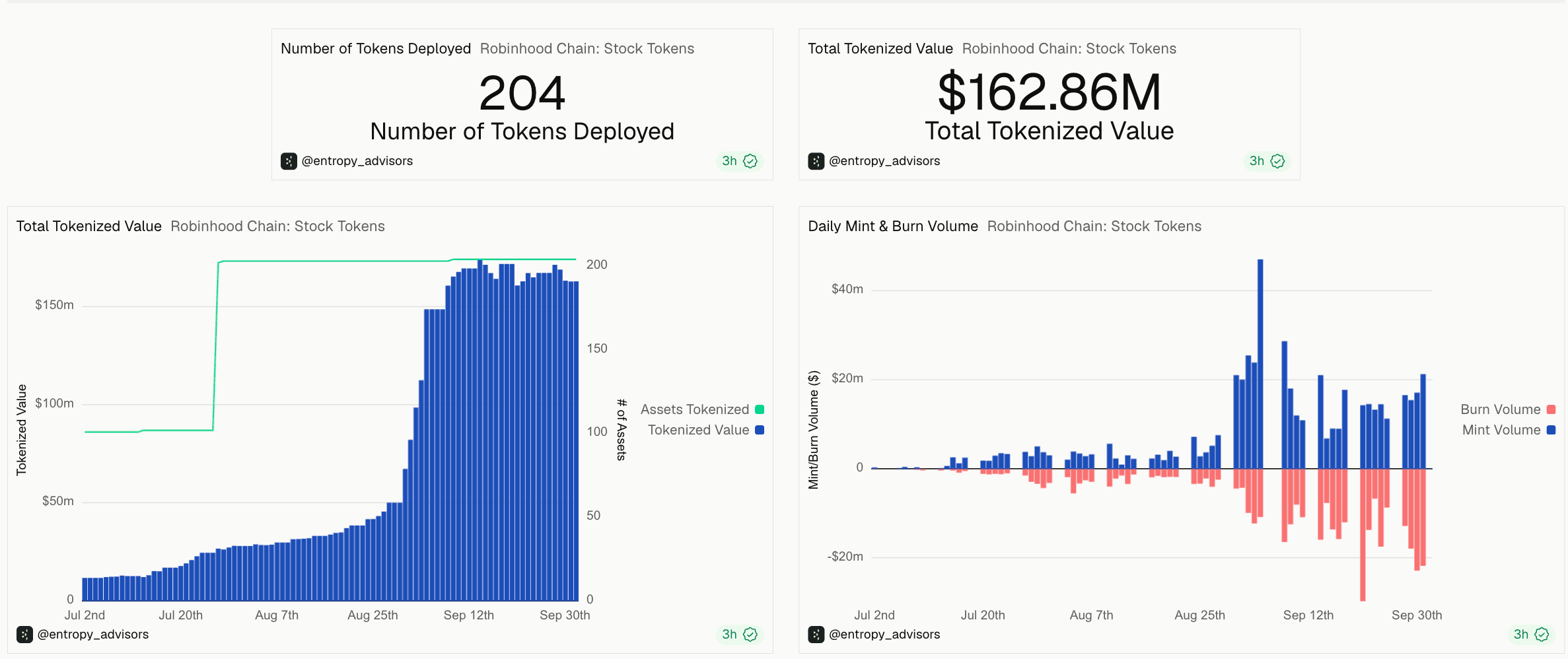
The other is the "meme coins are unsustainable" camp, represented by DeFi researcher Ignas. As early as September 9, he pointed out that "the on-chain stock and meme coin narratives, including those on Robinhood Chain, essentially depend on trading volume and transaction fees to operate. If trading volume dries up, rewards and buybacks will also disappear, leading to weakened holding incentives and ultimately triggering sell-offs." On September 22, he posted again stating that "Robinhood's meme coin and tokenized stock hype is weakening, with its tokenized stock TVL flat for two consecutive weeks and the number of burned stocks exceeding issuance." He further noted that meme coins are a "one-cycle trade" — investors can trade them but should not hold them long-term. Clearly, Ignas saw through the nature of Robinhood Chain's heavy reliance on meme coin narratives to sustain ecosystem heat and trading volume, and thus pointed out that its on-chain momentum had begun to fade.

Beyond revenue-side data, other Robinhood Chain metrics can also serve as references.
Since TVL reached around $900 million on September 6, Robinhood Chain's on-chain TVL has remained around $1 billion for nearly a month; however, its bridged TVL has slightly declined from approximately $3.4 billion to around $3 billion as of October 2;
The same applies to on-chain stablecoin market cap. Since Robinhood Chain's on-chain stablecoin market cap first broke through $1 billion on September 8, as of October 2, this figure is still hovering just above $1 billion. Without other incremental drivers in the short term, it may continue to remain at this level, with large-scale growth unlikely;
In terms of net capital inflows, Robinhood Chain recorded historical peaks of approximately $190 million and $213 million on July 24 and August 30, respectively. However, from August 31 to September 7, this metric saw 8 consecutive days of negative values, with cumulative outflows reaching approximately $470 million, nearly wiping out previous inflows. Although from September 8 to now, this metric has generally shown positive growth, its scale has dropped by approximately 80% compared to the peak.
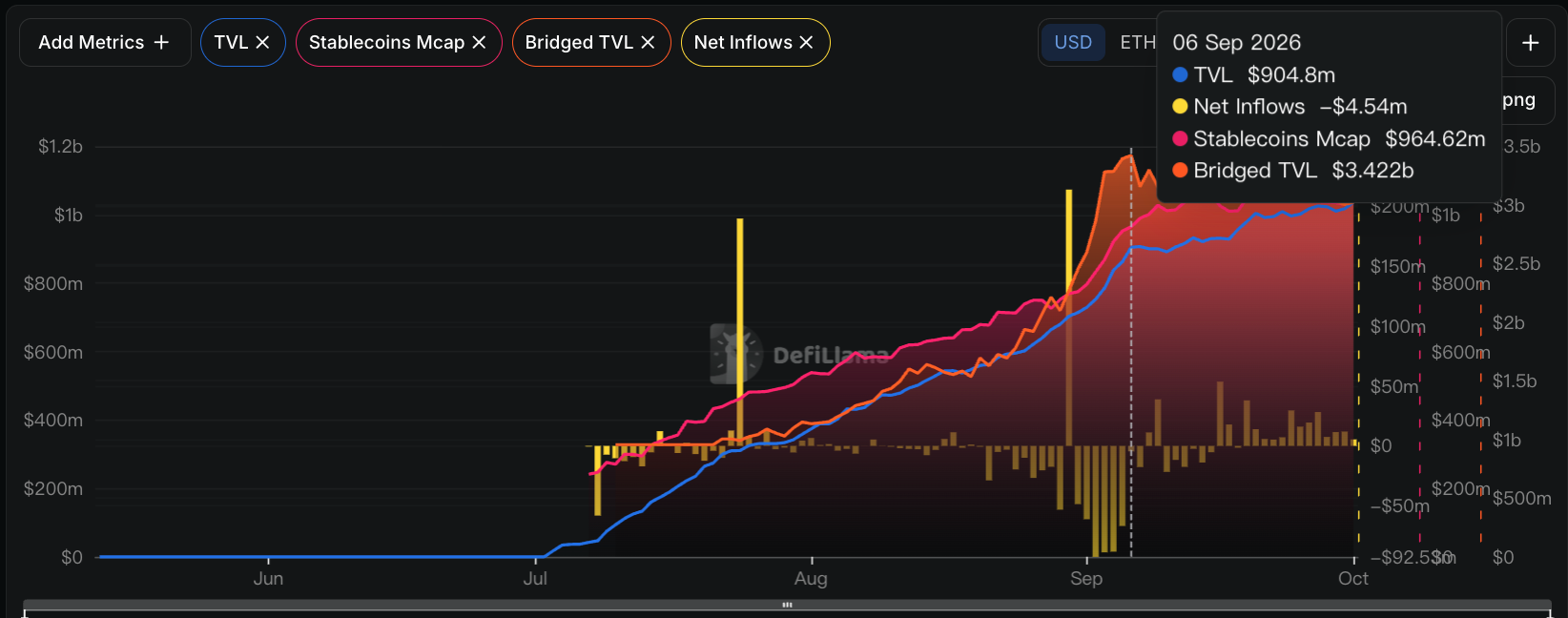
In summary, after passing through the first 3-month startup period since mainnet launch, Robinhood Chain's meme coin momentum and stock token market cap growth have both slowed significantly. The entire on-chain ecosystem has moved past its rapid growth phase and is gradually entering a steady development period. This is also corroborated by on-chain active address data.
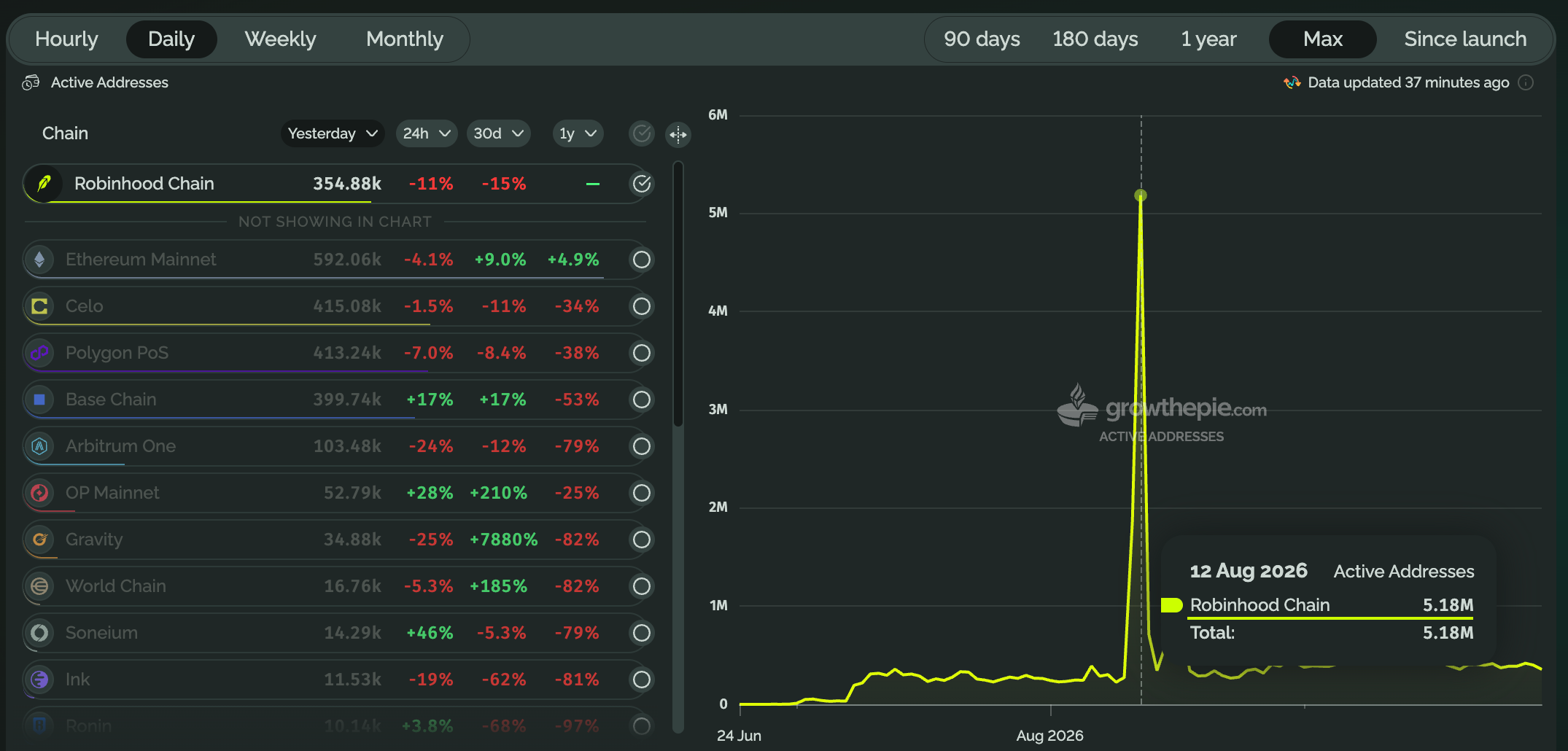
According to growthepie data, Robinhood Chain's on-chain active addresses peaked at 5.18 million on August 12, then gradually declined; currently this figure has dropped to around 354,000; the 24-hour decline is 11%; and the 30-day decline is approximately 15%. Therefore, although from the perspective of DEX trading volume, Robinhood Chain's daily trading volume remains around $1.5 billion; combined with the gradually declining transaction count data, this most likely means that large-volume wash-trading addresses remain active, but genuine retail investors have already cut their losses and exited.
Having covered the phenomenon, let's discuss the reasons.
Behind Robinhood Chain's First Wave of Enthusiasm Fading: Rampant Rug Pulls, Stock-Token Memes Fizzling Out, Stock Tokens Restricted, and Constrained Incremental Market Conversion
When it comes to Robinhood Chain's recent hype, it could be described as "rising by meme coins, falling by meme coins." Having enjoyed the surge in trading volume, fees, and revenue driven by the meme coin frenzy, it naturally could not escape the short cycle, rug pulls, and one-wave nature of meme coins. Additionally, there is room for optimization in stock-token meme gameplay, the number of stock tokens and subsequent asset planning, and incremental market conversion.
Rampant Rug Pulls: On-Chain Token Launch Groups Extracting Repeatedly
Previously, we exposed a Robinhood Chain on-chain token launch group in the article "Robinhood On-Chain Token Launch Group Exposed: Operating 53 Projects in 2 Months, Raking in Over $18 Million". This group harvested over $18 million in just 2 months through fund linkages, repeated fake-and-real token schemes, and supply sniping. And this was just what was found by following the trail — the actual scale is far greater. This phenomenon is not isolated on Robinhood Chain.
On September 28, according to monitoring by a security team, a high-risk meme coin fraud factory recently discovered on Robinhood Chain had approximately 3,589.14 ETH in two-way flows over the past 30 days, equivalent to about $9.49 million, involving hundreds of fraudulent meme coins.
As a new L2 chain, on-chain token launch groups are well-versed in rug pulls. The meme coin frenzy is, to some extent, inseparable from the contributions of these "serial entrepreneurs." But short-term boosts also mean medium-to-long-term ecosystem losses. As more people get harvested by rug pulls and are forced to cut losses and exit, the phenomenon of "trading volume unchanged but momentum fading" emerges.
Stock-Token Memes Fizzling Out: Trading Volume of Stock-Token Paired Assets on Top Launchpad Platforms Stays Below $1 Billion
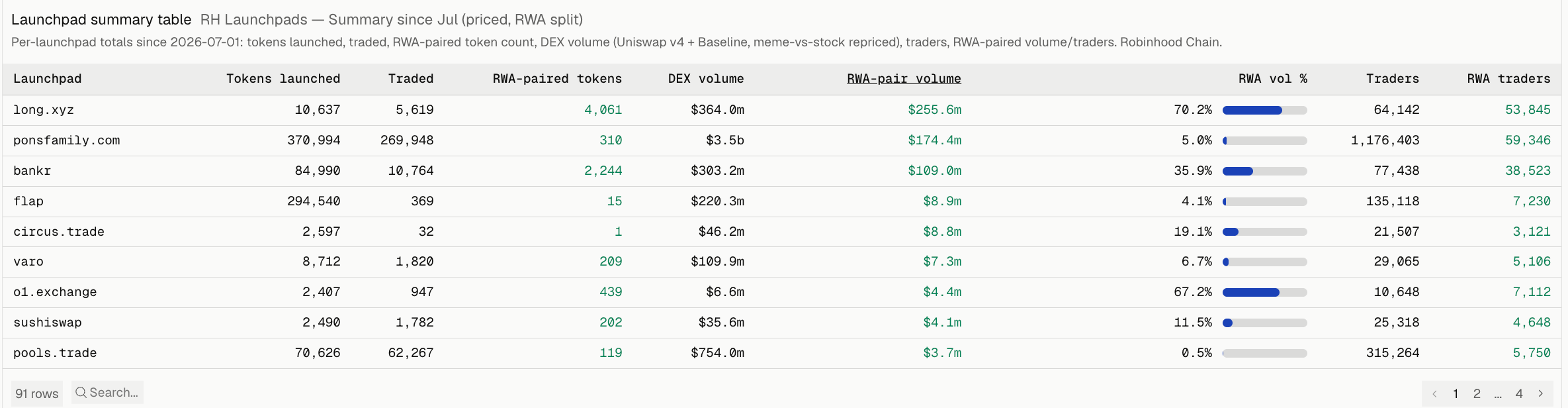
According to Dune data, although the number of stock-token paired meme coins on Robinhood Chain's top 9 Launchpad platforms has climbed to over 800,000; their overall trading volume remains at around $600 million. On the Long.xyz platform, RWA asset traders account for approximately 70% of total users, with approximately 4,000 stock-token paired meme coins and approximately 64,000 traders; on the Pons platform, RWA asset traders account for only about 5% of total users.
Stock Tokens Restricted: Robinhood Chain Has 200+ On-Chain Assets, but the SEC's Innovation Exemption Policy Narrows the Asset Issuance Window
Previously, the U.S. SEC introduced an innovation exemption policy detailing that stock token assets must be issued by third parties only with the issuer's permission, which to some extent challenged the legitimacy of stock token assets on Robinhood Chain. Although Robinhood's crypto head Johann Kerbrat stated that "for stock token products, Robinhood will actually purchase the corresponding company's stocks and hold them in custody," and Robinhood CEO Vlad previously revealed plans to increase related stock token assets to thousands, short-term constraints remain. For more on the innovation exemption, we recommend reading "SEC's Five-Year 'Innovation Exemption' Takes Effect: Who Gets the Tokenized U.S. Stock Boarding Pass?".
Constrained Incremental Market Conversion: Robinhood Users Struggle to Become Robinhood Chain Users
When Robinhood Chain first launched, beyond the innovative RWA asset issuance such as stock tokens, what was even more anticipated was that the tens of millions of users on its brokerage platform and crypto app could become new incremental users for the on-chain market. But so far, the conversion efficiency of this user base has been less than satisfactory. Previously, after CashCat launched on Robinhood and experienced a brief market cap surge, it also could not escape the fate of meme coin decline, fully demonstrating that Robinhood brokerage platform and crypto app users have not converted into Robinhood Chain meme coin traders.
Summary: First Wave Recedes, Robinhood Chain Enters Phase Two
Robinhood Chain, which originally hoped RWA assets would drive on-chain ecosystem development, instead became "the hottest thing in the crypto market" through meme coins. But it also could not escape the short-cycle, rapid-decay effects of meme coins, with the overall ecosystem gradually entering a steady development period.
The next wave of enthusiasm may require Robinhood Chain to bridge the liquidity gap between its brokerage platform and crypto app, thereby enabling more traditional financial market traders to become on-chain asset traders. Only then can it open up greater imaginative space and help the Robinhood Chain ecosystem and its own stock price reach new heights.