


From AWS Dream to Liquidity Harvesting Machine: The Zero-Sum Truth Behind Hyperliquid's Windfall Profits

Original | Odaily (@OdailyChina)
Author | Wenser (@wenser 2010)
Not long ago, an interview article with the founder of Hyperliquid went viral. In that Bloomberg podcast episode, Hyperliquid founder Jeff described the long-term vision of this 11-person team—which generates an average of $100 million in annual revenue per person—as "becoming the AWS of finance rather than replacing Wall Street." He also argued that Hyperliquid is like the TCP/IP protocol, and that regulation should fall on the layer with control, namely the HIP-3 and HIP-4 market deployers. Such a statement appears to fit the positioning of protocol infrastructure, but to a certain extent it blurs the responsibility Hyperliquid needs to bear as a market entity.
Behind Hyperliquid's staggering revenue, the scale of HYPE token buyback and burn has exceeded $4 billion. Countless people regard Jeff as an entrepreneurial idol, and many view Hyperliquid as "the best innovative product in the crypto industry." But few notice that the bloody price paid for this highly profitable machine is borne by countless harvested retail investors and numerous on-chain crypto whales. As the crypto industry enters its 17th year, Hyperliquid appears to be striving to connect with US stocks, TradeFi products, and RWA assets and to compete for pricing power in traditional capital markets. But fundamentally, it may simply be a CEX in a new shell, renamed as a Perp DEX.
Looking back at Hyperliquid's wealth-creation miracle and star-project halo, it is in fact also a bloody casino built on piles of bones and ruthless harvesting. We have no intention of criticizing or denouncing existing platforms and products, still less of challenging the ironclad, unchanging rule of the crypto market that one bears one's own profits and losses. But perhaps, beyond the on-chain ecosystem racing forward in the guise of innovation, people also need to see who is paying the bill for the progress of the era and financial innovation.
Those Who Made Huge Contributions to On-Chain Perp DEX Profits: 400,000 Retail Investors and Numerous Crypto Whales
Not long ago, Hyperdash founder Hanson Birringer published a long post exposing the harsh reality of Hyperliquid's real users: according to the organization's tracking of data related to nearly 400,000 retail wallets that accessed Hyperliquid through six consumer-facing applications (Builder Code)—Phantom, MetaMask, Rabby, Trust Wallet, Invo, and fomo—these users' cumulative losses amounted to approximately $280 million; of which about $126 million occurred after November 10, 2025 (a period of rapid expansion of Hyperliquid applications), while the remaining losses occurred before November 2025, or occurred on Hyperliquid but were not conducted through these applications. (Recommended reading: "Behind Hyperliquid's Grand Consumer Expansion, 400,000 Retail Investors Lost $280 Million")
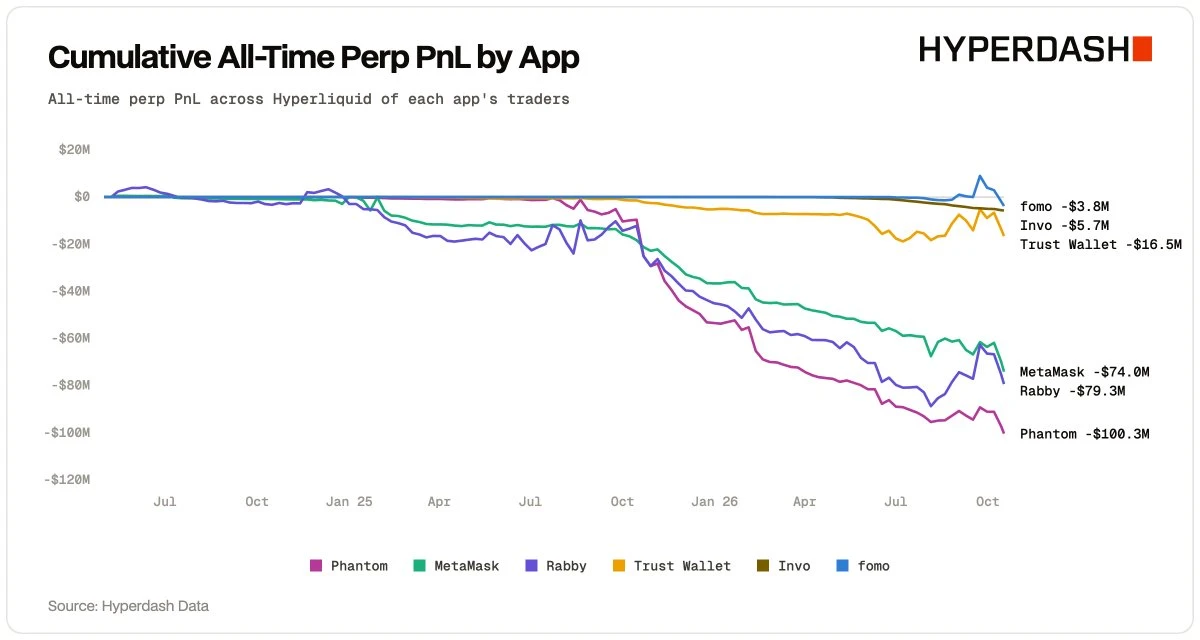
In terms of loss composition, fees accounted for more than 50% (especially among the $126 million in losses over the past year, fees exceeded half); applications added a Builder Fee on top of the base rate, making the cost of a $100 order approximately 6.5–14.5 cents.
In terms of user profile, the typical single-wallet deposit for the five applications was only $30–60, with Rabby users having larger funds and being more likely to profit.
On the other hand, user retention for these third-party independent channels was extremely poor: monthly active growth relied mainly on new user acquisition, and the 3-month retention rate for new traders was about 1/7; most stopped trading after suffering losses. In other words, within about 3 months, nearly 86% of users were harvested and promptly left.
In addition, rapid capital turnover was also a trading characteristic of these users. Among them, Invo users deposited a total of about $12.4 million but generated about $5.8 billion in trading volume. In terms of specific asset classes traded, BTC became the market with the heaviest losses (fees even exceeded users' closing gains); HIP-3 and small-cap USD trading incurred even higher attrition.
Like the casino business model, the growth of Hyperliquid's third-party consumer applications also relied heavily on continuous new user acquisition. The vast majority of retail investors simply "got harvested once and left" after contributing large amounts of fees, similar to what happened with DeFi, GameFi, SocialFi, and NFTs in the past.
Not only retail investors—crypto whales in the Hyperliquid ecosystem could not claim to keep winning either. More whales, after opening positions openly, often immediately entered the crosshairs of "whale hunters." Countless previous cases have told us: If you make money, don't make noise—otherwise you'll be wiped out.
A Detailed Record of Hyperliquid Crypto Whales' Massive Losses: From James Wynn to Maji, from the 10·11 Insider Whale to the Fall of the 100% Win-Rate Whale
Over the past two years or so, I have basically been the Odaily reporter who has written the most "insider whale profit-and-loss records," bar none.
During last year's "10·11 epic crash," I wrote an article on the insider whale. That address was later confirmed to be Garrett Jin. Although at the time he reaped $200 million in profit from a large short position, not long afterward he began his own losing streak—especially on ETH longs, where he lost about $250 million at one point, with his Hyperliquid account once reduced to only about $53.
On Hyperliquid, where on-chain positions are almost transparent, Garrett Jin was never an isolated case.
James Wynn was the earliest to earn the title "Hyperliquid whale" with over $87 million in profit and positions on the scale of $1 billion, gradually making the "Hyperliquid crypto whale" niche popular. But soon, he faded along with the extremely volatile crypto market, even descending to issuing tokens, shilling, and earning rebates. For details, recommended reading: "From Whale to Ant: Has On-Chain Contract Legend James Wynn Fallen?".
Afterward, the "50x leverage insider whale" @qwatio was also exposed by on-chain detective ZachXBT as possibly being a fraudster who had made headlines in British newspapers. See "50x Hyperliquid Whale's Identity Revealed—Actually a Fraudster Who Made UK News Headlines?".
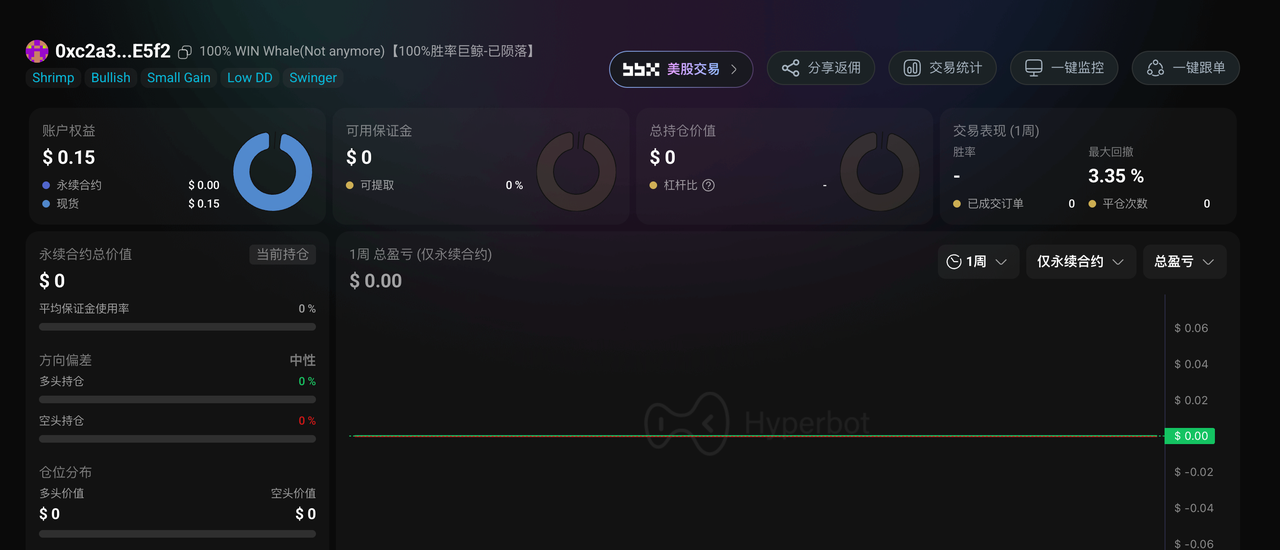
The "100% win-rate whale" also enjoyed great fame for a time, but ultimately faltered on the contract battlefield, leaving only a record of "100% WIN Whale (Not anymore)".
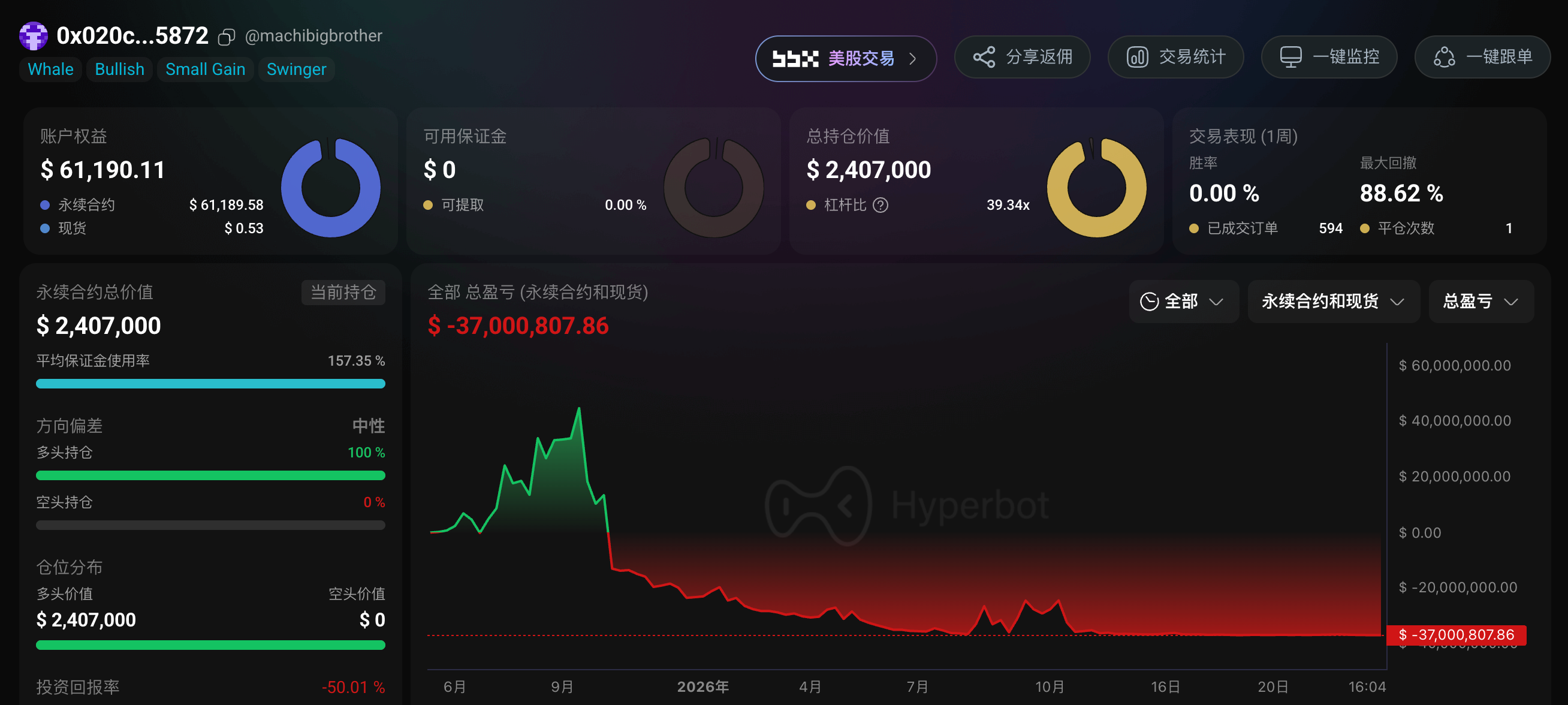
Maji is another "open-book Hyperliquid whale" who has remained active in the market. Recently we also briefly summarized his latest "liquidation diary"; see "Brother Maji: Oh No, I've Been Targeted Again". Previously he was liquidated 7 times in a row within just 10 hours, and in the latest round he gave back funds he had painstakingly compounded up to tens of millions of dollars. Latest data shows that his main address's cumulative total PnL is approximately $37 million.
Around November 2025, statistics showed that multiple high-leverage whales (including the so-called "insider whale" and "compounding whale") gradually went to zero after reaching profits of tens of millions, with average losses on the order of over $40 million each.
Isn't the truth obvious enough by now? So-called crypto whales are at most continuous contributors of trading fees and platform liquidity, not the "smart money" that many people believe they can blindly copy-trade. Compared with most people, they are merely "oversized retail investors" who have always had off-exchange capital and can keep topping up.
In fact, perpetual contracts have always been a typical zero-sum (or negative-sum) game. Longs and shorts offset each other's profits and losses, while the Hyperliquid platform and third-party applications (the so-called Builders) earn revenue by extracting fees (the negative-sum portion). As the underlying protocol, Hyperliquid can already be flush with profits from trading fees and market deployment fees alone.
As for HIP-3, HIP-4, and other contract markets and prediction markets that allow third-party deployment, they merely expand the "in-market coverage" from crypto gradually to stocks, commodities, prediction events, and other assets, but they have never changed the core business model of "zero-sum game + fee extraction."
Migrating from CEX to Perp DEX (Hyperliquid, Aster, and other platforms) is essentially still the harvesting of in-market liquidity and trading fees. The underlying matching engine, risk control, and liquidation logic are similar; only settlement and transparency differ by being on-chain.
On this point, the article "Perp DEXs Generate $125 Million in Fees Per Month—Who Is Really Being Rewarded?" also deeply analyzed the main value flows of such platforms: value such as fee revenue tilts more toward platform token holders rather than the traders who actually contribute order flow. The data behind this: 38 Perp DEXs generated about $125 million in fees within 30 days, with Hyperliquid alone contributing $84.55 million, accounting for about 67.6%, and the top five platforms together accounting for 85.6%. Among them, Hyperliquid uses about 97%–99% of fees to buy back and burn HYPE under the name of the Assistance Fund. By contrast, about 86% of HYPE holding addresses have never participated in perpetual contract trading, creating a clear mismatch between revenue creators and token value recipients.
As for the earlier attention it gained in traditional financial markets through Cerebras (CBRS) pre-market pricing, it now seems difficult to prove that on-chain Perp DEX platforms like Hyperliquid can steadily control capital market pricing power.
In October 2026, the IMF's "Global Financial Stability Report" noted the following characteristics of tokenized stock trading:
- More than half of tokenized US stock trades occurred outside regular trading hours;
- About 80% of trading volume was less than one share (clearly showing retail participation);
- Tokenized stocks' volatility was about 1.5 times that of the underlying stocks, with thinner liquidity and a more fragmented market;
- Overnight price changes contained some effective information, but within 5 minutes after the open, traditional stocks absorbed about 85–99% of the volatility from tokenized overnight moves;
- The market size remained very small, only about $2.3 billion (as of end-July this year), with liquidity, legal, and settlement risks.
Although the discussion concerned tokenized stock trading, it is still apparent that TradeFi on-chain derivative contracts have relatively limited spillover and driving capacity for traditional financial markets. Hyperliquid and many other on-chain Perp DEX platforms do not yet have an absolute advantage in this regard; they have merely shown some "predictive" capability through a very small number of individual cases.
In short, in my view, Hyperliquid remains a rare phenomenon-level product in the crypto market this cycle, but it is still far from becoming the so-called "AWS of finance." Its business model even determines that it cannot become underlying technological infrastructure; it has always been an "alternative casino + CEX in a new shell."
Of course I acknowledge the achievements Jeff and Hyperliquid have made so far, but the retail investors and whales silently bearing the corresponding costs behind it also deserve to be seen by more people.
Recommended Reading
220 Days After Trade.xyz Launched, Hyperliquid Is Becoming the "New Nasdaq"
How Was the 100% Win-Rate Whale Made? Revealing the True Identity of the "Trump Camp Insider"
BTC Falls Below $60,000, ETH Loses $1,600—Are Crypto Whales Holding the Bag for the Market?