

Earning Tens of Millions of Dollars a Month — Why Are Crypto Frontends So Profitable?

Over the past few years, Crypto entrepreneurs raced to build public chains and protocols, hoping to control the underlying technology and capture the fees. Whoever could attract more capital and transactions had a better chance to profit from them.
But as the underlying infrastructure has matured, another kind of business has emerged: instead of building an entire trading system from scratch, these players plug directly into existing protocols and focus their energy on product experience and competing for users.
What's more interesting is that some of these seemingly unremarkable trading frontends can earn tens of millions of dollars a month, even surpassing many platforms that run their own trading systems. Wallets, trading terminals, and social apps have all joined in, competing for the same pool of trading users.
From fighting over pricing power to fighting over users and trading flow, why has Crypto's business started to change in this way? And who stands to make the most money from it?
1. Crypto Frontends: Which Sectors Are Most Profitable?
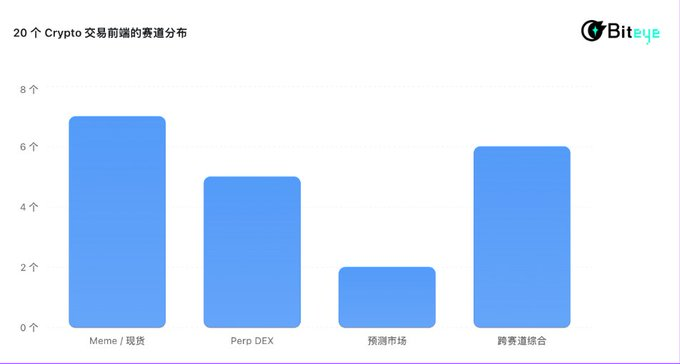
Using integration with third-party trading infrastructure and revenue of at least $100,000 over the past 30 days as our main screening criteria, we compiled a list of 20 representative Crypto trading frontends.
In terms of distribution, Meme-related platforms are the most numerous, with 7, represented by GMGN and Axiom. Several years on, Meme remains one of Crypto's hottest trading sectors. Token prices rise and fall, and narratives rotate constantly, but the trading terminals selling the shovels keep making money from trading.
Next is the Perp DEX category, with 5. Perpetual futures trading itself has a massive market, and traders tend to open and close positions frequently, generating continuous fee revenue. As platforms like Hyperliquid open up their trading capabilities, third-party frontends can also claim a slice of this large market.
Prediction markets are the fewest, with only 2. Third-party frontends in this sector are still competing for users, and many products compete through zero surcharges or low fees. Although trading volume is not small, the revenue that actually stays is limited, so under our revenue screening criteria it accounts for the smallest share.
The other 6 are comprehensive gateways. Wallets like Phantom, MetaMask, and Trust Wallet already control large numbers of users and assets, and by integrating Swap, Perps, and other trading features, they can turn their existing traffic into new fee revenue. Fomo, meanwhile, represents a new path of social trading, attempting to drive trading through content and social relationships.
Statistics as of October 21, 2026 (Revenue 30d)
2. Earning $1 Million a Month: What Sets These Six Frontends Apart?
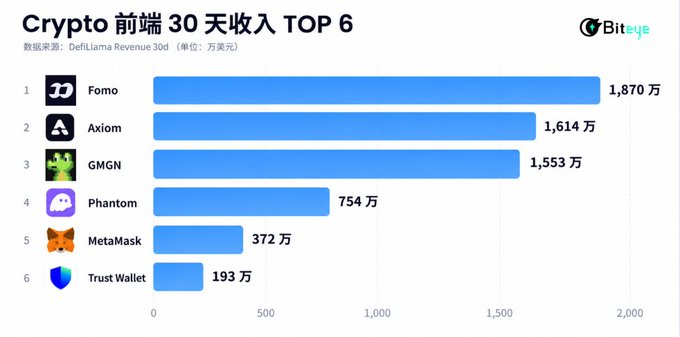
Having looked at the distribution across different sectors, let's now pick out the 6 leading frontends that generated over $1 million in revenue over the past 30 days. Although they all rely on other protocols to complete transactions, their approaches to attracting users and earning revenue are not the same.
- Fomo focuses on Social Trading, attracting users through social content and creators and then earning revenue from trading
- Axiom and GMGN are veteran trading terminals deeply rooted in the Meme sector, having accumulated large numbers of professional traders and earning fees through high-frequency trading
- Phantom, MetaMask, and Trust Wallet are wallets with huge user bases that convert existing users into new revenue sources by integrating more trading services.
Statistics as of October 21, 2026 (Revenue 30d)
Fomo @fomo | XHunt Ranking: 729
Fomo is a social trading app aimed at ordinary users, and its biggest feature is lowering the barrier to on-chain trading. Users don't need to understand different public chains, wallets, or Gas fees—they just deposit USDC and can directly buy and sell assets across different chains.
Beyond the trading experience, Fomo also integrates social features into the product, allowing users to follow others' trading activity and copy their trades directly.
More interestingly, it has also changed the way Crypto creators make money: in the past, KOLs mainly monetized through ads and project promotions, but now through Fomo callouts, they can also earn a share of the fees generated by followers' trades.
Fomo not only makes trading easier for newcomers but also gives creators a new channel to turn their influence directly into trading income.
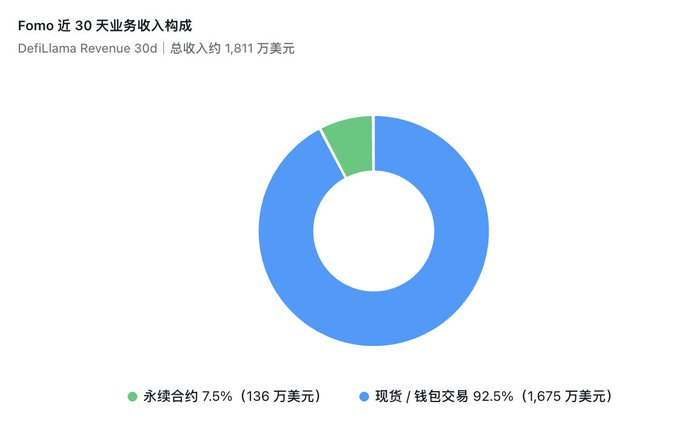
DefiLlama | Statistics as of October 22, 2026 (Revenue 30d)
Axiom @AxiomExchange | XHunt Ranking: 3173
Axiom is a leading Meme trading terminal in the Solana ecosystem, having accumulated a large number of active traders through features such as fast order placement and trending token discovery.
But as competition in the Meme trading market intensifies—especially with the rise of a new generation of social trading platforms like Fomo—Axiom has also begun looking for new growth space.
Over the past two to three months, Axiom's expansion has clearly accelerated. In August it launched a new asset management page, in September it upgraded its BNB Chain trading features, and it has also progressively expanded into ecosystems such as Base and Ink, no longer doing business solely around Solana.
Axiom is clearly no longer content to be just a Meme trading tool; it hopes to integrate market data, social features, and trading together, gradually moving toward becoming a Super App.
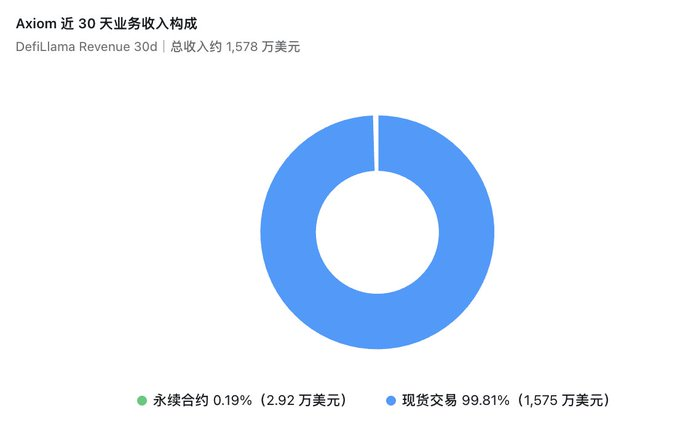
DefiLlama | Statistics as of October 22, 2026 (Revenue 30d)
GMGN @gmgnai | XHunt Ranking: 2030
GMGN is one of the most familiar Meme trading platforms in the Chinese-language Crypto community, having accumulated many loyal users through its Chinese-friendly interface and smart money tracking features.
However, with the rise of social trading platforms, GMGN has also begun to adapt. Recently it not only launched perpetual contracts but also rolled out social features such as Callout and trading leaderboards, and even integrated Fomo users' callout records into its K-line charts.
Recently, founder Haze has also been frequently posting job openings to expand the product and community teams. Moving from a Meme trading tool toward a comprehensive trading platform, GMGN clearly doesn't want to cling only to its past business.
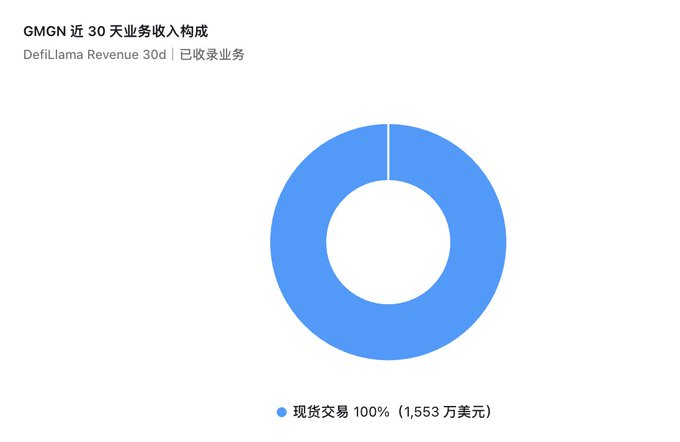
DefiLlama | Statistics as of October 22, 2026 (Revenue 30d)
Phantom @phantom | XHunt Ranking: 174
Phantom is a dark-horse wallet that emerged from the Solana ecosystem, and thanks to its simple, easy-to-use experience it once reached nearly 17 million monthly active users and completed a funding round in 2025 at a $3 billion valuation.
Over the past year, it has progressively added Hyperliquid contracts, prediction markets, social feeds, and even launched a payment card, attempting to let users complete trading, socializing, and daily spending within a single app.
According to DefiLlama data, Phantom's revenue over the past 30 days exceeded $7 million, most of which still comes from in-wallet token swaps and cross-chain services, while contract trading contributed about $1.2 million.
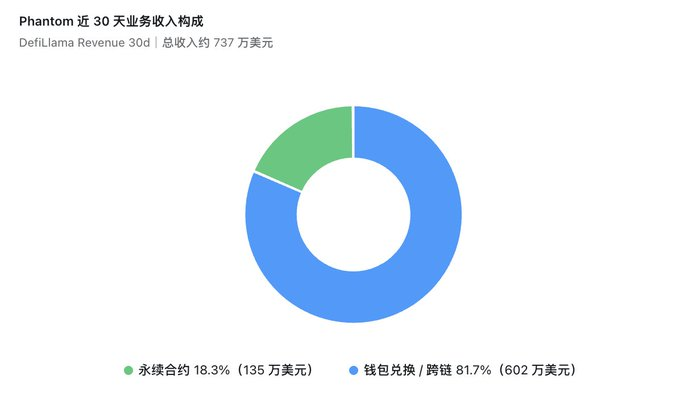
DefiLlama | Statistics as of October 22, 2026 (Revenue 30d)
MetaMask @MetaMask | XHunt Ranking: 117
MetaMask is one of the oldest wallets in the Ethereum ecosystem and was once almost an essential tool for getting on-chain. But over the years, limited improvements to the product experience have gradually driven many users to other wallets.
Facing competition, MetaMask has also begun to accelerate its transformation, successively integrating Hyperliquid contracts and the Polymarket prediction market in an attempt to evolve from a wallet tool into a comprehensive trading platform.
According to DefiLlama data, MetaMask's revenue over the past 30 days was about $3.72 million, of which traditional wallet transactions still contributed about $2.23 million and Hyperliquid contracts contributed about $1.29 million.
Interestingly, MetaMask used to make money from its wallet first-mover advantage, but now it too has to compete anew for users' trading needs.
DefiLlama | Statistics as of October 22, 2026 (Revenue 30d)
Trust Wallet @TrustWallet | XHunt Ranking: 1338
A wallet that supports multiple cryptocurrencies; beyond storing assets, it also lets users directly buy and sell tokens, make cross-chain transfers, and trade contracts.
Recently, Trust Wallet required 21 business leaders to open X accounts to communicate directly with users, a sign that the team is stepping up investment in user growth and community operations.
At the same time, the way it makes money is also changing.
According to DefiLlama data, Trust Wallet's revenue over the past 30 days was about $1.93 million, of which $1.56 million came from Hyperliquid perpetual contract trading, accounting for over 80%, while traditional wallet services such as Swap and cross-chain contributed only about $370,000.
For Trust Wallet, wallets used to make money mainly from users depositing and swapping tokens, but now contract trading has become the bulk of its revenue.
DefiLlama | Statistics as of October 22, 2026 (Revenue 30d)
3. Not Building the Underlying Layer: Why Have Frontends Become a Contested Battleground?
Fun fact: Phantom earns more trading revenue through Hyperliquid than TradeXYZ does.
Fomo can be said to be the culmination of this round of frontend innovation. It integrates cross-chain trading, social feeds, and creator revenue sharing, allowing KOLs to earn fees through callouts. This trend has also attracted new players such as SmartX, while veteran terminals like GMGN and Axiom have also been adding social features.
What trading frontends are fighting over is not just the fee from a single trade, but all of a user's future trading needs.
A single trading gateway can support many businesses. Today it attracts users through Meme trading; tomorrow it can integrate contracts, prediction markets, and even payments and wealth management. Each additional business line is an opportunity to generate new revenue from existing users.
A research report from Re7 Capital shows that third-party frontends' share of trading in the perpetual contract market has grown from less than 1% in early 2025 to about 20% in August of this year.
This is also why wallets, trading terminals, and social platforms all want to capture this gateway. Wallets control users' assets, trading terminals have accumulated trading habits, and social platforms have creators and followers. They start from different places, but all hope users will complete more trades within their own products.
4. Final Thoughts
Over the past few years, Crypto has spent a great deal of time building infrastructure to make trading faster and cheaper. But for most ordinary people, complex operations such as wallets, cross-chain transfers, and Gas fees remain a barrier to entering Crypto.
Now, trading frontends are trying to change this. They keep the complex operations in the background, letting users complete trades just like using an ordinary app. Fomo's rapid growth has also shown us the user demand behind this simple experience.
In a report this year, Binance Research proposed that wallets, trading platforms, and fintech apps are gradually converging toward the same kind of product: one account and one balance that can complete more and more financial operations.
This also means that what frontends compete for in the future may not just be Crypto trading users. As services such as US stocks, prediction markets, and payments gradually move on-chain, they have the opportunity to become a unified gateway for ordinary people to manage assets, invest, and spend.
In the past, Crypto has been working hard to move more assets and financial services on-chain. In the next stage, what may truly be worth watching is who can make these services easily accessible to more ordinary people.
And today's seemingly ordinary trading frontends may well be the starting point of this change.