

Opinion: Compound Governance Tokens Will Open DeFi’s Pandora’s Box

Editor's Note: This article comes fromBabbitt Information (ID: bitcoin8btc)Editor's Note: This article comes from
Babbitt Information (ID: bitcoin8btc)
Babbitt Information (ID: bitcoin8btc)
Compound is undoubtedly the star of the Defi project, and Defi is currently the hottest field in the cryptocurrency industry. Recently, Compound started its process of decentralization by introducing a governance system and a governance token, COMP. As the final step in the process, Compound recently released a distribution plan for COMP tokens.
Although the utility of COMP is designed for governance, it is definitely an incentive design. With COMP tokens, even Compound borrowers can turn a profit! This incentive is so strong it will undoubtedly drive tremendous growth. Unfortunately, such an incentive design will inevitably lead to illusory growth like FCoin's "transaction is mining". And it will likely lead to centralized governance, which goes against Compound's original vision or philosophy of a decentralized protocol.
In addition, the DeFi ecosystem is intertwined, and Compound is becoming the basis of many other DeFi products. This huge change will open Pandora's box and greatly change the entire DeFi market. It is difficult to predict how this complex economic game will play out in the market. However, it will be interesting to watch the COMP token launch.
secondary title
Borrowers are also able to make a profit, really?
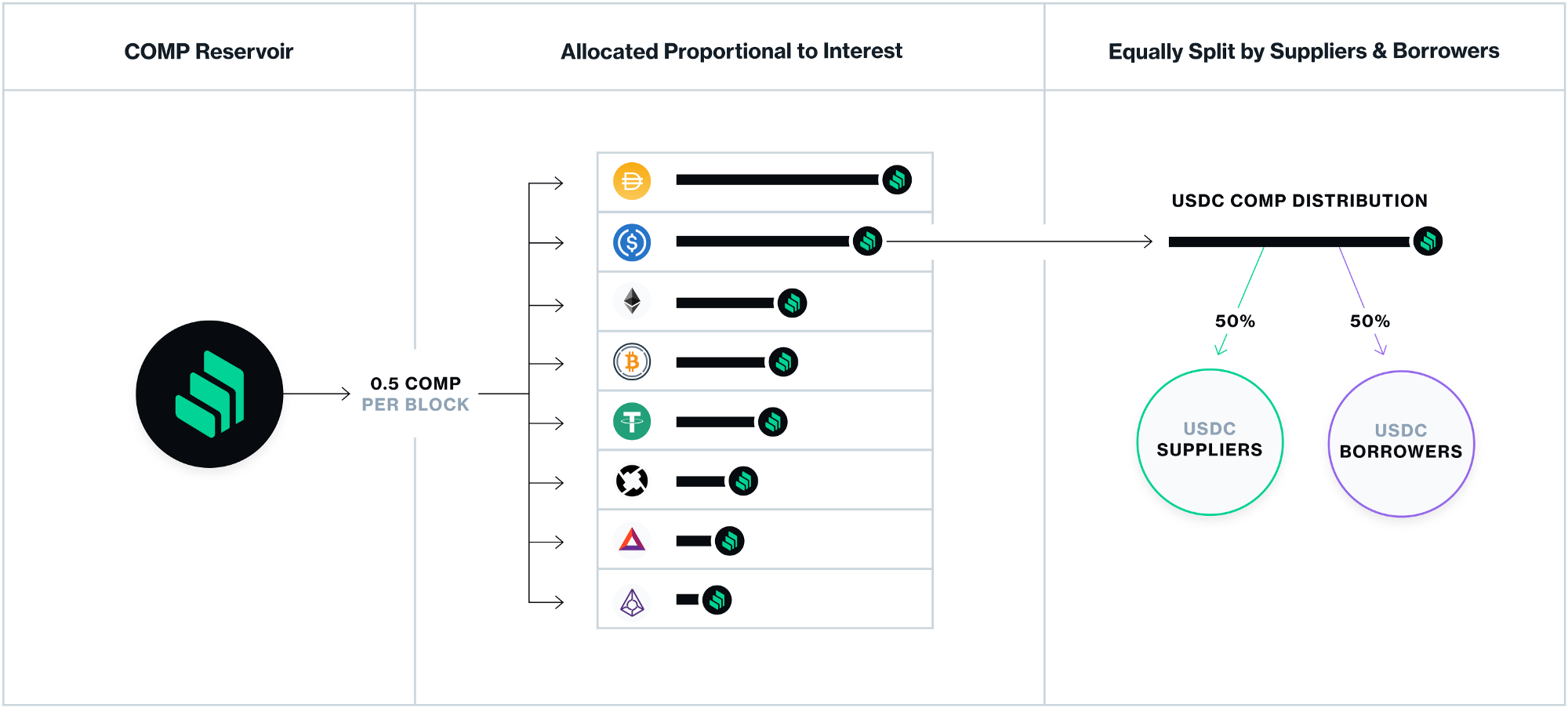
Compound’s business is cryptocurrency lending, and the proper measure of traction is the total interest generated by the platform. Therefore, it should come as no surprise that COMP tokens are distributed proportionally to interest, as shown in the diagram above. The design also correctly provides incentives for loan providers and borrowers.
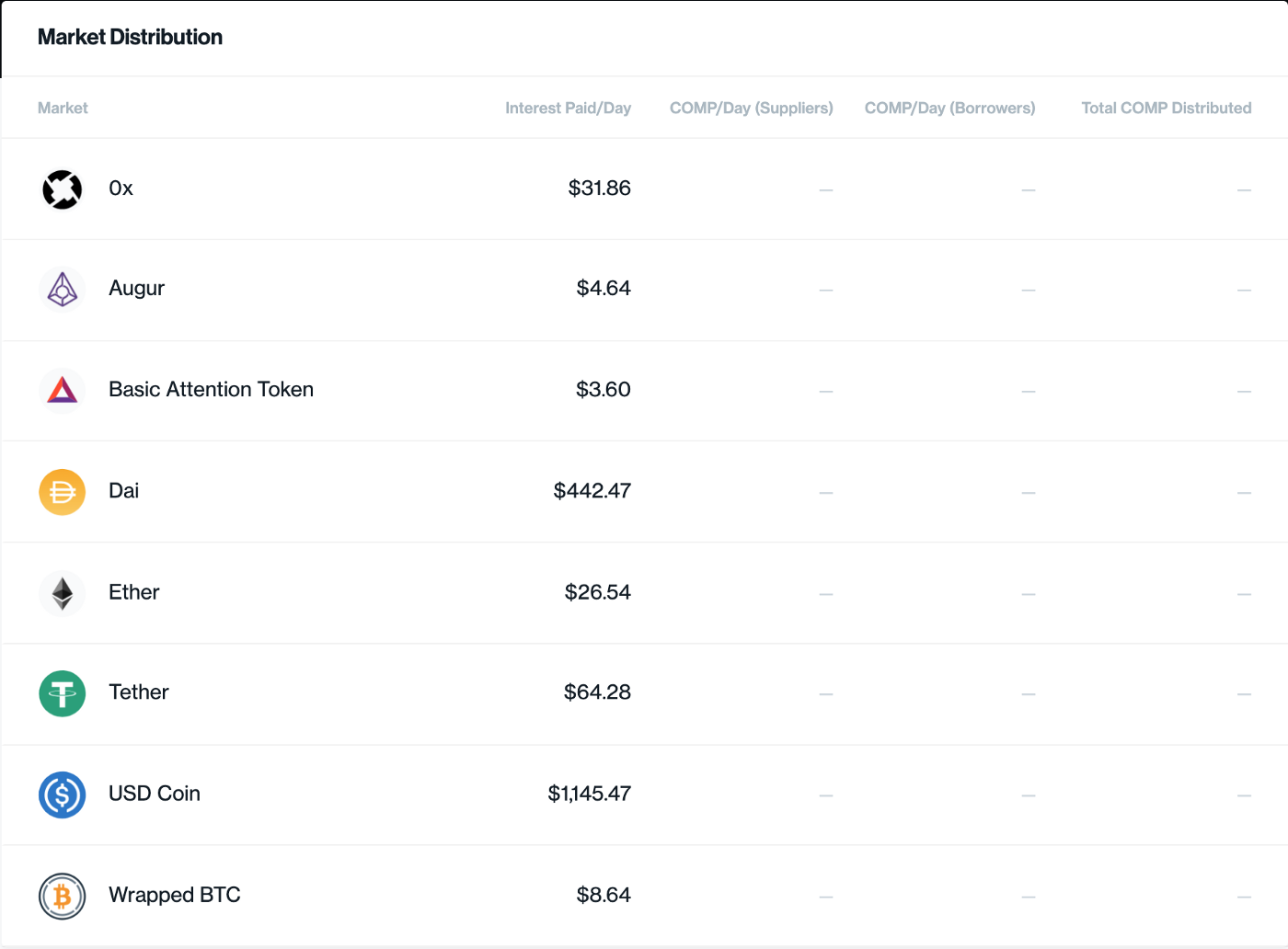 In order for any token-based incentive to be effective, the token needs to establish a market value. As for how to evaluate a governance token like COMP, there is currently no reasonable way. However, Compound creates implied value for its COMP token by distributing tokens to its equity investors. It is reported that the company raised a total of 33.2 million US dollars through two rounds of financing (seed round financing of 8.2 million US dollars, A round of financing of 25 million US dollars), and distributed 2,396,307 COMP tokens to investors, while its total token supply is set at 10,000,000 COMP.
If calculated according to the cost of acquiring coins by investment institutions, then the market value of COMP = $33.2M/2,396,307*10,000,000 = $139.33 million. For the sake of analysis, we use $150 million as the market cap, so the price of each COMP token is about $15.
According to the COMP distribution plan, loan suppliers and borrowers will receive 0.5 COMP per 1 Ethereum block (or 2880 COMP per day). At a price of $15 per COMP token, the value distributed to Compound users is 15*2880 = $43200 (per day).
$43,200 a day might not seem like a lot. However, according to COMP Dashboard data, the total daily interest paid across all Compound markets is only $1,727.5 (the above screenshot was taken on May 31, 2020). This is equivalent to 25 times the normal interest incentive ($43,200/$1727.5 = 25)! So what does that mean?
For the borrower, this means they are paying $1,727.50 in interest per day but earning $21,600 per day (50% of $43,200). For the supply side, this means that their loan interest rate will increase by 12.5 times. For example, for USDT, the loan interest rate can be as high as 25%, while the current interest rate is about 2% (2%*12.5x=25%). Is there any other lending platform that can match this rate of return? That said, through the planned launch of the COMP token, Compound will effectively enhance its crypto lending platform.
secondary title
phantom growth
With such a crazy, powerful incentive design, the use of the Compound protocol will undoubtedly experience growth, and experience rapid growth, at least initially. This is because strong incentives will change the behavior of users using the Compound protocol, which will attract new types of users including speculators and arbitrageurs.
For many borrowers, with the COMP token incentive mechanism, Compound is transforming into an investment platform, which initially provides high returns of 12.5 times. Participants will borrow assets they don't actually need, but only pay interest to earn COMP tokens. As long as returns are positive, borrowers will keep flocking.
In the current macro environment where the Federal Reserve interest rate is close to 0, and the interest rate of USDT will be as high as 25%, arbitrageurs will convert fiat currency into USDT, and then earn returns through Compound, which is a no-brainer. Those large Compound asset holders now have a strong incentive to supply their unused assets and use them as collateral for loans, so that they can earn COMP tokens as both loan providers and borrowers."Incentive design also has a positive amplification effect initially. Strong incentives will attract more borrowers and suppliers to use the Compound protocol, which will generate more interest, driving the value of COMP, which in turn creates more incentives."Will the music stop? When will it stop? It is difficult to predict when, but one thing is for certain, that the market cap of COMP will grow much higher than its intrinsic value, and at some point, the market value of COMP will start to drop. Then, it triggers negative amplification. A lower COMP value will reduce incentives, which will cause borrowers and suppliers to leave, which will generate less interest, further depressing the value of the COMP token.
Transaction is mining
the design of. Will the above scenario play out in the market? How will it play out?
No one can really predict with accuracy. But let's wait and see, it will be another good case study.
secondary title
Pandora's Box
The potential impact of the COMP token distribution plan will not be limited to the Compound protocol itself. With the visualization of the "Money Lego" narrative, the DEFI market has become intertwined, and Compound is becoming the cornerstone of many DeFi products. The issuance of COMP tokens will open Pandora's box, and its impact on the entire DeFi ecosystem will be a very complicated economic game, which deserves our detailed study.
Compound's goal is to make its protocol completely decentralized, but it is actually unlikely that Compound will achieve this goal, because the issuance of COMP tokens will benefit those users with a large amount of assets. A few big players with a lot of resources will earn the majority of COMP tokens, will this lead to centralization? BAT, REP, ZRX, and ETH projects, relevant holders will transfer their reserve tokens to Compound to earn most tokens and vote down any new markets so they can continue to earn more tokens currency? Will USDT and USDC mint new tokens and deposit large amounts of new tokens into Compound to earn more COMP, while voting out any new markets so they can continue to earn more tokens?
COMP rewards are great for Dharma because instead of transferring COMP tokens to its users, it can capture all the value of COMP tokens and only transfer a portion of the value to its users by increasing the fixed rate . But this also means a huge risk for Dharma, because big players can flood the supply side, which will reduce Dharma's interest rate and COMP income. In this way, Dharma's fixed interest rate for its customers becomes higher, but The interest rate and COMP income obtained from Compound have become lower, so will Dharma collapse?
in conclusion
Does this design help Compound kill the competition? For example, will users continue to deposit ETH into MakerDAO to mint DAI and pay borrowing fees, or instead deposit ETH into Compound to borrow USDC and actually make money? To compete with Compound, will other projects issue their own tokens offering similar rewards? Since DAI is the foundation of the DeFi market, will reducing the supply of DAI crash the entire DeFi market?
secondary title
in conclusion
The issuance of COMP tokens is an effective incentive design that can promote the rapid growth of the Compound protocol. In fact, through the COMP token, Compound is fueling its crypto lending platform with super-high incentives, which will inevitably lead to illusory growth.