

The Big Short 2.0? What PoS and DeFi Can Learn From Mortgage-Based Securities (MBS)

Editor's Note: This article comes fromBabbitt Information (ID: bitcoin8btc)Editor's Note: This article comes from
Babbitt Information (ID: bitcoin8btc)
, by Tarun Chitra and Alex Evans, translated by: Free and Easy, published with permission.

One view is that the culprit of the 2007-2008 financial crisis was mortgage-backed bonds (MBS), and the staking derivative products currently appearing in the cryptocurrency world are similar in nature to MBS, then Will its introduction also lead to a crisis?
The original article was co-authored by Gauntlet founder Tarun Chitra and Placeholder member Alex Evans. In this article, they propose that if PoS and DeFi protocol developers decide to add pledged derivatives functions to their protocols, they need to consider that they actually In addition to adding trustless mortgage bonds (MBS) to the system, which may introduce huge risks, they evaluated the theoretical model through simulations and found that there is indeed an "optimal condition".
image description
(Image from: flickr.com)
"I think the role of interest rates is to maintain an equilibrium, not between the demand and supply of new capital goods, but between ... the demand for liquidity and the means to satisfy that demand."
— Montesquieu
Americans have clearly understood the phrase "liquidity is king" since the stock market crash in 1929, and the 2007 financial crisis was the first in many people's minds. Devastating losses occurred in nearly every market, most notably in what was supposed to be the safest, government-protected market: real estate. Born out of the ashes of this crisis, cryptocurrencies promised censorship-resistant currencies whose supply could not be manipulated by governments.
To explore these issues, this article will focus on the leverage of decentralized finance (DeFi) protocols and proof-of-stake (PoS) network tokens, the latter of which are often referred to as staking derivatives. We hypothesize that many leveraged cryptocurrency products look like the culprits of the 2008 financial crisis. Our motivation for this comparison is not to condemn DeFi or PoS, but to point out specific opportunities where these protocols can do better. But we also assume that the same risks are likely to emerge in crypto markets if left unchecked.paperWe tried in our recent paper on derivative financial instruments
. . .
paper
In , these and other risks are modeled. We discuss not only PoS networks, but also DeFi protocols (Aave, Compound, and Synthetix) and draw analogies between their characteristics and those found in traditional securitization structures.
What are staking derivatives?"locking"First, let's understand why staking derivatives exist.
The goal of PoS coins is to replace the energy-consuming proof-of-work (PoW) hashing work with the security provided by locked-in crypto assets. PoW forces miners
energy and hardware, while PoS forces participants to lock up funds. But how are they different?ReportThe key difference comes from liquidity constraints. In order to ensure that the network is live (can continue to accept transactions), PoS networks force users to lock their stake for a long time. By locking up funds, the network can enforce penalties when validators perform malicious actions, known as slashing. For example, if the network needs nodes to be online 99.999% of the time to ensure liveness, validators who are not online may be slashed during the selection of blocks to produce.
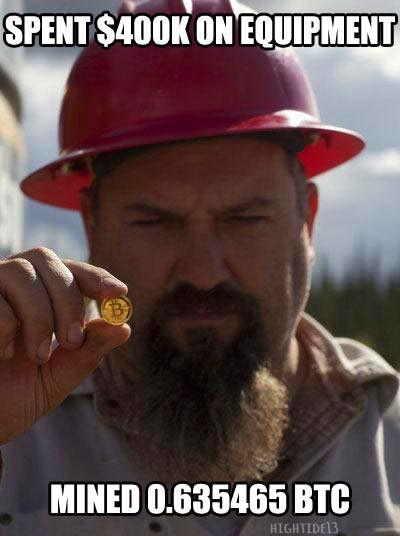
PoW miners, on the other hand, lock up "stake" in funds by spending upfront capital on mining hardware, a cost they repay when they earn large rewards and fees. Given the upfront cost of hardware, miners often experience liquidity issues while waiting to amortize their machines and make a profit. If, say, miners' expenses increase (for example, due to increased energy costs), they may have to borrow cash to pay their electricity bills. Currently, miners use the coins they earn to borrow against collateral. In theory, they could use their mining hardware as collateral to borrow cash. However, Leo Zhang of Anicca Research writes
Report
According to Shi, the secondary market in the mining market is weak, making lenders afraid to accept mining machines as collateral. Instead, miners directly collateralize their coins to borrow money, which is the main reason for the surge in leverage offered by lenders such as BlockFi and Nexo.
In Bitcoin, miners receive earned coins every 100 blocks (about 16.6 hours), so coins are easy to obtain. In contrast, this is difficult to do with proof-of-stake (PoS) networks, as many protocols typically stipulate that PoS coins are locked for weeks or even months. In order to allow PoS validators to obtain similar liquidity to PoW miners, the developers came up with staking derivatives. These derivatives let you borrow by issuing a synthetic asset collateralized by your locked-in equity, thereby providing partial liquidity to participants. Synthetic assets should be priced such that they are never worth more than the underlying borrowed asset and lose value if the borrower defaults. In the simplest case, a default occurs when a validator is heavily slashed and falls below the minimum stake level. The network will then take validator stake and reallocate it as needed.
But how does the network determine the price at which validators can borrow? The key parameter is the derivative pricing function. Let's consider how two parties execute this loan mechanically. Imagine a borrower goes to a lender to check the PoS chain to see the balance of the borrower. If the borrower's requirements and balance are satisfactory, the lender can release tokens to the borrower, add the loan to their loan book, and recalculate the price. Tracking prices is important because it allows the lender to price any subsequent loans accurately. Lenders then continue to monitor the chain. If the borrower is forfeited, the lender updates their loan books and prices. At the end of the lockup period, the lender can call the funds for liquidation, or assess the price the borrower has to pay. All of these steps, however, rely on the lender being able to trust that the borrower will repay the correct amount at the end of the lockup period.[1]And these transactions can be executed through smart contracts. In fact, smart contracts can directly interface with the consensus algorithm of the PoS protocol. Such a contract can monitor slashing and compute derivative pricing functions. Additionally, we can price derivatives by using constant function market makers (CFMMs) like Uniswap. This interaction between a consensus protocol and a DeFi protocol demonstrates the increased capital efficiency that can be achieved when a consensus protocol can interface with a smart contract application layer.
However, many of today's PoS networks do not support this feature natively, which may seem odd that money can be borrowed from the network itself. However, some newer networks, such as Celo, Terra, and Facebook's Libra, implement their consensus algorithm as a smart contract executed by a distributed virtual machine. In these systems, consensus is a first-class citizen that can be upgraded to interact with other smart contracts. Moreover, DeFi contracts can interact with the consensus and read the current state of the system to determine if a default event (such as slashing) has occurred. For example, Celo’s blockchain implements a constant function market maker (CFMM) used in the consensus protocol to manage the stability of its algorithmic stablecoin. Their real-time protocol effectively has staking derivatives built in.
Are all these loans safe? After all, the security achieved by a PoS network is directly proportional to the amount of funds invested. That is, to double spend
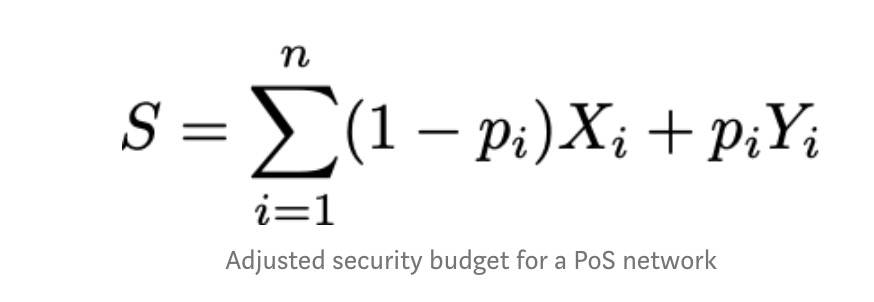
Will cost 33% or 50% of equity capital. By borrowing collateral (a type of rehypothecation), they can gain leverage on their capital when they buy X coins and have rights to X + Y coins, where Y is the size of the loan (in units of X, determined by the derived pricing function). However, if they default, the network will keep XY coins, reducing the security of the network. Thus, if p is the probability that a borrower defaults on his loan in Y coins, the network has (1-p)X + pY coins pledged and loses security by issuing such loans.
. . .
Estimating p-values is extremely difficult because borrowers' credit quality changes as their value changes, leading to dramatic incentive problems. For example, if the price of a derivative product rises to a very high price, people can effectively reduce the forfeiture cost to zero and give up their equity. On the other hand, if p is really small, say one billionth, then the security loss faced by the network is small (one billionth of XY), and the income available to validators is almost the same as that in PoW Income is the same.[2]Things get more interesting when we consider how to aggregate derivative loans. In order to facilitate the liquidity and price discovery of equity derivative assets, we hope that PoS derivatives will be interchangeable among validators. This is similar to how Maker outputs Dai, a fungible asset, while a single cdp/vault remains non-fungible.
In this case, the price of the staking derivative is tied to the collective obligation of the validator base. Issuing bonds backed by pools of secured loans, which is what mortgage-backed securities (MBS) and related securitization structures do. But how to provide loans to users through the network to achieve leverage similar to MBS? Let's take a step back and look at why individuals and banks need mortgages.[3]Say you just bought a house for $640,000, you put down $100,000 down, and you pay $3,000 a month for the next 15 years. Ten years from now, let's say you have $460,000 in home equity
, and you want to buy a Tesla. You have very little cash in your bank account, but you do have $460,000 worth of assets! What if you could borrow $100,000 through a house and pay it back in 5 years? This is exactly what a home equity loan is. Note that this loan provides you with leverage, allowing you to immediately acquire a liquid asset (cash) through an illiquid asset (house) at the cost of paying some interest. If the homeowner is unlucky enough to crash the Tesla and lose his job, causing him to default on the $100,000 loan, the lender can repossess the house to liquidate the loan.
Next, let's say you're a bank that issues mortgages

. When you take out a $500,000 home loan, you suddenly have $500,000 less capital available to borrow. To make matters worse, debt is illiquid, you cannot borrow directly from debt to get more money to lend to other people. Such situations are what securitization is for! Securitization is the process of placing an asset in the custody of a company that owns no other assets but issues shares, which are then sold to investors. If an asset, such as a house, mortgage, or bundled mortgage is worth $1 million, the company issues 1,000 transferable shares, each of which has the right to 1/1,000 of the asset.
The entity performing the securitization, such as a bank, will charge a fee for creating the shares. Note that loan holders gain liquidity (cash) by gaining leverage on the future cash flows (interest payments) of an illiquid asset. If the homeowner can't pay the interest, the bank repossesses the home, sells it in a foreclosure auction, and distributes the proceeds to holders of the 500 shares. In practice, lenders group many homes together and sell bundles of home shares -- a type of mortgage-backed security.
And in the cryptocurrency world, we have both types of borrowing and lending. To the borrower, a lender like Compound or Aave is like a Tesla loan - you pledge your crypto collateral (similar to a house) in order to get a stablecoin (similar to buying a Tesla) Dollar). If you cannot repay the loan, or if your collateral is worth less than the amount you borrowed, you will be liquidated.
in
Similarly, staking derivatives allow validators to borrow money as they stake their operations. If there are many validators lending their stake at the same time, the network will distribute the debt to everyone based on their probability of default. And a network that must price the loss of security must pass an estimate
to aggregate the total security capital of the network.
in
S is the amount of funds used to secure the network;
p is a vector of default probabilities (e.g. the i-th element is the default probability of the i-th validator);
X is a vector of pledges (e.g. the i-th element of X is the amount staked by the i-th validator);
Y is a vector of borrows (e.g., the i-th element of Y is the amount borrowed by the i-th validator via the stake derivative);
Just as mortgage-backed securities (MBS) represent the aggregate value of many loans, pools of collateralized derivatives are lied in a single portfolio that is then tokenized. Aggregated price is the most important measure, it represents the price of network security!
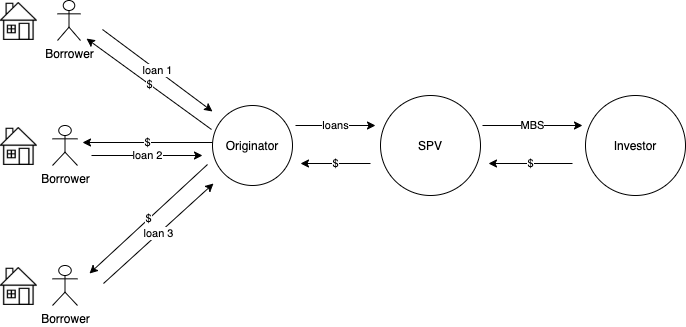
But if pledged derivatives are like mortgage-backed bonds (MBS), aren't they bad and scary? Will we trigger another financial crisis?LiquityPerhaps, there is a key difference between "crypto securitization" and MBS. First, let's take a step back and look at the characteristics of securitization. The simplest function of securitization is to pool assets and issue securities collateralized by their cash flows. In the MBS (admittedly caricatured) example below, a mortgage originator offers home loans to consumers. The originator then sells the loan to the special purpose entity for cash. The entity finances the purchase by issuing bonds, such as MBS, to investors. These will represent the cash flow of potentially tens of thousands of personal loans and will be far more liquid than the loans that make them up. This allows larger buyers to purchase a single liquid asset that matches their risk appetite without having to take out thousands of individual loans.
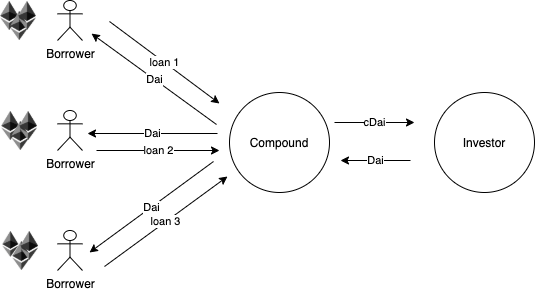
If we look at DeFi lending protocols like Aave and Compound, we find a very similar structure. A heterogeneous set of loans is pooled into a smart contract. The protocol finances these loans by issuing bonds, such as cDAI, which are backed by the cash flows from the loans. In this sense, Compound and Aave are not only lending agreements, but also securitization agreements.
The key difference is that lending protocols can both generate loans and perform securitization automatically. In contrast, in conventional securitization, the relationship with the borrower is usually handled by a separate entity within the originator. For PoS, this difference is crucial because the protocol needs to automatically enforce liquidation on over-indebted borrowers. picture[5]。
Such DeFi protocols plan to do the same.[4]Securitization transactions are often identified by tranching: the issuance of different classes of securities backed by the same pool of funds to satisfy different risk appetites. At first glance, this seems to be lacking in the above example of Compound issuing uniform bonds in the form of cDAI. However, we are starting to see options emerging that offer lower risk (such as combining cDai with insurance protection via Opyn or Nexus Mutual) and higher risk (such as PoolTogether) to cater to lenders with different preferences.
One of the specific problems with mortgage-backed bonds (MBS) that contributed to the disastrous financial crisis of 2007-2008 is that they are difficult to price transparently. Part of this is due to principal-agent problems, and a large part is due to the lag time between when a default occurs and when it hits MBS. For example, if a borrower defaults on a house, the defaulted payment is first passed on to the lender. The lender then reports the delinquent payments to the Mortgage Securitization Division, which then informs all shareholders that their liens are in default. Due to the vagaries of the U.S. domestic market, the process could take months to propagate defaults through the complex financial system
In the world of cryptocurrencies, however, the problem is less obvious. With crypto leverage, all participants know when a loan defaults, whether it’s crypto or pledged collateral. This means that financial products that rely on these loans, such as collateralized derivatives, can be priced and liquidated immediately upon default. Although liquidations are still risky - for example, market and liquidity risk can inhibit liquidators in protocols (such as Compound or Maker) from performing liquidations
— but more efficient than traditional markets. The relative ease of liquidation, which leads to efficiencies in the cryptocurrency world, means more complex securities that can be priced, packaged, and reused in ways that are more difficult in the traditional financial world.
However, this benefit does not come for free. Unlike originators who are close to borrowers, protocols lack knowledge of the borrower's underlying credit quality. Also, the quality of the collateral it receives in cryptocurrency tends to be much lower. The way DeFi protocols seek to solve these problems is through high centralization requirements and aggressive liquidation policies.
Additionally, there are additional risks associated with collateralized derivatives as liquidations reduce the money supply. The reason is that when a validator defaults on a loan, the PoS protocol burns its stake out of the system. A reduction in the money supply provides additional future expected rewards to other validators, but may reduce the security of the system. Even if the agreement compensates by increasing the currency exchange rate, it is possible for the market to discount the value of these assets. Therefore, every time there is a liquidation, the security of the network may be greatly reduced.
Finally, traditional securitization structures rely heavily on diverse pools of loans representing many different borrowers. And the pseudonymous nature of DeFi and PoS protocols can make it difficult to assess how exposed the protocol is to any single entity. This makes studying the distribution of wealth among borrowers even more important for PoS. Wealth inequality among PoS participants can compromise security by concentrating risk on a small number of borrowers.
This is the focus of our paper, in which we examine how staking derivatives affect inequality and rewards in PoS networks. We find that, under certain conditions, staking derivatives can reduce inequality. There are two intuitive reasons for this effect. First, by allowing validators to recycle capital, validators regardless of size have access to a similar set of opportunities, thereby leveling the playing field. Second, the default of an over-leveraged validator increases the returns of others by burning funds. This effect is even more pronounced when large validators default. We expect that validators specifying "too big to fail" will invalidate this result. For derivatives to work well, validators must share the risk of default proportionally and collectively punish risky behavior, especially by large entities.
. . .
What does this mean for protocol developers? If they decide to add collateralized derivatives functionality to their protocol, they need to consider that they are effectively adding trustless mortgage bonds (MBS) to their system. On the positive side, they allow validators to optimize their capital efficiency and achieve better overall returns, while liquidations ensure that these liens are priced correctly at all times. On the other hand, the familiar risks of mortgage-backed bonds (MBS) may still linger in the PoS system. If online lending standards are lax, derivatives could significantly reduce the security of the network. Protocol designers need to carefully design a derived pricing function that tells validators how much they can borrow.
We evaluated their theoretical model using Gauntlet's proxy simulation platform and found that there is indeed an "optimal condition" under which these derivatives can be added well. In these cases, the positives can greatly outweigh the negatives, and the PoS protocol's staking derivatives can effectively balance out. Failure to properly price default risk, or to aggressively enforce liquidation if necessary, can result in a significant loss of safety.
Cryptocurrencies are now entering soaring 20x leverage, and it would be wise for protocol designers and operators to carefully understand the risks in the financial engineering they are about to engage in.
We would like to thank Hasu, Georgios Konstantopoulos, Haseeb Qureshi, Celia Wan, Leo Zhang (Anica Research), Yi Sun, Matteo Leibowitz, Shannon Brick, Guillermo Angeris, Xien Tang Kao, Mario Laul, and Fabian Trottner for their comments and critiques of this blog post and paper and suggestions.
1. If the system is using the Byzantine Fault Tolerant consensus protocol, it will be 33%, if the system is using the 'longest chain' Nakamoto consensus protocol, it will be 50%.
2. Equity is the difference between what you owe on the mortgage and the current value of the home. As you pay off your mortgage, your home's equity increases. If you owe $180,000 on your mortgage and your home is worth $640,000, your home equity is $460,000.