

My month as a DeFi farmer: Talking about the risks and potential benefits of Balancer liquidity mining

Editor's Note: This article comes fromBabbitt Information (ID: bitcoin8btc), Author: Overnight Porridge, published with authorization.
Editor's Note: This article comes from
Babbitt Information (ID: bitcoin8btc)Balancer。
Babbitt Information (ID: bitcoin8btc)
, Author: Overnight Porridge, published with authorization.
In the recent explosion of DeFi farming, strange projects such as sweet potato YAM, pasta, crayfish, grapes, etc. have attracted the attention of many people, and the thousands of percent annualized returns (APY indicators) shown by these farming activities are indeed Some people feel suffocated, but the author has never felt heart-beating.
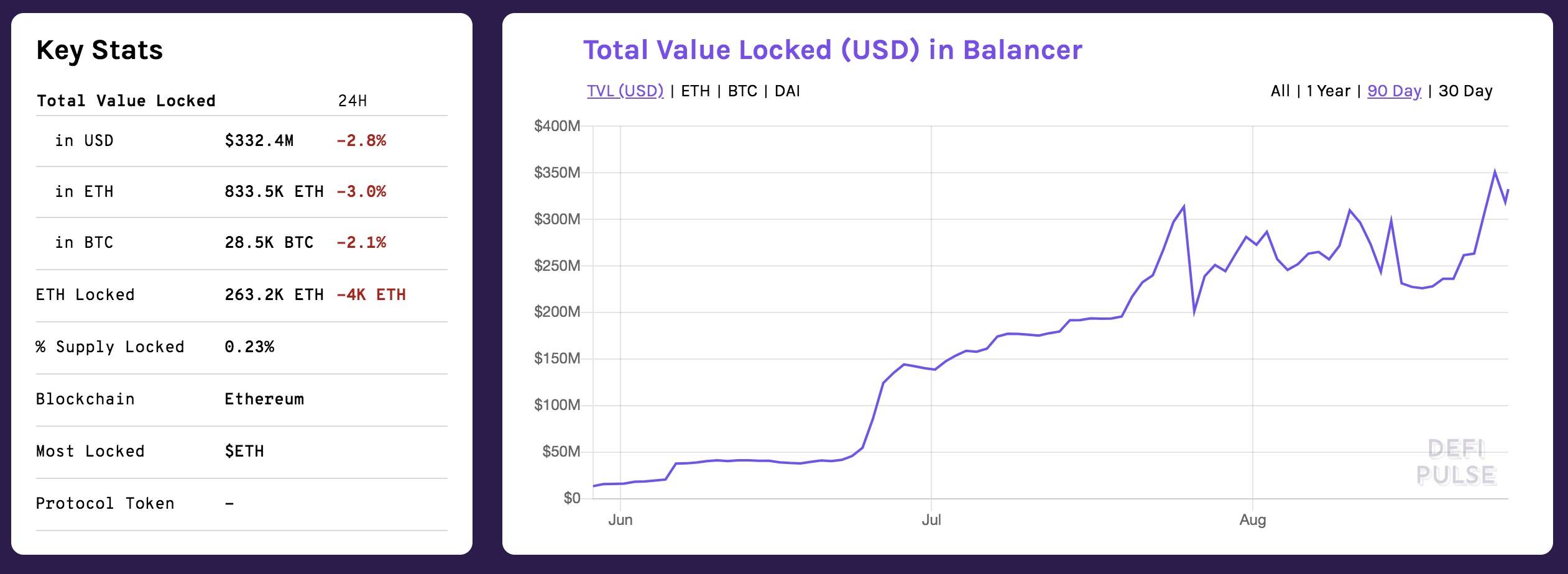
As of now, Balancer has grown into one of the most liquid protocols in the DeFi space. This automated asset management platform has customizable liquidity pools, each of which can support up to 8 assets, and the protocol also has flexible weight and dynamic transaction fee settings.
In addition to these, Balancer's liquidity providers (LP) can use a single asset to enter and exit the asset pool, which is obviously more friendly than the Uniswap protocol (Note: Uniswap liquidity providers must provide two types of tokens, and require 1: 1 provided in equal amounts).
As of now, the total value of assets locked (TVL) in the Balancer protocol has reached 332 million US dollars, ranking second in the DEX category, and this has a great relationship with Balancer's governance token (BAL) liquidity mining incentives relation.
According to official settings, 145,000 BAL tokens will be allocated to the protocol's liquidity providers (LP) every week.
secondary title
Different influencing factors for the distribution of BAL tokens, some pools have an annualized rate close to 300%, while others are less than 2%
Over the past month, Balancer governance has incorporated various factors that are tied to the BAL tokens allocated to LPs, including:
Fee Factor (feeFactor): The lower the percentage of transaction fees, the higher the BAL weight obtained;
Cap Factor (capFactor): Different fund pools have an upper limit on the BAL that can be obtained;
Wrap Factor (wrapFactor): Pools with the same anchor assets can obtain lower BAL rewards (such as sETH/wETH);
Ratio Factor (ratioFactor): The asset pool with a weight of 50/50 can obtain the most BAL rewards;
bal factor (balFactor): asset pool with BAL tokens, which can get a reward multiplier of 1.5 times;
With the passing of the bal Factor (balFactor) proposal, asset pools with BAL tokens have received the most BAL token liquidity returns in the past few weeks.http://pools.vision/)。
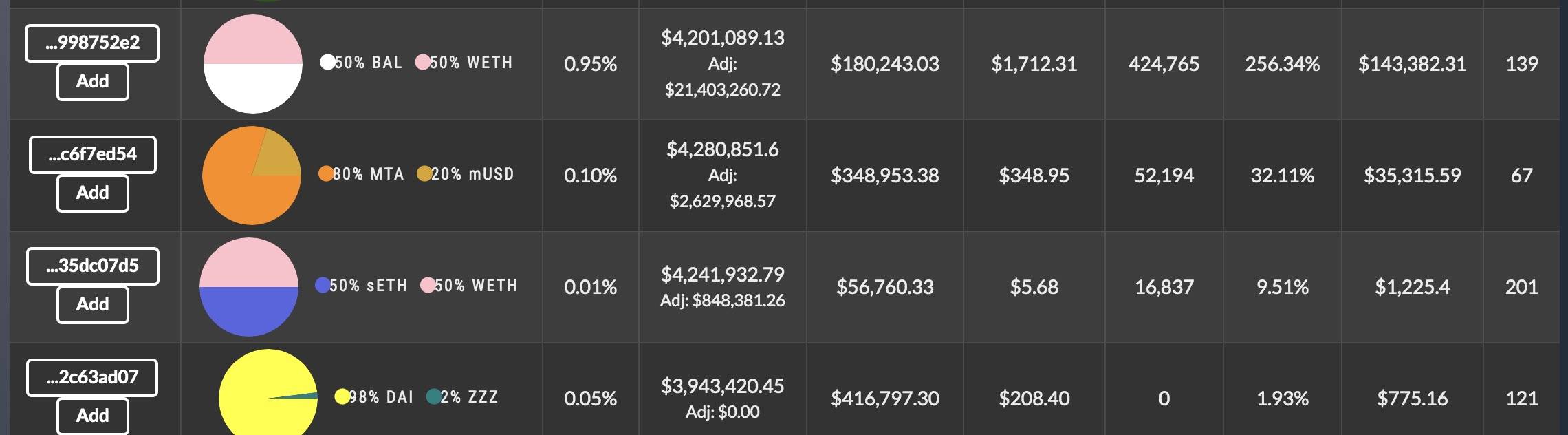
In addition, as the rules in the governance proposal show, Balancer's liquidity staking aims to further incentivize the BAL liquidity of "useful" asset pools, such as WETH, DAI, USDC, and WBTC, which are high-quality assets combined with BAL, can obtain the highest rewards.
According to the official setting, among the 145,000 BAL rewards per week, only 31% of the BAL tokens will be allocated to non-BAL liquidity providers, while the remaining BAL will be allocated to the BAL liquidity pool.
With the application of this new proposal, the APY index of the BAL liquidity pool has soared sharply. Depending on the pool you enter, the APY index will fluctuate between 200% and 300% (for the income, please refer to:
In contrast, pools without BAL tokens have an APY index between 1% and 80%, depending on each pool.
secondary title
Potential benefits and risks of being a DeFi leek farmer
Above we talked about the distribution rules and conditions of BAL token liquidity mining, so what does this mean for liquidity providers?

Reminder: The APY index (so-called annualized return) here is linked to the price of BAL tokens.
If you only look at the APY index, then it is undoubtedly the most appropriate to join the pool with BAL tokens, and this requires the "seed" of BAL tokens, or you can only provide other assets. Like other AMMs, provide Assets mean that they are subject to the risk of impermanent loss. For example, when the price of BAL tokens fluctuates sharply, this impermanent loss will appear.
Obviously, if you participate in the farming of the BAL token pool, the potential income will be much higher, but you will also face more risks.
Another farming option is to choose a pool suitable for market making (such as your own existing tokens, and comprehensively consider impermanent loss, transaction fee rewards, and other reward factors, etc.).
According to the preliminary plan and under ideal conditions (that is, no more participants to participate in the competition), the income that the author can obtain as a Balancer liquidity farmer for a month is about 6% of the seed amount, which is basically the same as other high-quality non-BAL liquidity Pooling is similar, but since this is an 80:20 weighted pool, impermanence loss will be less of an issue.
References:
1、https://yieldfarmer.substack.com/p/bal-liquidity-staking-alpha-tractor