

Is DeFi ready to go "mainstream"? What do the big names in the currency circle think?

This article comes fromFinancemagnates, original author: Rachel McIntosh
Odaily Translator |
Odaily Translator |

In 2020, the decentralized finance (DeFi) industry is experiencing explosive growth. What is driving DeFi forward? Can the industry achieve sustainable development through innovation? Let Mr. Odaily (WeChat: o-daily) study with you.
2020 has definitely been a dramatic and explosive year for the entire cryptocurrency industry, and we have seen many unusual things happen, such as:
l More and more new users are pouring into the encryption industry;
l Bitcoin crashed and recovered;
l The Federal Reserve released a large amount of liquidity and adjusted monetary policy in an astonishing way, and this series of measures may pave the way for the further development of the cryptocurrency industry.
But in contrast, a rising star has shaken the entire encryption industry, it is: Decentralized Finance - DeFi.Joe Lallouz, co-founder and CEO of Bison Trails, a blockchain infrastructure-as-a-service company that is a member of the Libra Association
express:
"The pace of innovation in decentralized finance is astonishing. DeFi didn't exist at all two years ago. For all intents and purposes, this vertical didn't really take off in the first place. It might just be an idea a few people were talking about at a meetup. Hope Platforms and systems based on smart contracts can be used to "build a financial ecosystem". But now, you will see new protocols, and new technologies for different protocols-from liquidity pools to automated market makers, from lending to lending From insurance — you see, everything can be built in decentralized finance.”
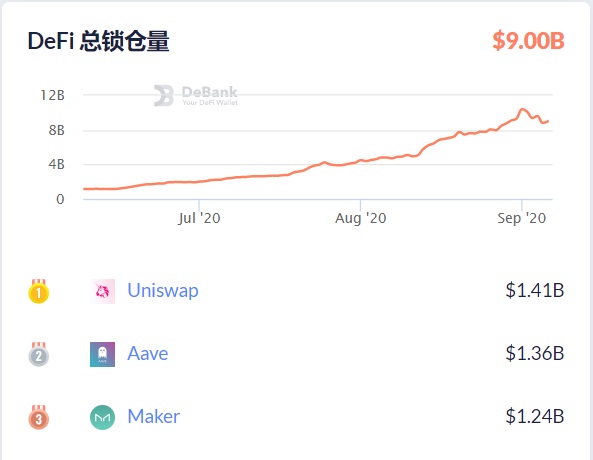
With the explosive growth of the decentralized finance industry, the prices of tokens related to various DeFi protocols have also skyrocketed, such as Chainlink’s LINK, Band Protocol’s BAND, and Compound’s COMP, etc. The prices of these tokens have soared It has also become the headline news of major media. At the time of writing this article, according to DeBank data, the total lock-up volume of DeFi reached 9 billion US dollars, of which the top three DeFi protocols are: Uniswap (1.41 billion US dollars), Aave (1.36 billion US dollars), and Maker (1.24 billion US dollars) .
So, what is driving the pace of innovation in decentralized finance? What does the rapid development of DeFi mean for the future of the entire cryptocurrency industry? Is DeFi ready for the "mainstream" world?
Next, let Mr. Odaily (WeChat: o-daily) and everyone take a look at how the big names in the industry view these issues.In fact, as global economic uncertainty is intensifying, more and more people are becoming interested in alternatives to traditional financial products/services.Steven Becker, Chief Operating Officer and President of MakerDAO, a decentralized financial platform
Thinking that the DeFi industry has actually only gradually risen since 2020, he said:
"At the beginning of 2020, the total value of locked positions in the DeFi market was approximately US$1 billion. This figure was almost the most important milestone in the DeFi market at that time. But since then, some DeFi projects have begun to solve the core pain points of the global traditional financial industry, including : Optimizing payment channels, improving credit and financial transparency, etc., and then stimulating explosive growth in this field. What follows is that more and more people are interested in DeFi production. Due to the gradual expansion of global financial uncertainty, people have already Started to look for alternative solutions, which may be one of the reasons why DeFi has been amplified in a short period of time.”
Indeed, cryptocurrencies as a whole have become increasingly attractive to the global public as faith in traditional monetary systems has been shaken. With the massive impact of the new coronavirus (COVID-19) on the global economy and the subsequent changes in monetary policy in various countries, many market analysts believe that people are desperate to find other ways to protect their savings.
"Today's market environment can explain why DeFi will experience explosive growth in 2020. When we are approaching the milestone of 10 billion US dollars in total locked value, it fully demonstrates that more and more people want to seek more transparent and effective storage solutions. solutions. DeFi has the potential to completely reshape the global financial system, blending traditional economic scale and familiarity with the security, efficiency, and transparency of public chains. The inherent security, efficiency, and transparency of public chains will drive innovation and growth , which we have never seen before.”
secondary title
Rising number of use cases could expand DeFi popularity
DeFi continues to grow as the number of potential use cases for decentralized finance platforms continues to grow.
“Decentralized finance use cases can allow users to create credit and create loans by themselves, because DeFi technology allows users to own their own banks and use their own assets for collateral, so as to get the whole experience. Some decentralized finance platforms can also use For storing credit points, users do not have to hand over money to banks or fund managers, they can have control, and they can also control where the money is stored and how it is used. In addition, some decentralized financial applications can also be used to transfer credit , users can use traditional payment tools (such as Visa, etc.), and can also use public blockchains to exchange funds around the world in real time. Not only that, decentralized financial tools can also be used to invest in something that is not for consumers at all under the current situation Assets used, such as world-renowned artworks, or traditional investment vehicles that used to be reserved only for institutional investors, as well as certain special types of investment funds and trading contracts.”
secondary title
Yield farming and staking are attracting new users
In addition to creating "replicating" traditional financial services, the decentralized financial ecosystem has also begun to explore how to provide users with innovative revenue opportunities. Gregory Keough, founder and CEO of the DeFI Money Market (DMM) Foundation, noted:
Seeing the huge success of Ethereum in the DeFi field, other blockchain networks have also begun to incentivize users to invest directly in their networks, which means that token holders who are willing to invest their tokens in the network for a long time have created Another potential profit opportunity.
secondary title
DeFi still needs to be "battle tested" before mainstream adoption
It’s important to note that not all is sunshine and roses in the decentralized finance industry: there have been many “negative” moments in this emerging market this year, which also seem to indicate that the DeFi ecosystem is not yet ready for “mainstream adoption”. for example:
1. In March 2020, the price of Ethereum tokens plummeted on "Black Thursday". As a result, a large number of loans fell below the mortgage threshold, which triggered a liquidation process. The liquidation process was carried out in the form of a mortgage auction. Users can obtain mortgages by bidding for DAI However, due to the market crash this time, some liquidators won the auction of the Ethereum collateral liquidation procedure with a bid of DAI with a price of 0, which also caused MakerDAO to have a debt of 4 million US dollars in outstanding loans. MakerDAO community members said that MakerDAO had a surplus of more than $500,000 before the price fell, but eventually had more than $4 million in debt due to the collapse of the Ethereum market price.
2. In April 2020, the dForce ecosystem protocol Lendf.me was hacked. Fortunately, after communication, the hacker returned 99.95% of the funds;
3. In June 2020, the Balancer liquidity pool was attacked by a flash loan and lost 500,000 US dollars. The liquidity of the two token pools, STA and STONK, which suffered losses, has been exhausted.
From this series of events, we found that the DeFi ecosystem at this stage is still unable to allow users to operate their own funds with 100% trust, especially those users who do not have enough "spare money" - this view is not groundless, because There is a lot of evidence that most of the users currently operating transactions on DeFi platforms are actually entities with a lot of "spare cash".Kyle Samani, Co-founder and Partner, Multicoin Capital
First to point out this phenomenon, he explained:
"At present, there is still a very small circle of DeFi transactions. Basically, there are about 100-1000 'Ethereum whales' controlling this market, and their transaction volume accounts for 90-95% of all DeFi protocol transactions. %."
“Everyone involved in DeFi today is like, oh, this is interesting stuff — let me try to understand what a digital currency loan is, and if I can use these assets, maybe I can do something interesting. Although now The DeFi user base is still relatively small, but in the long run, market volatility is actually a good thing for the industry, because the sooner and faster problems arise, the sooner and faster they can be eliminated, and ultimately let us These services and products can be transitioned to more 'mainstream functionality' early on."
secondary title
Now may be the time to rethink the backbone of the DeFi ecosystem
In addition to malicious actors hacking and disrupting DeFi protocols, there are other technical challenges that need to be solved before the decentralized finance industry can go mainstream.Stuart Popejoy, co-founder and president of blockchain infrastructure company Kadena
He believes that the DeFi industry must take one thing seriously, namely: re-evaluate the usability of the Ethereum blockchain, he said:
"Due to the insufficient capacity and poor scalability of Ethereum 1.0, DeFi now has to spend more than $500,000 in transaction fees per hour, so only when DeFi moves to Layer 1 with larger capacity, we can see whether DeFi is enough. maturity, and whether it can become mainstream."
“Ethereum 1.0 is clearly trying to reduce gas fees by millions of dollars in the next few weeks, and eventually enough gas will be released to bring the price back to reality and achieve a new equilibrium. After all, Ethereum during periods of high traffic The performance was not satisfactory. For example, at the end of 2017, CryptoKitties (encrypted cat) became a popular collection game on the Ethereum blockchain. Due to the rapid popularity of this game, the network was almost paralyzed, and some non-CryptoKitties transactions (such as ordinary ETH token transfer transactions) can take minutes, hours, or even days to complete.”
secondary title
“The rent is too high”
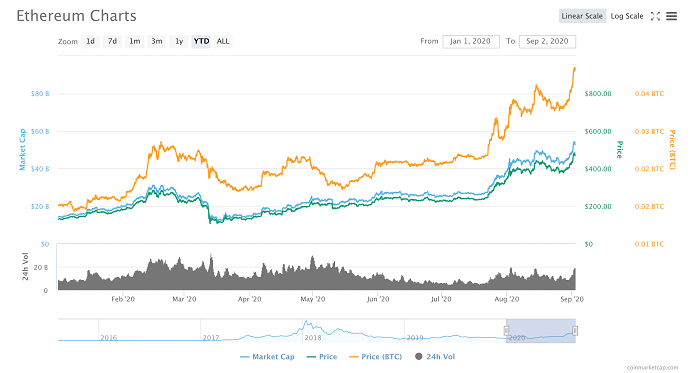
Last Tuesday (September 1), according to the monitoring data of Etherscan, the gas fee of Ethereum soared to 479gwei in a short time, and the average gas fee also reached 436gwei. The top three gas fees of each application were: Uniswap V2 (25.96%) , Tether (11.08%), and SushiSwap (2.88%), so some people complained that "the cost of a DeFi transaction is more than $10."
In this regard, Stuart Popejoy said:
"The current state of Ethereum is very worrying for decentralized application developers and projects. If we compare gas fees to block rents, then this rent is really too high. Ethereum immediacy means The ability to transact within a predictable amount of time has now turned into a seemingly very haphazard race. If you are an application developer and provide time-sensitive services to a small number of Ethereum users, then You’ll find yourself waiting longer and longer behind a flood of transactions due to the latest DeFi craze, and simply because DeFi apps are attracting more users than normal apps, These users represent a completely different market, but that doesn’t matter: non-DeFi apps will still lose out to DeFi apps simply because of low transaction volume.”
In other words, DeFi applications on Ethereum and other blockchains have to deal with more growing pains to be ready for the wider world. At the same time, the development of the underlying blockchain closely related to DeFi also needs attention.