

General Counsel of Compound: DeFi interest rate agreement ≠ lending agreement

Editor's Note: This article comes fromBabbitt Information (ID: bitcoin8btc)Editor's Note: This article comes from
Babbitt Information (ID: bitcoin8btc)
Here is the translation:

, Author: Jake Chervisnky, translation: free and easy Xi, published with permission.
Note: The author Jake Chervinsky is the general counsel of Compound Labs. In this article, he explained the difference between DeFi interest rate agreements and trust-based lending. In his opinion, although the term "lending" is widely used, And it's laymany, but it misrepresents the economic activity supported by DeFi rate protocols.
Here is the translation:
DeFi protocols support many types of permissionless financial services, but as of today, lending is not one of them.
While the term "borrowing" is widely used, and it is informal, it misrepresents the economic activity that these agreements support. Users of these protocols do not provide credit or owe debt, which is an essential feature of loan transactions. Users securely earn interest through over-collateralization and free market liquidations (instead of borrowing).
This article will explain how DeFi protocols are mislabeled as "lending" protocols, what the term "lending" actually means, why these protocols don't support lending, and why it's important to describe honestly and accurately what DeFi can and cannot do. important.
Disclaimer: I am the General Counsel of Compound Labs, Inc. This article expresses my personal views, not those of my employer, nor should it be considered legal and financial advice.
secondary title
DeFi replaces institutions with protocols
The core idea of DeFi is to distill the complex financial services provided by traditional institutions into their constituent rules and procedures, and convert them into self-executing codes. These autonomous agreements share the permissionless, non-custodial Attributes. So far, DeFi developers have launched various protocols that support a wide variety of intermediary-free economic activities, including digital asset exchange, payments, portfolio management, derivatives trading, prediction markets, private transactions, and more.
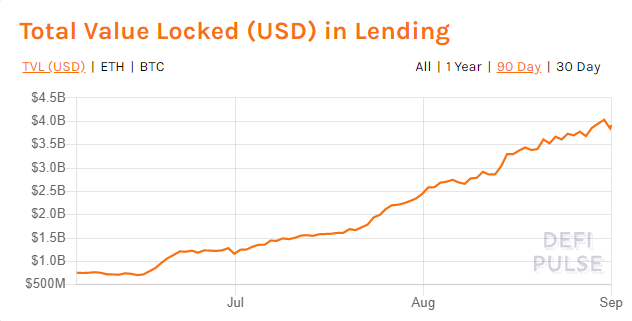
And one popular category of DeFi includes so-called “lending” protocols, where users provide digital assets as collateral to earn interest, borrow other assets, and create stablecoins that track the value of fiat currencies like the U.S. dollar. DeFi users have shown tremendous interest in these protocols, with billions of dollars of capital flowing into them in the past few months alone.
Above, Defipulse.com reports $3.92 billion worth of funds locked in “lending” protocols as of September 1, 2020
secondary title
How the So-Called "Lending" Protocol Works
There are currently several DeFi protocols on the market known as "lending" protocols, each of which has its own unique features and characteristics. Despite their differences, they all rely on the same basic mechanisms to function: overcollateralization and liquidation.
For the sake of convenience, I will refer to them as "interest rate agreements", and users first provide assets as collateral to the agreement. Providing assets to the protocol is a bit like depositing money into a bank account, but no third party has custody of those assets and users maintain exclusive control of their assets at all times.
Users who provide assets to the agreement can borrow other assets from the agreement, but there is a limitation that the value of the assets that can be borrowed is always less than the total value of the mortgaged assets. Since users are always putting up more collateral value than they can borrow, their positions are said to be overcollateralized.
For example, suppose you want to borrow DAI by staking ETH using an interest rate protocol. You first provide $1,000 of ETH to the protocol, and then you can borrow part of that amount in DAI stablecoins from the protocol, depending on the protocol’s borrowing limit. Assuming that the agreement stipulates that you can only borrow 75% of the mortgage funds, then you can only borrow USD 750 in DAI if you mortgage USD 1,000 in ETH. $250 of your position is overcollateralized.
Now suppose the market price of ETH drops by 4%, then your collateral assets are no longer $1000, they are now only worth $960. Your position is still overcollateralized by $210, but you have now exceeded the borrowing limit of the agreement. The $750 DAI you borrowed exceeds 78% of your ETH depreciation, which means that your position will be liquidated by a third party , the third party can repay some of the DAI you borrowed until you get back below the limit. At this point, the liquidator might repay $150 in DAI and get your collateralized $160 worth of ETH, making a $10 profit and making your new position $800 collateralized in ETH, borrowing 600 USD DAI, the ratio is still 75%.
As you can see, the combination of overcollateralization and liquidation is designed to keep the interest rate agreement solvent, that is, to prevent users from being unable to recover their assets because other users borrowed assets and cannot repay the assets provided. As long as users' positions are liquidated and remain overcollateralized, these protocols will not suffer loss of funds, and users will be able to withdraw their contributed assets at any time. As of now, the system has proven effective by securing billions of dollars in assets through the economic incentives of free market liquidation rather than relying on trusted third parties.
secondary title
The Heart and Soul of Lending: Credit and Debt
Before discussing why the interest rate agreement does not enable "borrowing", we should first define the word "loan". Simply put, a loan is a transaction in which one party gives money to another party who promises to pay it back later, usually with interest. There are at least two parties involved in every loan: the party giving money ("Lender" or "Creditor") and the party receiving money ("Borrower" or "Debtor").
Loans are a familiar and common aspect of financial life for most people. You may have made or received a loan at some point in time. In fact, you're probably a party to at least one loan right now. Maybe you took out student loans to pay for college, or a mortgage to buy a house. Maybe you paid monthly with a rental car or credit card, or maybe you lent money to a friend or family member.
In all of these examples, as in every loan, the same fundamental element is at work: trust. When a creditor gives money to a debtor, the creditor trusts that the debtor will pay back as promised. The government trusts you to pay your student loans, the credit card company trusts you to pay your monthly bills, and you trust your friends or family to pay you back.
First, it refers to the money that a lender provides to a borrower. Lenders "extend credit" by making payments to borrowers, or provide "lines of credit" by allowing borrowers to request loans in the future.
Second, it refers to the lender's confidence that the borrower will repay the loan, usually based on the borrower's reputation for reliability and solvency. Borrowers who gain the trust of lenders are said to be "reputable" or "good credit."
In short, credit is the basic feature and necessary condition of borrowing and lending.
secondary title
Cost Benefits of Credit and Debt
It is important that each line of credit is matched with corresponding debt. Credit describes the creditor's trust that the debtor will repay the loan as promised, while debt describes the debtor's obligation to do so.
As parties to a loan, the creditor and the debtor accept different costs in pursuit of different interests.
If all goes well, the creditor gets their money back plus interest, which the creditor can book as profit. To obtain this benefit, creditors pay an opportunity cost by using their money over the life of the loan and lose the opportunity to spend or invest it elsewhere. The creditor also bears the risk that the borrower will not be able to repay the loan, causing the creditor to lose some or all of his funds. This risk is often referred to as "default risk" or "credit risk".
On the other hand, the debtor gets the benefit of spending the creditor's money on a cost that the debtor would not otherwise be able to afford. To obtain this benefit, the debtor pays a "cost of capital" in the form of interest, which usually accrues at regular intervals, such as monthly, sometimes weekly or daily, until the loan is paid in full.
The debtor also runs the risk of not being able to repay the loan, which can have various negative consequences. Depending on the terms of the loan, the debtor may only have to pay some additional fees or penalties. But in worst-case scenarios, debtors could be caught in a "debt spiral," in which interest accrues on outstanding loans faster than debtors can pay off their debts, which could eventually lead to bankruptcy.
The system's best-known features are credit scores and credit ratings, which are used to indicate a debtor's likelihood of defaulting on a loan. Credit scores and grades take into account factors such as the debtor's payment history, outstanding debt, and available credit. In the US, the major credit agencies Equifax, Experian and TransUnion provide credit scores for individual consumers, while the major credit rating agencies Fitch, Moody's and Standard & Poor's provide ratings for companies and sovereigns.
Even with reliable credit scores and ratings, it is impossible to completely eliminate the risk of default, and it remains virtually impossible to determine whether a debtor will be able to repay a loan. To manage residual risk, a sophisticated creditor will usually require the debtor to sign a legal agreement that allows the creditor to "enforce the loan" in the event of default. This means that the creditor can sue the debtor in court and obtain a judgment against the debtor for the outstanding loan amount. The creditor may, by judgment, seize other assets belonging to the debtor to pay off the loan.
Now that we’ve discussed the mechanics of interest rate protocols, and the nature of credit-based lending, we’re ready to bring these two concepts together and explain why DeFi lending doesn’t exist, at least not yet.
secondary title
DeFi basically doesn't do credit or debt
So far, we have discussed how (1) the core feature of lending is that the creditor trusts the debtor's ability to repay the loan, and (2) how the core purpose of DeFi is to remove trust as a requirement of financial activity. As you can see, these systems take opposite approaches to the trust problem.
In fact, the design of the interest rate protocol does not involve trust at all. As noted above, their solvency and soundness depend on over-collateralization and liquidation mechanisms, rather than credit and debt expectations and commitments.
Remember that credit is the lender's trust that the borrower will repay the loan, usually based on the borrower's reputation for reliability and solvency. Unlike lending, asset providers to interest rate agreements don’t need to trust borrowers to repay the assets they borrow, and in fact, they often don’t know the borrowers at all. There are at least two reasons for this:
First, like the decentralized networks on which they reside, interest rate protocols are permissionless by default, meaning they can be used by anyone with access to the internet. This means that, without the use of blockchain analytics services, it is difficult or impossible for suppliers to link real-world identities to specific borrowers.
Secondly, DeFi transactions are carried out on the basis of "point-to-pool" or "point-to-protocol", which means that users provide or borrow alternative assets to tradable assets in the liquidity pool stored in the agreement, rather than to Certain counterparties offer and borrow fungible assets. This means that it is difficult or impossible for the supplier to identify any particular borrower who arguably borrowed their assets rather than another supplier's.
Instead of relying on trust in borrowers, lenders rely on overcollateralization and liquidation to ensure they can withdraw assets at any time. Borrowers must provide more collateral than they can borrow, and lenders can seize collateral at any time, or liquidate through a free and open market. These mechanisms work exactly the same regardless of the creditworthiness of the borrower.
Rather than having the benefit of spending someone else’s money based on a repayment promise, DeFi borrowers put up collateral up front that exceeds the entire amount they may owe later. Borrowers are free to walk away, never repaying the assets they have borrowed, without imposing any additional risk on lenders. In doing so, the borrower would lose their collateral, which would eventually be forfeited through liquidation. Either way, the purpose of the protocol is to return the lender's assets in full.
In other words, overcollateralization and liquidation are designed to eliminate the risk of default. Lenders don't have to worry about a borrower not being able to repay the loan because it doesn't matter whether the borrower repays first. This is not to say that interest rate agreements are risk-free at all, but simply that they do not pose a risk of default, which is a hallmark of lending.
In short, since interest rate agreements do not involve credit and debt, and because they do not rely on trust and do not expose users to default risk, the transactions they facilitate are not actually loans.
secondary title
It is worth acknowledging that collateral collateral is not unique to rate agreements, it also plays a vital role in lending. Nevertheless, the DeFi transactions we are discussing here are quite different from mortgage lending.
In unsecured loans, creditors rely solely on their trust in the debtor to repay the loan, combined with their trust in the courts to enforce these loans in the event of the debtor's default. Whereas, in a secured loan, the creditor also serves as collateral for the loan the interest on specific assets pledged by the debtor. Creditors can also use collateral to cover losses if the debtor defaults.
But the collateral that exists in a secured loan doesn't change its fundamental character - it's still dependent on credit and debt. Secured creditors still develop relationships with specific debtors they trust to repay the loan, often using credit scores and ratings to assess the debtor's creditworthiness. The debtor who pledged the collateral remains committed to future repayments in accordance with the terms of the loan and cannot easily walk away with the creditor's assets taken. The loan remains at risk of default, which could have serious consequences for both parties to the transaction.
secondary title
Misunderstanding the DeFi protocol is not good for everyone
If you've read this far, you're probably wondering why spend so much time explaining what seems to be a semantic distinction, the term "borrowing" is so easily understood by the general public, who cares if it's technically accurate? ?
In fact, we should all care about it. For the future of DeFi, describing precisely what we are building, and honestly acknowledging the limitations we have yet to overcome, is more than pure semantics.
Over the past few months, the previously usually thoughtful and stable DeFi sector has begun to show signs of a speculative boom reminiscent of the ICO bubble of 2017. Part of the reason for this bubble is that developers exaggerate the potential of blockchain technology to solve all the world's problems while attracting investment from an unsuspecting public. Today, we can find that the vast majority of ICOs have failed, and many are essentially fraudulent.
While DeFi differs from ICOs in key ways, the dangers of irrational market behavior are the same. There's no way to stop people from taking risks with their assets, but we can at least help them make informed decisions. This means explaining exactly what DeFi protocols can and cannot do, and being honest about how disruptive they are.