Editor's Note: This article comes fromCoin Encyclopedia (ID: coinwiki), Author: Da Mao V587, reprinted with authorization by Odaily.
Editor's Note: This article comes from
Coin Encyclopedia (ID: coinwiki)
, Author: Da Mao V587, reprinted with authorization by Odaily.
Last night, the DeFi world staged another wave of unexpected and wonderful drama: the DeFi insurance project Cover Protocol was attacked, causing its tokens to be increased by a large amount. The hackers successively cashed out on SuShiSwap, Uniswap and other DEXs, which directly caused the price of the token COVER to rise. Starting from around $800, it plummeted all the way. During the period, it plummeted, rebounded, and plummeted again as the news reversed.Later, "white hat hackers" followed up with additional issuance, and simply smashed it to the end, and immediately transferred the cash-out profits worth 4,374 ETH to the address of YieldFarming.insure (the predecessor of Cover Protocol), which objectively made a certain degree of redress . Subsequently, the DeFi insurance agreement Cover protocol officially released a solution, saying that it is planning to launch a new COVER token, which will be distributed according to the data before the additional attack.The wonderful collision of dropout "problem boy" and "DeFi geek"The predecessor of today's Cover Protocol is SAFE (that is, yieldfarming.insure). SAFE pioneered insurance policy mining (insurance + mining). Participating in its liquidity mining can obtain SAFE token rewards, which triggered the market after its launch. s concern.However, the two founders of SAFE later had conflicts. On September 16, one of the founders, chefinsurance (net name, still a college student) issued a document accusing project member AzeemFi (net name) of being dishonest and maliciously selling millions of dollars worth of money. The token of the US dollar, causing SAFE to plummet. At the same time, chefinsurance thinks that AzeemFi will fork Yieldfarming.insure, saying that he was manipulated by this member. It is suggested that if you invest in AzeemFi projects, you must keep your eyes open and protect yourself."COVER protocol"At this time, AC's ambitious "DeFi cross-border mergers and acquisitions" are beginning to emerge. As the most controversial "geek" in the DeFi world, AC contacted chefinsurance (net name). Under the mediation of AC, the previous Azeem, with whom he has a dispute, is willing to withdraw entirely.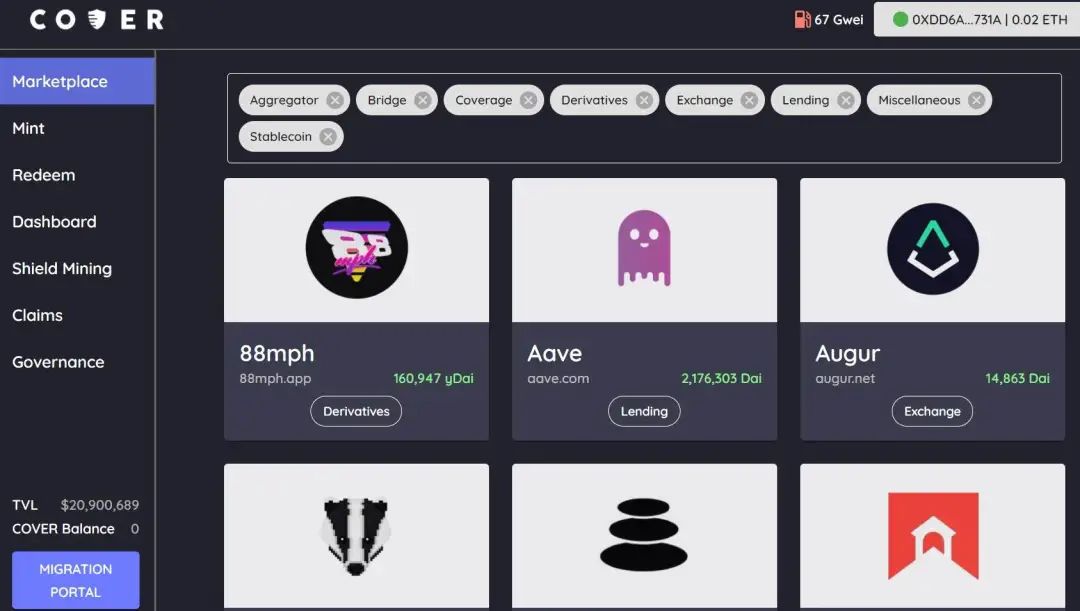 In addition, chefinsurance (screen name) himself dropped out of college immediately, received $25,000 (and 5 ETH) funded by AC and funds provided by BlueKirby.eth, and devoted himself to the new project. And this new project is Cover Protocol:
SAFE->SAFE2->On September 18th, the SAFE project team
The identity published an article saying that due to the immature launch of SAFE, the team decided to rebuild the new protocol COVER protocol, which allows users to buy and sell insurance based on anything on a completely decentralized and scalable platform.
Later, through a simple design similar to binary options, the Cover protocol opened up a new direction for DeFi insurance, refreshing the entire market, and its pool funds quickly sprinted from millions of dollars to tens of millions of dollars, becoming a decentralized insurance. of the best.
And if you count the process from SAFE to Cover, you will find that the corresponding tokens have actually undergone multiple "replacements".
At the beginning of the launch of the Cover protocol, COVER was not issued, but SAFE2 was still maintained. On September 26, SAFE launched the SAFE2 contract migration plan, which lasts for 5 days and allows holders to convert SAFE tokens into SAFE2. Inflationary shocks caused by liquidity mining.SAFE2 does not carry out liquidity mining, and the maximum supply will remain at 52689. After launching the COVER protocol, SAFE2 will be converted into COVER tokens.Beginning on November 20th, the migration plan of SAFE2 tokens to COVER began, in which 1 SAFE2 was converted to 0.5 COVRE, and the Token supply of COVER was 90,000 in the first year, 10,000 in the second year, and halved every year thereafter. There are 160,000 COVER tokens.
The official solution after this additional attack is to issue new COVER tokens in the form of snapshots, and COVER will migrate to the new "COVER2" again. After last night, Cover also has "real Cover" and "fake Cover". .
However, even if the official launch of a solution corresponding to the "reissuance of coins", the follow-up specific detailed compensation will definitely vary according to the specific rules of each stakeholder.Therefore, "reissuing coins" is just a start to the finishing work, and it cannot satisfy all users who have suffered losses, but it is already a relatively optimal choice at present.
- “Cover is a completely worthless governance token”
- After this additional attack, the official team of Cover Protocol issued an emergency statement, advising investors not to buy COVER again. In fact, before this, the Cover Protocol official has repeatedly emphasized: COVER (currently) is a governance token with no value at all, so buy it carefully.
- The reason is also very simple, the Cover protocol currently contains four types of tokens:
- DAI (stable currency) represents the deposit that the market maker needs to pledge;
Insurance claim rights represented by CLAIM tokens;Insurance demand side rights represented by NOCLAIM tokens;COVER tokens represent rewards and governance tokensAccording to the design of the Cover protocol, the original insurance mining of SAFE was changed to Shield Mining. Among these four tokens: DAI is used as collateral, CLAIM represents the claim right of the insurance demander, and NOCLAIM represents the rights of the insurance provider , COVER is the governance token.Among them, 1 CLAIM token + 1 NOCLAIM token ≈ 1 collateral, if a claim occurs, 1 CLAIM token ≈ 1 collateral, and the NOCLAIM token is reset to zero; if no claim occurs at maturity, 1 NOCLAIM token ≈ 1 collateral, CLAIM tokens go to zero.
That is to say, users use DAI when purchasing insurance and pledge casting, CLAIM and NOCLAIM are mainly responsible for the realization of insurance functions, while COVER tokens can only be used for "project governance" and have no value capture ability for the Cover network. That is to say, the price of COVER has no direct relationship with the status of project funds, and is mainly determined by the supply and demand prices in the market. To put it bluntly, at least according to the current economic model, COVER is still in the stage of "hype concept".Of course, the value of governance tokens is unquestionable, but as a matter of fact, COVER is a governance token, and the decision to re-issue new tokens after this additional attack is still directly decided by the project party, which can only show that COVER is a governance token. The attributes of the currency still need to be built slowly.In contrast, I still want to praise YAM. After the "24 hours of horror", even if the function of adjusting the amount of currency was urgently suspended, the YAM team initiated a community resolution and specially made a tutorial to help users stop mining. Mining and putting forward coins to vote has truly realized community decision-making governance.