

On the eve of Polkadot's ecological explosion, understand cross-chain DeFi from Acala
Editor's note: This article comes from,, reproduced with permission., reproduced with permission.
On February 2, 2021, Fuyao, Acala’s global open contributor, Cao Yin, managing director of the Digital Renaissance Foundation and Acala consultant, and Shui Rongzi, PolkaWorld’s marketing director, and three guests were guests at Deep Chain Finance’s “PolkaShot Polkadot Ecological Series” Salon”, shared and exchanged around the theme of “understanding cross-chain DeFi from Acala on the eve of the outbreak of Polkadot ecology”.
question Time
question Time
Deep Chain Finance: Can you give us a brief introduction of what kind of project Acala is and what role it plays in the Polkadot ecosystem?
Fuyao: Many people think that Acala is a combination of DeFi applications on Polkadot, but this understanding is not three-dimensional enough. Visually speaking, Acala is an independent blockchain network that inherently has stable coins, Staking derivatives, DEX and on-chain governance models.
In 2020, the Acala Mandala test network has also iterated 5 versions, and the cumulative active users have exceeded 40,000. In the process of iteration, it has many innovative advantages, such as: support for multi-currency payment fees (FlexiFee): Acala has implemented a custom network service fee. Users do not necessarily need network native Tokens to pay when making transfer transactions. All assets on the Acala platform can be used for service fee payment.
Cross-chain interoperability: First of all, we have reached in-depth cooperation with Ren, Ampleforth, and Polkadot’s officially named Bitcoin cross-chain bridge project Interlay. Ren is now also trying to cross ETH into the Acala ecosystem. In addition, Acala and Phala interoperability enables Polkadot ecology's privacy layer DeFi assets to achieve cross-chain.
More advanced smart contracts: Acala makes good use of the full technology stack of the Substrate framework, including the underlying technology infrastructure (such as RPC, Web-Assembly Runtime, P2P, etc.), and also includes related smart contract modules at the application layer (such as the Ethereum Virtual machine EVM and WASM).
In addition, Acala also launched the LP Staking function and the Polkadot ecological open Oracle channel.
Finally, we all know that it is very difficult to upgrade Ethereum itself or some DeFi projects. In many cases, there are multiple versions of a project, such as single-mortgage Sai and multi-mortgage Dai, Uniswap v1 and v2.
For Polkadot and Acala and other Substrate-based chains, all core protocols are updated and upgraded without forks and low perception.
Just like the hot update of the App in the mobile phone, it is very convenient and friendly for users and project parties. Therefore, all Substrate-based chains can easily and seamlessly plug and play business functions through fork-free on-chain upgrades.
Cao Yin:
Cao Yin:First of all, we cannot say that Polkadot has an advantage over Ethereum DeFi. Polkadot has just started the parachain auction now, and it is not yet online. So it is still too early to say that Polkadot DeFi has an advantage over Ethereum.
However, I am very optimistic about Polkadot's DeFi ecology, which can surpass Ethereum's DeFi ecology in the long run. This is actually not rigorous. It should be said that Polkadot’s DeFi ecology and Ethereum’s DeFi ecology, including other DeFi ecology that will appear in the future, will merge into one, and then become a general cross-chain DeFi ecology.
There are three reasons why I am optimistic about Polkadot’s DeFi, and I will introduce them to you one by one below.
First, Polkadot Substrate’s one-click blockchain architecture provides developers with a very good development experience. Friends who have used Solidity should know that the development of Solidity is relatively difficult. Then, Ethereum puts consensus and business logic together, so developers dare not do too many radical applications or function settings on the project code or contract code.
Polkadot, which adopts the architecture of relay chain and parachain, adopts the architecture of Substrate's one-click release chain, which allows the developer to easily generate blocks for its business logic and consensus on the relay chain Separate it.
In this way, developers, such as DeFi ecological chains like Acala, can test a variety of very advanced and useful DeFi functions on their own parachains without worrying about affecting the block generation on the intermediate chain. At the same time, Polkadot also has a pioneer chain such as Kusama, developers can first deploy some fun, more radical, more advanced, and more novel functions on Kusama. Then, if this function is suitable, it can be safely upgraded after running down, or relocated to other chains, which provides developers with a very large room for flexibility. This is the application scenario and development environment that developers dream of.
If you carefully study some of the main modules and frameworks on Substrate, you will find that the main functions on Substrate are equivalent to one module for each city, and he disassembled the structure of this chain into modules one by one. Developers can easily combine them into their own parachains according to their needs like building blocks.
The second point is that now Ethereum has entered a bottleneck, and Ethereum 2.0 has great uncertainty. The ecological development of DeFi is also particularly rapid. The existing Ethereum DeFi ecosystem, or the infrastructure of DeFi, has been unable to keep up with the development of DeFi. There is an urgent need for a more scalable, more customized, and more convenient for developers. friendly infrastructure. There is no doubt that it must be Polkadot.
After careful study, we can find that the series of functions that Ethereum 2.0 wants to achieve have actually been realized on Polkadot. For example, sharding, Polkadot has completed the sharding chain on Ethereum, which we call the beacon chain, through the architecture of the parachain.
Polkadot has actually completed all the things that Ethereum 2.0 has to do so far, 120%, not to mention that there are many functions that Ethereum 2.0 does not have on Polkadot. For example, like the direct upgrade of online governance, this is a very convenient, efficient, and customized hair chain structure.
The third point, the reason why I am optimistic about Polkadot is actually the same as the second point. That is, Polkadot can serve the current DeFi ecology of Ethereum very well.
I had a metaphor before. The classification of DeFi can be divided into three layers. Layer 1 is the underlying BTC, which is the value storage layer, and the second layer is Ethereum, which can be called the asset issuance layer. The third layer is actually Polkadot, which is actually the operating system layer of DeFi.
The first layer, the underlying Bitcoin is very difficult to shake, as long as the market value of Bitcoin is still greater than the market value of all other non-Bitcoins, Bitcoin will always be a store of value, a role of digital gold. Because of its limited performance, Ethereum may be limited to an asset issuance position.
After the assets are issued, various operations must be performed, such as transactions, derivatives, contract issuance, mortgage lending, etc. This financial function requires a high-performance, scalable, and seamlessly upgradeable platform like Polkadot. chain.
In the long run, this operating system layer will go down. Polkadot is not only the third operating system layer, but it will also become a very important second layer, which is the asset distribution layer. Just like the current trend of cloudification in our IT industry, the operating system is integrated with storage and bandwidth. So, looking at Polkadot in the medium term, it will keep pace with Ethereum and become the second-tier asset on top of BTC.
Polkadot has the main network and Kusama forerunner. Gavin wrote an article before. His definition of the DOT main network is high security and high reliability. It can serve those big companies, big banks and big institutions, and become an enterprise-level and financial-level safe and reliable network. platform. And Kusama is dedicated to start-ups, new projects, new companies, and new applications.
Therefore, from his classification of the two mainnets of Kusama and DOT, it can be found that it takes into account what we now call the original blockchain, such as the issuance of these assets. At the same time, it also has a very big vision. It also wants to bring those non-blockchain-native assets, such as stocks, national bonds, and some financial derivatives, and even introduce this real estate to Polkadot for issuance, and then through Kusama The cross-chain bridge with DOT allows this blockchain-native and non-blockchain-native assets to operate at a very low cost and efficiently. Shuttle between the two main networks for transactions does not define Polkadot as a competitor of Ethereum but defines Polkadot as a competitor of the Internet.
Deep Chain Finance: Acala is known as the Polkadot Ecological Financial Center, so what problems can this "financial center" solve for the current development of DeFi and what help can it provide?
Fuyao:At present, the problems of DeFi that have been repeatedly raised by the community are high cost, slow speed, and difficulty for users to use.
Therefore, Acala has made many improvements on top of this, such as the improvement of the Flexi Fee (multi-currency payment handling fee) network handling fee mechanism, users can choose any asset in the network as a handling fee (now supported: aUSD, ACA , DOT, LDOT, XBTC, RenBTC), this function is similar to WeChat priority payment, this design is more friendly to ordinary users, and reduces the existing DeFi transaction costs and usage threshold.
And in order to deal with the black swan event in the market, Acala also launched the QoS service. That is to say, 20% of the space in each block is reserved for important transactions at the system level. This function is like an emergency passage on a highway, ensuring the normal operation of important functions anytime, anywhere.
Of course, the more important point is that Acala's positioning is to be a DeFi Hub on Polkadot, but since many existing DeFi contracts are deployed on Ethereum, Acala's smart contract module also considers compatibility with Ethereum. It is also convenient for the growth of developers.
To this end, Acala proposed a set of self-developed Ethereum compatible solutions. This solution creates a JavaScrpt SDK that simulates a Web3 provider and can package Polkadot Extension into an extension similar to MetaMask. Such ready-made Ethereum Dapps can also use Polkadot Extension to interact with Acala EVM.
In this way, Acala EVM not only avoids some legacy problems of Ethereum, but also retains the advantages of Substrate while being compatible with Ethereum.
For example, let Acala have a customizable underlying mechanism, allow users to use any supported tokens to pay transaction fees, local cross-chain functions, on-chain governance mechanisms, hot update (no need for contract migration), etc. And these innovations are more difficult on Ethereum.
In short, whether it is the optimization and improvement of some DeFi functions on the chain or the compatibility with Ethereum smart contracts, Acala will bring a broad and rich DeFi ecological map to the entire Polkadot ecosystem.
Cao Yin:
Cao Yin:Ethereum DeFi and Acala directly interoperate, which is the so-called Polkadot will become the general operating system for DeFi. Ethereum is Dos, Polkadot is Windows. Now there are a lot of top Ethereum DeFis coming to Acala for cooperation. Ren and Ampl have already been announced, and there are still heavyweights that have not been announced.
Many people regard Acala as an application. In fact, Acala is an Ethereum, an Ethereum dedicated to finance.
Acala is also divided into two mainnets, one on Kusama and one on Polkadot. On the two mainnets, its functions and positioning are also different. The governance deployment on Kusama will be very fast, and it is also an experimental and forward-looking application.
In fact, this is a forward-looking main network that becomes the first network. This layout can enable Acala to provide both the level of security like ICBC and the innovative social nature of Ant Financial. In this way, it can Meet the needs of different users and different scenarios.
I want to emphasize one last point later, that is, we have always emphasized the composability of this DeFi. But with the continuous development of DeFi, I found that the definition of composability is actually undergoing different and constant evolution.
For example, in the previous DeFi, it only made a small and beautiful application of its own, and then integrated with other DeFi. So what are we discovering now? Some leading applications like Aave, Compound, and Sushi are changing from external composability to ecological composability. They will incubate some projects by themselves, or they will set up some internal teams to make some innovative applications, and then combine them on their own platforms.
What is the benefit of this so-called ecological internal composability? First, because they are all from the same group of developers, or from the same community, the reliability of the project code developed by it will be more guaranteed. At the same time, because DeFi often has problems due to this external composability, then this kind of Ecological internal combination can be avoided. This security failure is caused by not understanding the code, calling the combination casually, or because other people's code upgrades have not kept up. Ecological internal composability, it can not only provide this kind of plug-and-play diversified functions, but also provide the highest level of security.
Deep Chain Finance: It is understood that Acala has launched its fifth testnet, Mandal TC5, and held the fifth round of testnet incentive activities. In addition, Mr. Cao also mentioned that Acala and AMPL, Phala, Injective, etc. The project has cooperation. So, what is the current progress of Acala's product development and ecological expansion? What is the next point?
Fuyao:According to the latest official progress of Polkadot, it is expected that the Kusama parachain slot auction on Polkadot’s first network is expected to be in Q2 this year, and we still need to wait for Polkadot’s official announcement.
In preparation for the slot auction, we will be the first to launch Acala pre-network Karura on Kusama.
And Karura is positioned as the Kusama ecological DeFi financial center. Compared with the Acala main network, the rhythm is relatively fast, and the style and gameplay are innovative and flexible. All the functions of the Acala main network will be launched on Karura first.
In addition, our Acala has made full use of the advantages of Polkadot’s cross-chain interoperability. Currently, we have completed the deployment of the RenVM bridge module on the Mandala test network, added RenBTC as collateral, one-click quick exchange in Swap, and provided RenBTC for decentralized exchanges. liquidity, and FlexiFee also supports RenBTC as a network transaction fee.
Synthetic assets are also introduced to complete the integration of aUSD with the Laminar chain, allowing users to transpose aUSD in the Acala network to the Laminar platform to generate synthetic assets (such as fEUR) and participate in margin transactions.
Finally, in terms of privacy, Acala and Phala have achieved interoperability. Through the combination of DeFi parachains and privacy parachains, the cross-chain of DeFi assets in the privacy layer of Polkadot ecology has been implemented.
One thing everyone needs to pay attention to is that the cost that everyone pays for participating in the parachain slot auction is that they cannot obtain the Staking income during the lock-up period, so it is very important for the project party to give the participants of the parachain slot auction how much share.
For Acala, the purpose is to give most of the Tokens fairly to the participants in the parachain auction, so as to form a true community autonomy and decentralization.
In the first year of Karura slot auction, a large part of 11% will be used to encourage participation in PLO. Lock 100 KSM, get at least 1200KAR in 1 year. Among them, 30% of the rewards have no lock-up period, and the rest are released linearly. In addition, there is a recommender mechanism, with an additional 10% reward.
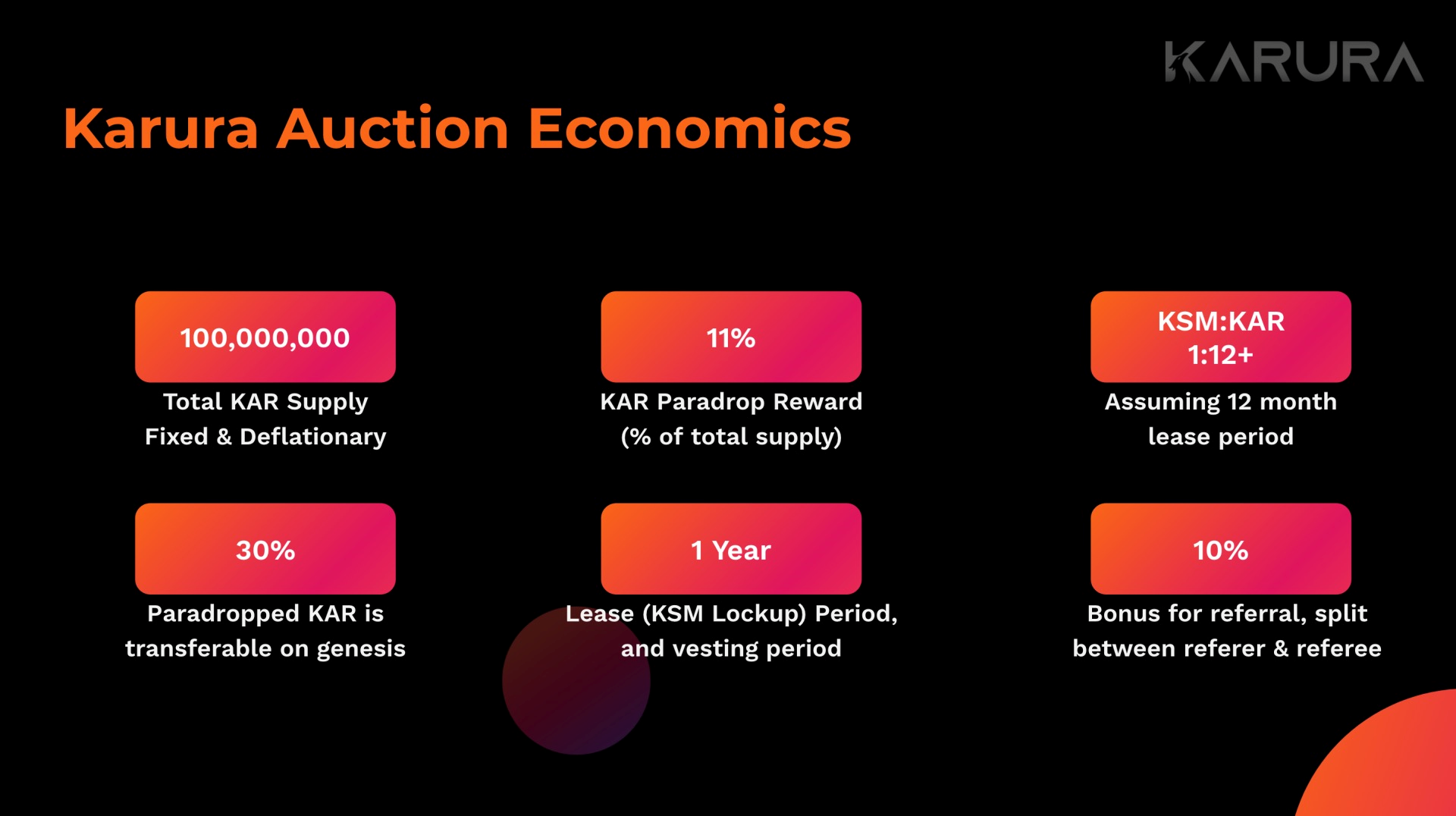
The online process of Acala Pioneer Network Karura. Simply put, there are 7 steps:
1. Connect to the parachain test network Rococo V1 for related tests (currently at this stage);
2. Parachain-related codes will be pre-deployed on Kusama after testing;
3. Announce the schedule for the first parachain slot auction;
4. Kusama will open the crowdfunding module of slot auction, users can choose Karura in the Crowloan module and lock their own KSM;
5. The slot candle auction starts;
6. When Karura successfully took the slot, the founding block was born;
7. Distribute KAR rewards.
At the same time, we are also contributing new functions to the Polkadot crowdloan (slot auction) module. When the final bidding module is completed, Acala will determine the detailed bidding participation plan and incentive plan according to the supported functions, and our Chinese community and the public will be announced as soon as possible.
Deep Chain Finance: Parachain slot auction is the most concerned item in the Polkadot ecosystem right now. Recently, the Polkadot testnet Rococo V1 has also started to access the parachain testnet. What is the parachain slot auction? Why so much attention?
Water Forgiveness Son:Hello everyone, I am Mizuko Mizuko, Marketing Director of PolkaWorld. Let me first answer what is a parachain slot auction?
The first thing to be clear is that the infrastructure of Polkadot is composed of a relay chain + N parallel chains. If a parachain wants to access Polkadot’s relay chain and share the security of the Polkadot network, it needs to use slots to Access Polkadot.
At the same time, due to the scarcity of resources in the early stage of the Polkadot network, the number of slots is relatively limited, so if you want to obtain the right to use slots, you need to obtain them through bidding. This is the auction of parachain slots. So why is it getting so much attention?
Slot auction is a new way of playing in the blockchain world. When a new concept is first proposed, it takes time to prove its true market value. Under the premise of high uncertainty, some frothy. In my opinion, the essence of the auction is a market pricing behavior due to its scarcity. To a certain extent, due to the extreme scarcity, the market will give a higher price than itself. Slots may have a high premium, and it is very likely that the first project to bid for a slot will need to pay a higher cost and need to have corresponding strengths at the same time.
Then its own Token value will not be low. This is also one of the reasons why people look forward to it, because there are many unseen opportunities in it. But from a long-term perspective, the parachains on Polkadot will undergo continuous screening, elimination, and iteration. This process will gradually make the market more rational.
Deep Chain Finance: Polkadot can be said to be a highly anticipated project and ecology in 2021, but its main network has not yet launched. Although the parachain slot auction has attracted much attention, there is no definite time point. What are the difficulties in the development and development of Polkadot? When will we see a state of qualitative change?
Fuyao:For Polkadot, in order to allow each connected parachain to enjoy bank-level shared security, it must be based on stability and security.
How to be oriented to parachain applications with sufficient flexibility, the biggest difficulty lies in the need to balance user needs and engineering implementation, and basic network facilities are the most important part.
The Polkadot community has always had an impetus for technological excellence. After laying the groundwork at the theoretical level, the rest is the superstructure, so that commercial applications can be realized steadily.
Moreover, Polkadot, as a new generation of blockchain protocol, specially builds the interconnection between the entire blockchain network, allowing blockchain networks to work seamlessly on a large scale, allowing heterogeneous types of blockchain networks Being able to send any type of data between them will unlock a plethora of real-world use cases.
And combine the best features of multiple high-quality blockchain networks to pave the way for the emergence of new decentralized markets, allowing various applications or providers to provide users with fairer and more complete services.
If Polkadot shows great potential and usability in multiple fields such as DeFi, Internet of Things (IoT), governance, identity management, network decentralization, and asset tracking in the future, Polkadot will really bring about qualitative changes.
We all know that it is DeFi that rediscovers the value of Ethereum. So the last thing I want to say is that Acala is Polkadot’s bottom-level financial infrastructure and is the first stablecoin system. When Acala is connected to Polkadot in the form of a parallel chain, users will have more diversified Transaction options.
What followed was a brand new financial market, and the price fluctuations caused by the buying and selling relationship led by Polkadot also allowed users to capture a lot of value.
To put it simply, the value capture generated by those DeFi projects in the Ethereum ecosystem will also bring opportunities to capture value in the Polkadot ecosystem, and even new opportunities will appear. The important thing is that this gold rush opportunity is for all It's just the beginning for people.
Deep Chain Finance: At present, there are many projects in Polkadot ecology or so-called Polkadot ecology. How can investors judge whether a project is reliable, and what should be paid attention to when investing?
Water Forgiveness Son:Cao Yin:
Cao Yin:First of all, we are very concerned about the ability of the team. The projects I invest in are basically teams with long-term attention, such as Acala. When Acala was not named Acala before, we worked together with them. Through in-depth observation of the Acala team's capabilities, experience, team ambitions, and ways of doing things, we decided to invest in cooperation after an in-depth understanding.
Then we have to examine whether we have the ability, determination and confidence. Taking the present as an example, I think that in Polkadot, for example, teams like Acala and Darwin have been deeply cultivated in Polkadot for two years or even longer. Before everyone knew Polkadot, they had already identified Polkadot and carried out in-depth development in Polkadot.
For example, the Acala team has been building the mobile version of the Polkadot wallet on Polkadot since 2018, and then gradually made it into the center of Polkadot’s current DeFi hub, so this is actually a must for a successful team. The quality of preparation, strategic vision, and at the same time, the ability to persist for a long time, not to be attracted by some external temptations.
Of course, not all friends have access to early projects like us. For many friends, he may want to invest from the second level. Then I suggest to look at two points:
First, whether this project has received official technical approval from Polkadot. There are already a lot of Grants now, because Polkadot's attitude towards Grants is lenient entry and strict exits, so you can basically apply for Grant now, and you can get it at any time.
It just says that a milestone cannot be completed until it is completed. Grant In principle, Polkadot officials do not allow these project parties to publicize before completing milestones, saying that they have obtained a Grant, and use the Grant as an endorsement. In fact, many teams outside are doing this now, which actually means that these teams have no confidence in themselves, and they come out to promote without completing milestones.
So, I will screen these project parties one by one, what type of Grant does it refer to, how far it has been completed, and what are the milestones? Finally, check. This is all public information on the official website, and everyone can check it.
I also like these project parties, whether he has joined the builders of Substrate, and whether he has received high-level evaluations. This is actually a very core and rare recognition.
Second, I also look at whether the project party has obtained the support of some strategic institutions of this institution at the international head during the financing stage. For example, with the support of some big-name strategic investment institutions such as Grayscale’s parent company DCG, they all have a lot of very senior analysts who will conduct a 360-degree review of these projects, including its team background , technical capabilities, and due diligence on its code skills. If you get investment from these institutions, you can also enter their very unfathomable dyke ecology.
[Disclaimer] Deeplink publishes this information to disseminate more information, and does not represent any views, positions or investment hints on this site. If the information infringes intellectual property rights, please call or write to inform us in time, and this site will delete the article as soon as possible.