Editor's Note: This article comes fromEthereum enthusiasts (ID: ethfans)Editor's Note: This article comes from
Ethereum enthusiasts (ID: ethfans)
Ethereum enthusiasts (ID: ethfans)
, author: Kyber Network, translation & proofreading: Min Min & A Jian, reprinted with authorization by Odaily.
In the past year, DeFi has ushered in rapid development. In response to the changes mentioned in our article published last October, we have decided to address key architectural constraints and issues.
In this article, we explain how we plan to remove past growth constraints (e.g. fractional permissioned model with high gas usage), allowing Kyber to quickly adapt to DeFi trends and drive innovation while benefiting liquidity providers, order takers , developers and KNC holders.
First, we are working on a Kyber 3.0 upgrade. This upgrade will transform Kyber from a single protocol to a goal-oriented liquidity protocol hub for different DeFi use cases. This will be the biggest change to Kyber's architecture and token model since its inception, and will be implemented in two phases - Katana and Kaizen.
Second, we will release a new liquidity protocol, Kyber DMM, as a major supplementary feature of the new network. Kyber DMM is the first automated dynamic market maker in the DeFi industry, which will bring great convenience to liquidity providers. It is completely permissionless, allowing anyone to provide liquidity and any taker (eg, dApps, aggregators, and end users) to access liquidity.
Third, in order to support the new architecture and increase the overall value of the network, we will put forward a proposal to upgrade KyberDAO and KNC to a new type of token contract and launch a vote. This move aims to significantly increase the governance rights of the KNC token, create multiple utility streams, and support new liquidity innovations.
The Kyber Network has been a leader in innovation since the dawn of DeFi, creating the first liquidity aggregation protocol, on-chain endpoints, and KyberDAO (one of the most successful DAOs and communities in the DeFi industry). Additionally, we launched KyberPRO - the only on-chain professional market maker framework and market maker gateway into DeFi. Kyber 3.0 marks a new phase for us with our heads held high. We want everyone to join in.
A new network architecture that breaks through limitations and develops innovations
Although this model worked well in the early stages of DeFi development (we provide the best quotes for order takers through on-chain aggregation and a unique network of liquidity providers), as time goes by, the limitations of this model become more and more obvious , causing us to be unable to quickly capture key DeFi trends, including the recent rise of aggregators, permissionless liquidity provision, and trading between stablecoin pairs.
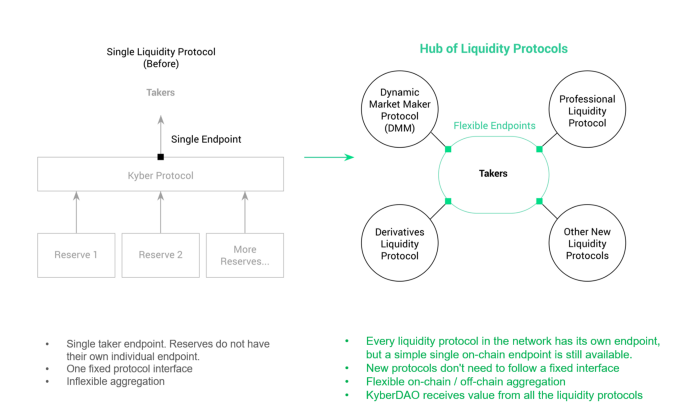
In order to break these limitations, improve adaptability, and prevent Kyber from missing the DeFi trend, we are upgrading Kyber from a single liquidity protocol to a diversified goal-oriented liquidity protocol hub to suit different DeFi use cases.
We will overhaul Kyber's previous reserve system. Important reserves such as Fed Price Reserves (FPR) and Bridge Reserves will be upgraded to a comprehensive liquidity protocol. In the future, the Kyber team and developers in the Kyber ecosystem will also create new protocols.
image description
- Kyber will be upgraded from a single liquidity protocol to a hub of different liquidity protocols -
What does this reform mean for liquidity providers and order takers?
DeFi has many use cases and possibilities. We believe that a single liquidity protocol cannot accommodate the needs of all liquidity providers, order takers and other market participants. This structural reform allows us to innovate quickly and integrate new protocols into the entire network to adapt to different needs.
For example:
- 1. Extensive liquidity supply options
- As we move from a fixed interface/permissions model to building various goal-oriented protocols, we will be able to serve different types of liquidity providers. Different liquidity providers have different needs and goals.
As far as professional market makers are concerned, they can efficiently make markets on the chain through Kyber's professional liquidity protocol, without the need to deploy and maintain their own reserve contracts.
In terms of external on-chain liquidity sources wanting to access our large network of takers (100+ people), they can work with our Kyber team to join our on-chain Bridge protocol.
As far as all liquidity providers are concerned, they can uniquely contribute to our new automated permission-free dynamic market maker according to their preferences.Next, we have the potential to develop a derivatives protocol dedicated to derivatives aggregation and trading, an advanced trading protocol that supports stop-loss functionality, and a protocol that facilitates token sales. Each protocol will have a different set of liquidity providers.2. Taker options with strong flexibility and high gas efficiencyIn this network upgrade, we have broken some important limitations of the existing architecture. The existing architecture is centered around only one network-level endpoint and one fixed reserve interface for all reserve types. This creates some important limitations, the former leading to higher gas fees and difficulty for aggregators to choose liquidity sources, and the latter limiting the range of options, especially considering that Ether is the only quote currency.The new Kyber 3.0 architecture is designed to reduce overall gas costs. Takers (e.g., dApps and other integrations) now have the flexibility to source liquidity directly from the protocol of their choice, or filter out liquidity sources in the network that they do not need. This drastically reduces gas usage and enables flexible on-chain (and even off-chain) aggregation options.
Additionally, takers can enjoy greater flexibility as Ether will no longer be the only quote currency. We expect that all protocols will support multiple quote currency pairs, as well as token pairs and stablecoin pairs (eg, DAI and USDC) trading, thereby providing better liquidity.We anticipate that these reforms will bring greater convenience and flexibility to order takers, especially aggregators, to effectively utilize Kyber’s liquidity. We will also continue to provide a simple network-level on-chain endpoint to trace the liquidity sources of all protocols in the network in order to find the best offer.
3. Driving Innovation Through New Liquidity ProtocolsThrough this new architecture, KyberDAO, the Kyber team, and the DeFi ecosystem can jointly create and maintain a new type of liquidity protocol that can be seamlessly used by order makers and order takers. We believe Kyber can really add value to new protocols while allowing developers to be creative. We are also working on making it easier for developers to build and integrate on Kyber.The first dynamic market maker (DMM) in the DeFi industry
Kyber will launch the DeFi industry's first automated dynamic market maker. This is also the first new liquidity protocol to be added to the Kyber network, accessible to everyone including liquidity providers and token teams. This new Kyber DMM solves two key problems of automated market makers (AMMs) - capital inefficiency and impermanent losses.Typical AMMs and other liquidity platforms in the DeFi industry are static. The Kyber DMM protocol is different. It is designed to optimize fees and quotes for liquidity providers and takers respectively based on token pairs and market conditions. This can be achieved through two simple yet novel mechanisms: programmable pricing curves based on the nature of token pairs and dynamic fees based on market conditions.1. Improve capital efficiency through programmable pricing curvesThe current generation of AMMs uses a "one size fits all" pricing curve, and the most common curve used in the Uniswap model (designed to accommodate all possible price changes).For example, stablecoin pairs (USDC/USDT) do not perform well on regular AMMs (Uniswap) because the fixed price curve is designed to accommodate all types of token pairs. That is, the slippage rate is the same whether it is a stablecoin pair or a new token/Ether pair. This leads to extremely inefficient capital allocation for liquidity providers, as they need to provide a lot of money (compared to the fees they charge much less).Kyber DMM's programmable pricing curve allows creators of liquidity pools to customize pricing curves and pre-set capital amplification factors for liquidity pools.
Stable currency pairs with low price volatility (such as USDC/USDT, ETH/SETH) will be able to support liquidity pools with high amplification factors. This means that, assuming the same liquidity pool and trading volume, the slippage can be reduced by up to 100 times. For other token pairs (such as WBTC/ETH), capital efficiency can also be improved by 5 to 10 times. In this way, liquidity providers have the opportunity to earn more fees.image description
- The lower the slippage rate, the better -Liquidity providers can decide which liquidity pool to inject funds into. We believe that the market will ultimately decide on the best parameters for different token pairs, leading to greater capital efficiency.2. Reduce impermanent losses and increase profits for liquidity providers through dynamic feesAs we all know, the risk of impermanent loss is a major problem of current AMM, which refers to the loss caused by the sharp fluctuation of the price of one token in the token pair relative to the other token. We expect high volumes when there are sharp price swings within a token pair.
As such, the Kyber DMM monitors on-chain transaction volume and adjusts prices accordingly. When the market is normal, the DMM works like any other AMM. When volume is higher than usual, the DMM raises the fee; when volume is lower than usual, the DMM lowers the fee. This is similar to the profit maximization strategy of professional market makers.By raising transaction fees when token prices fluctuate sharply, DMM can help liquidity providers offset "impermanent losses" and make them earn more fees, thereby reducing the impact of impermanent losses. Conversely, when price volatility is low, the DMM will dynamically lower the price, thereby encouraging users to increase their trading volume.3. Simple, user-driven, license-freeUnlike complex mechanisms that rely on external information input mechanisms or fixed systems, Kyber DMM uses its keen insight into the market to design an elegant mechanism to benefit liquidity providers and order takers.
Through an intuitive and user-friendly interface, anyone can determine key parameters and contribute liquidity to any token pair, while any order taker (such as dApp or end user) can access liquidity on demand.We will work closely with KyberDAO, the token team, and other participants in the DeFi ecosystem to find the best incentive mechanism to increase the adoption rate of the DMM protocol and attract more liquidity to it. In the long run, the higher the adoption rate of the Kyber DMM, the more fees KyberDAO will collect (and the higher the rewards for KNC voters).Kyber DAO and KNC Migration Proposal
- In order to facilitate changes in network architecture, development of new protocols, and general growth of Kyber, the Kyber team will propose major upgrades to the KyberDAO and KNC tokens.
- From the perspective of the amount of pledge and the number of DAO participants, KyberDAO has grown into one of the most successful DAOs in the DeFi industry. In addition, KyberDAO has a comprehensive platform ecosystem that provides staking and voting services, and representatives from different Kyber stakeholders (dApps, liquidity providers, KNC token holders, etc.) who provide important feedback on proposals composed of networks.
- There are three main motivations behind this proposal:
Enhance KyberDAO's Governance
Create multiple sources of utility for KNC and increase its valueEnabling KyberDAO to Drive Liquidity Innovation1) Strengthen the governance rights of KyberDAO
The governance importance of KyberDAO will increase significantly as it will be responsible for governing multiple liquidity protocols with different needs, some of which will provide additional KNC use cases. Token holders can decide for themselves which new protocols to fund, protocol fees, and choose growth opportunities through liquidity mining programs.Community is critical to Kyber's long-term success. As Kyber transforms into a multi-purpose liquidity network, we expect the KyberDAO's governance rights and responsibilities to increase substantially, with the community taking on the heavy burden of determining new growth opportunities, value capture opportunities, and incentives.2) Create multiple utility streams for KNC and increase its value
After these changes, the KyberDAO (KNC voters) will charge fees to all major protocols on Kyber (starting with the new DMM protocol and existing protocols). KyberDAO can also vote to reward liquidity providers and users, thereby increasing the adoption rate of new protocols. In addition, KNC needs to be upgraded to a new token in order to manage multiple protocols and collect fees from them, while capturing the value generated by all innovations in the Kyber network.Holding KNC means forming an interest bundle with all important new liquidity agreements.
3) Enable KyberDAO to drive innovation and fund new protocolsIn this new model, KyberDAO will determine how to support and fund DeFi innovations (eg, liquidity incentives and rewards) and provide a sustainable liquidity infrastructure. The entire innovation process from ideation to funding to adoption and growth will be driven by KyberDAO.Phase 1: Katana
Katana (Japanese: Knife) means quickness, decisiveness, and focus on bringing out Kyber's full potential.During the Katana phase (Q1, Q2), we will launch the Kyber DMM and submit proposals for KyberDAO and KNC upgrades. Phase 2 (Japanese: Improvement) and the Kyber 3.0 upgrade will be completed by the end of Q3.
a) KNC Migration Discussion and ProposalCommunity engagement is critical to Kyber's long-term success. To encourage discussion and gather feedback on important topics in Kyber, we will soon be creating a conversation-based governance forum to complement our official Discord channel. The KNC migration and upgrade proposal will be our first major topic of discussion in this forum, which will eventually be voted on in KyberDAO.
b) Kyber DMM Litepaper, testnet, security auditThe Kyber DMM Litepaper will be released in February, detailing how Kyber DMM works and its unique advantages over existing liquidity protocols. Kyber DMM will be launched on the mainnet around the end of March. Prior to this, Kyber DMM will be launched on the test network and undergo smart contract audits to ensure the security of this new infrastructure.
c) KyberDAO and KNC upgrades (waiting for proposal approval)If KyberDAO passes this proposal, our team will continue to promote the upgrade of KyberDAO and KNC, which will lay the foundation for major structural reforms and promote the upgrade of existing reserves to multi-functional protocols. We will be speaking with various stakeholders shortly to help them prepare and ensure a smooth transition.Provide sustainable liquidity infrastructure for DeFiKyber 3.0 is the biggest architectural change since Kyber was born, which will lay the foundation for the growth of user base, liquidity and trading volume, and make Kyber the cradle of liquidity innovation.