

The Second Batch of EOS Foundation Funding Projects Released: Supporting the Development of EOS DeFi

EOS is a highly scalable blockchain, tested over 3 years, with ultra-low latency, high throughput, and a robust permission system that enables building applications unimaginable using any other technology. Therefore, EOS is very suitable for the development of financial applications. Before the full-scale outbreak of DeFi, the core of the development of EOS ecology was decentralized finance (DeFi).
Last summer saw a major shift in the crypto ecosystem. At the time, trust in the traditional financial system was also plummeting as the COVID-19 pandemic exposed weaknesses in it. In an industry where people chase profits and value prices, DeFi has become a new phenomenon and has begun to gain attention at an unprecedented rate, because the total value locked (TVL) on the chain is unprecedented, and liquidity mining has become a major trend.
DeFi has existed on EOS since 2018, when it launched its first decentralized exchange, and continued into 2019, with the launch of the first collateral-backed stablecoins and lending products. In 2020, with the launch of automated market makers (AMMs) such as Defibox and Defis Network, and the emergence of exchange aggregators, liquidity mining, and bridging technologies, further innovations in EOS DeFi will continue to occur, making the ever-growing EOS DeFi ecosystem The system is more mature. As it stands, EOS’s DeFi offerings are very advanced, offering some top-notch features and functionality that are almost on par with or better than anything else on the market.
You might be wondering why EOS hasn’t experienced anywhere near the same level of explosion in TVL compared to some of its competitors, even though we have some of the best products and technology. There is no single answer to this question, as several variables are at play. Understanding what exactly we're missing, and determining how we can best address those gaps, is critical for EOS to be the DeFi machine it has always been.
secondary title
EOS USDT CEX listed
Even though EOS is a highly liquid token that is available on almost every centralized exchange, EOS alternatives do not have this luxury level in terms of availability. Tether (USDT) is the most liquid stablecoin on the market, but the EOS version of USDT is only available on Bitfinex and Kucoin, making it difficult for users in many excluded countries to gain access to these fiat currencies and stablecoins. .
For example, imagine being a large holder with a large stablecoin position on one of the most liquid exchanges for EOS such as Binance or Huobi. If the person wants to bring their liquidity to the EOS chain to participate in DeFi, they will be required to first exchange all their stablecoins for EOS, then withdraw EOS on the chain, and then use DEX or AMM to exchange EOS back to USDT .
This is a big problem because it leads to unnecessary tax events and temporary volatility risk for token holders, as well as possible slippage when swapping from EOS back to USDT if the order is large enough. Large DeFi investors also suffer from high levels of slippage if they want to exchange 1 million EOS back to USDT on-chain. This doesn’t make sense to them, and it’s one of the reasons why on-chain liquidity has been low compared to other DeFi ecosystems.
In addition to large currency holders, the lack of EOS stablecoins also brings great inconvenience to those who use stablecoins as compensation for their work. For example, when holders want to move stablecoin funds off-chain to their bank accounts, the cumbersome swaps into and out of EOS described above are also required.
ENF is working hard to resolve this bottleneck, making it a priority to get the EOS version of USDT listed on more major exchanges. Doing so would be costly as it would require not only paying the exchange’s listing fees, but also providing liquidity for professional market makers and liquidity providers.
Interoperability
Interoperability
When DeFi exploded on a large scale, Gas fees on Ethereum skyrocketed to the point that it priced most users out of actively participating in its DeFi ecosystem. When this happens, it opens the door for other third-generation blockchains to gain significant TVL and market share. They are able to do this because they have token cross-chain bridges that allow ERC20 tokens to be seamlessly transferred between blockchains.
On the basis of token cross-chain bridges, the foundations behind many of these third-generation chains have been able to use their funds to provide attractive liquidity mining rewards to incentivize capital transfers to their chains and participate in their chains. DeFi ecosystem. Before ENF, this highest level of support wasn't even an option.
EOS already has bridging technology that provides a solution for transferring tokens and data across blockchains. However, compared with EVM-to-EVM bridging, it is still not very convenient to establish an EOS account. EVM-to-EVM bridging is in the chain Use the same wallet key between. Interoperability will be a key component of EOS' future success as more projects become multi-chain to scale to multiple ecosystems and communities.
Additionally, enabling EOS to be transferred to other blockchains could give it additional utility as a collateral, while also increasing its accessibility and liquidity in other DeFi ecosystems. Ignoring other ecosystems is equivalent to a country ignoring or refusing to participate in international trade. EOS needs to be optimized in this regard to reach its full potential.
Making it easier for existing projects to scale to EOS is another element that ENF is working on. This will be achieved by focusing on improving the native EOS developer experience as well as working towards EVM compatibility, which will enable existing EVM-based projects to be deployed on EOS without major code modifications and enable EOS to Take advantage of a huge developer talent pool.
In the short term, developers and projects will be able to take advantage of the EVM's mature tools, open source standards, and knowledge base, while in the medium to long term, they will gain access to the many advantages of the EOS virtual machine.
secondary title
The second batch of EOS Foundation funding projects released: a total of 1.1 million US dollars
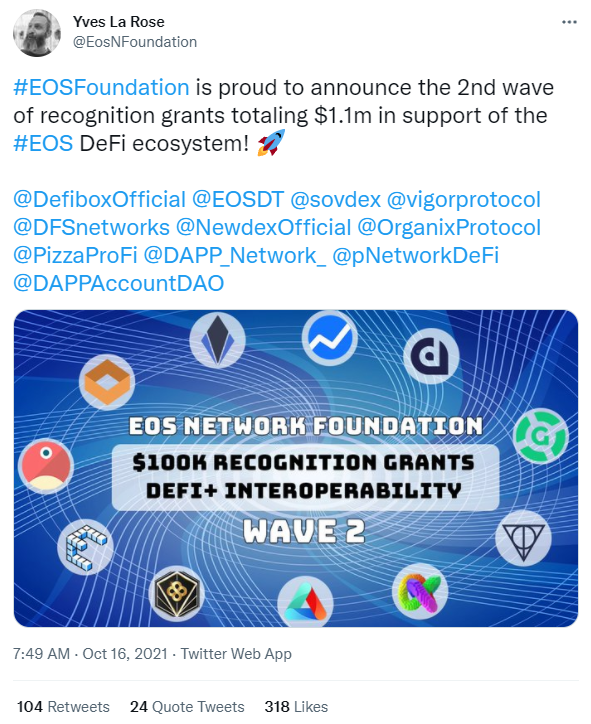
As I mentioned in my previous post, ENF will announce a new wave of recognition grant recipients every two weeks until all five batches of grants have been disclosed. The 11 projects in this batch are among the 34 previously announced, and the largest number of any group. DeFi is one of the most valuable use cases for blockchain, and supporting its development on EOS will be a top priority for the EOS Network Foundation.
Each of the funded projects below will receive a $100,000 grant in recognition of their persistence in building on EOS.
PIZZA:PIZZA is a decentralized financial network on EOS with a variety of DeFi-related products, including USDE stablecoins, swap aggregators, DEX, leveraged tokens, and their core decentralized lending products.
DefiBox:A professional one-stop DeFi application platform on EOS with a TVL of 120 million US dollars. Currently offering swaps, USN stablecoin generation, lending, lending, and DAO governance.
Vigor:Vigor is a decentralized lending protocol built by Vigor DAC.
Equilibrium:Built EOS's first USD-pegged currency utilizing underlying EOS and BTC collateral. One of the first DeFi products, using voter rewards to offset interest rates.
Defis network:A series of open source DeFi protocol AMM exchanges, algorithmic stable coins, synthetics, cross-chain pegs (ETH), mining pools
SOVDEX:An algorithmic DEX with trading, mining and CPU atomic swaps. The SOV team has also developed the first variable rate self-deflation token on EOS.
eCurve:An exchange liquidity pool on EOS, modeled after Ethereum's Curve. It is designed to be extremely efficient and low-risk for stablecoin transactions, providing supplemental fee income for liquidity providers.
Newdex:One of the original and most popular DEXs on EOS. It features a hybrid order book that aggregates limit order matching with AMM swap pools to maximize liquidity depth.
DAPP network:DAPP Network is a general-purpose bridging framework and set of middleware services that help scale decentralized applications and enable interoperability between EOSIO and EVM-based blockchains.
pNetwork:Creator of pToken, which is pegged 1:1 to assets on 10+ blockchains including EOS. The pToken bridge enables assets like pETH and pBTC to be transferred from their native chain to EOS, where it can be used in DeFi.
Organix:Synthetic asset issuance and trading protocol on EOS.
As we address some of our own bottlenecks above, as well as improvements to user onboarding, I have no doubt that EOS will be able to become the market leader in DeFi. Thanks to these projects for sticking to the EOS ecology and making certain achievements. In the future, the EOS Foundation will announce more funded high-quality projects to promote the rapid development of the EOS ecosystem