

Dialogue with Sirius Finance, a cross-chain stablecoin exchange hub on Astar

The Astar ecosystem is developing at an alarming rate.
In order to make it easier for friends who missed the live broadcast to watch Ryan’s wonderful sharing, Odaily specially compiled the transcript of last night’s AMA, as follows:
In order to make it easier for friends who missed the live broadcast to watch Ryan’s wonderful sharing, Odaily specially compiled the transcript of last night’s AMA, as follows:
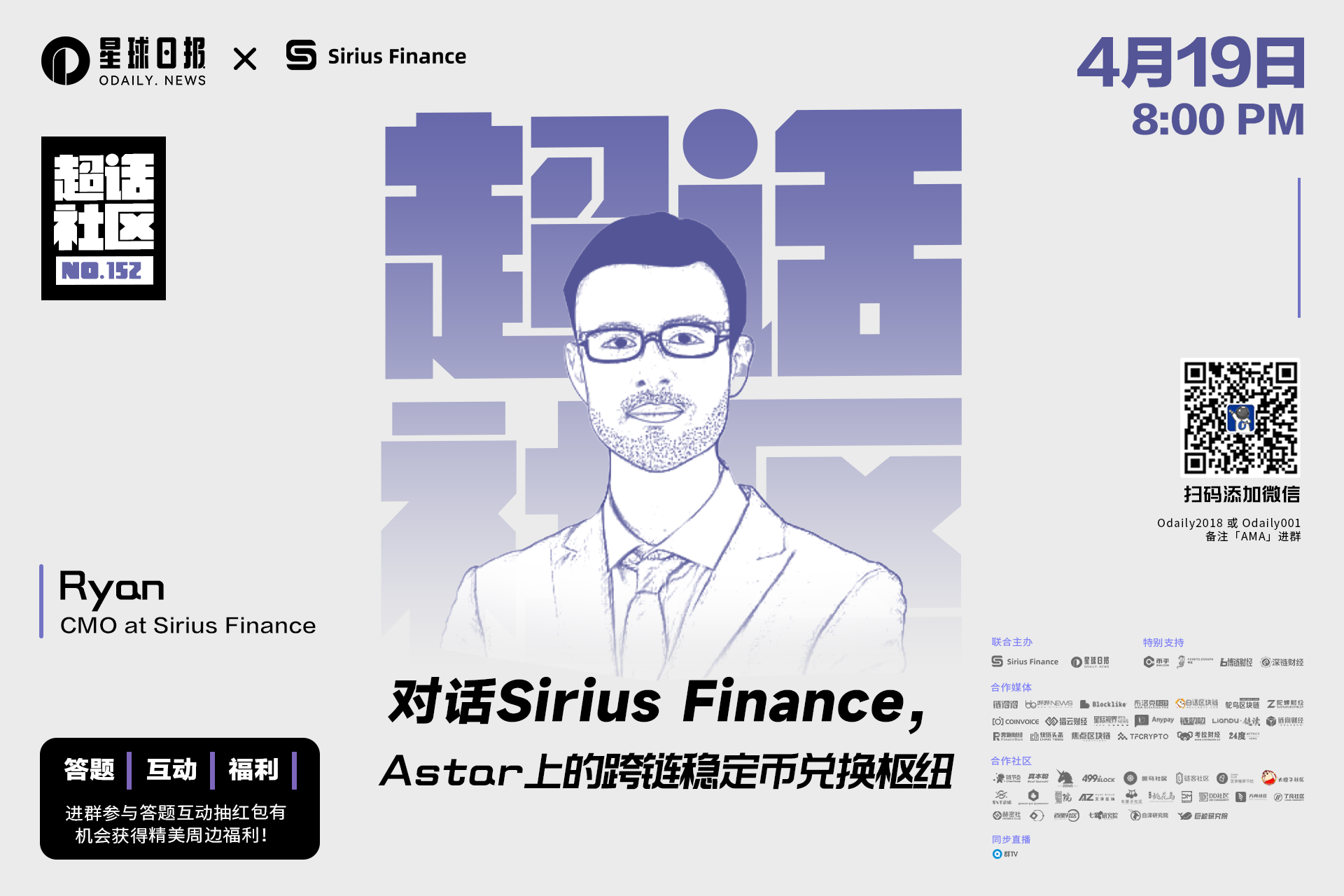
Q1: Please give a brief introduction to the basic situation of SiriusFinance.
A1: Hello everyone, I am Ryan, the CMO of Sirius Finance. Sirius has a team of 15 people, including developers, project managers, marketers, and experts in blockchain and smart contracts. Our development team is composed of a group of blockchain developers with rich experience in the DeFi field. They are proficient in various DeFi application types, such as AMM, LP income farming, and IDO launchpad.
Sirius Finance takes its name from "Sirius", the brightest star in the universe. Sirius Finance is a cross-chain stablecoin AMM DEX, which aims to attract and lock huge value through stablecoins, provide liquidity providers with low slippage transactions and attractive APY, thereby improving the overall profitability of the Astar ecosystem, and Bring more financial innovation. Ultimately, our goal is to serve as a low-slippage stablecoin exchange protocol that connects Polkadot, EVM-compatible chains, and other major Layer 1 blockchains.
Q2: When it comes to the DEX protocol focusing on the stablecoin field, it is hard not to think of Curve, the current giant project on the track. Compared with Curve, what innovations does Sirius Finance have?
A2: The most critical difference is Astar's cross-chain vision. If all goes well, all Dapps connected to Astar will be able to use Sirius' liquidity pool, just like other DeFi protocols use Curve's pool. Although Curve has been deployed to many new ecosystems with lower gas fees, the vast majority of Dapps that have built connections with it are on Ethereum, and we all know that Ethereum still has some bottlenecks in terms of gas fees. For Sirius, we will not only connect to Dapps on Astar, but also connect to most Dapps in the entire Polkadot ecosystem, thereby increasing the scale of users and liquidity.
Sirius is not Curve, and we will learn from its successful experience in many ways, but now it is time for the native protocol of the Polkadot ecosystem to connect to all Dapps on parachains. To promote the development of an ecosystem, deep liquidity is essential. Most of Curve’s liquidity is on Ethereum, where there will always be high gas prices. What we want to do is to create Something simple but practical, something that will make little people feel valued, something that doesn't exist yet but is very urgent for Astar and the entire Polkadot ecosystem.
Q3. Why did Sirius Finance choose to develop based on Astar instead of other ecology such as Ethereum?
A3: We chose Astar because we think it is the most suitable. Astar not only has native cross-chain attributes, but also has the ambition to become the hub of the entire Polkadot Dapps. This enables Sirius Finance to support various stablecoins, not only on Astar, but also on Polkadot and even other chains, thereby expanding the liquidity scale and increasing exchange options for users. Supporting more classes of stablecoins will also further decentralize Sirius Finance as we can have multiple liquidity pools competing for a higher APY.
Then, the Astar ecosystem is developing rapidly, and a large number of native DeFi projects are emerging, such as algorithmic stablecoins, lending, income aggregators, etc., which is in stark contrast to the development of other parachains. These native protocols will work closely with Sirius Finance to improve the yield of liquidity providers and provide more liquidity options.
Q4: Sirius Finance just launched the main network on April 16. So far, how is the data performance?
A4: Great progress. We hit the ATH TVL milestone of over $18M in the first 24 hours. The current APR is as high as 79.69%, and the TVL is $17,629,411, and it is still growing.
Q5: Security issues have always been one of the biggest challenges in the DeFi industry. Does Sirius Finance have plans to entrust a third-party security agency to conduct an audit?
A5: We have completed Peckshield's contract audit, and we are also having SlowMist audit our code.
Q6: Let’s talk about tokens. What is Sirius Finance’s native token? What role will the token play within the overall protocol?
A6: The native token of Sirius Finance is SRS. The SRS plays a key role in the governance of the protocol. Users are required to vote on protocol changes and other protocol-related parameters. SRS can be locked to get veSRS for governance and get additional rewards.
Q7: As far as we know, SRS will also adopt the governance model of veToken. Can you briefly introduce its governance mechanism for us?
A7: veToken is a token model. SRS holders can choose to lock their SRS in exchange for veSRS, so as to participate in the governance of Sirius Finance. According to the lock-up time, the ve SRS that a single SRS can exchange The amount will also vary, with a longer lockup period rewarding more veSRS. Sirius Finance allows all users to benefit from the protocol through veToken and other incentive mechanisms, and also encourages all users to truly participate in protocol governance and manage Sirius Finance in a decentralized manner, thus providing high-quality stable currency exchange for the Astar ecosystem Serve.
Users can also earn more veSRS through the lockup form of veToken. Holders of veSRS also share additional transaction fees and can vote on parameters of various liquidity pools, including pool weights, adding/removing pools, revenue growth management, fee management, airdrop token priority, and more.
Q8: How can I get SRS? Are there plans for an IDO?
A8: We do plan to list SRS on major DEXs and CEXs, but it will depend on market conditions and when we can achieve a relatively high TVL. We expect to conduct an IDO at the end of May and list our native tokens on exchanges around June.
Regarding CEXs listing, we are negotiating with Kucoin, OKX and Gate. Regarding the IDO platform, we are also negotiating with PolkaStarter and ArthSwap.
Q9: I saw this sentence in the official document - "Sirius Finance will expand from stablecoins to other similar valuable tokens", which means that Sirius Finance will also expand to the field of non-stablecoins in the long-term plan ?
A9: Yes, a large number of mainstream currencies, BTC/ETH/DOT/ASTR/ACA may become our targets, and these resolutions will be decided by our DAO voting.
Q10: The last question, it has been a while since the last round of DeFi broke out. As a late-developing project, how does Sirius Finance view the current development of DeFi? In the foreseeable future, how long before we see the next large-scale outbreak?
A10: Sirius focuses on the coming Web3.0 era. The bull-bear cycle at the financial market level has its own market rules. We don't care much about when there will be a big outbreak. Regardless of bulls or bears, we will focus on products and services. In our constant attempts, we will provide valuable services to DeFi users and contribute to the infrastructure construction of Web3.0. As the basic construction part of the new DeFi public chain, we insist on focusing on the innovation and development of our own products.