

Read the SBT that V God really conceived in one article

Compilation of the original text: Bai Ze Research Institute
Compilation of the original text: Bai Ze Research Institute
Soulbound Token (SBT) is the brainchild of Ethereum founder Vitalik Buterin. This exciting technology is set to shake up the Web3 world and has already caught the attention of the crypto community.
In this article, we'll explore SBTs, from their origin story to their game-changing Web3 game. We will also share about how they work, why they are beneficial and what applications do they have in Web3?
What are SBTs?
Soulbound Token, also known as "Soulbound Token", is a unique, non-transferable and non-financial token that represents an individual's online identity, reputation and affiliation.
Like resumes or medical records, SBTs are used to demonstrate a person's seniority and affiliation on the Web3 network. These tokens cannot be sold or traded and serve only as a permanent record of an individual's digital identity.
Decentralized Social Credit System - This has been a hot topic among Web3 enthusiasts. The government’s credit-scoring system, which may send shudders to privacy advocates, and SBTs are like night and day, one top-down and one bottom-up.
SBT lets you control your identity and reputation while still forming trusted communities and collaborations.
Vitalik, the "brains" behind SBT, put it best:
"Creating SBTs in the crypto industry could be a route to an alternative where NFTs can represent more of who you are than just something you can afford as something to show off .”
Where did SBT come from?
So, let's dig into the history of SBTs and see how they've come a long way.
It all started in May 2022 when the "brains" behind the idea, economist and sociotechnical expert E. Glen Weyl, lawyer Puja Ohlhaver, and Ethereum co-founder Vitalik Buterin, came together to propose The concept of Soulbound Token.
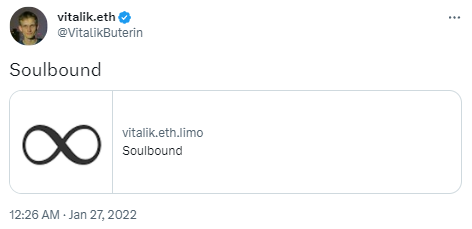
They envision SBT as a fundamental building block in Web3 and DeSoc (Decentralized Society).
DeSoc, or Decentralized Society, is a bottom-up community that aims to push Web3 towards hyper-financialization and create a more inclusive, democratic and decentralized social system. The non-transferable SBT is held by the "soul" (that is, the account) as a way to better quantify the social relationship network in Web3. The social relationship measurement based on the SBT token system can further create DeSoc.
So why is SBT gaining popularity in the Web3 space? It all comes down to its unique strengths and potential for a more inclusive, democratic and decentralized future.
How does SBT work?
A defining feature of SBTs is their non-transferable nature. Unlike other token standards such as current ERC-20 and ERC-721, SBT has no monetary value and therefore cannot be bought, sold or transferred to another wallet. This is because it is linked to everyone's soul "Soul". Souls is an account for users to store SBT. Therefore, SBT is also a decentralized identity system.
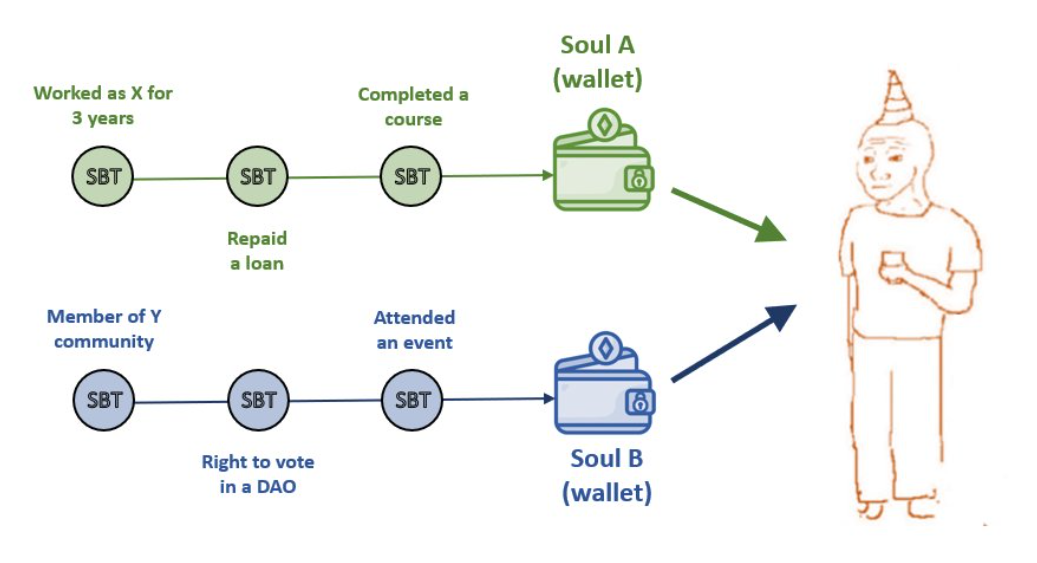
It should be noted that in DeSoc, a person may have multiple souls, which are used for different purposes.
Let's take a Decentralized Autonomous Organization (DAO) voting system as an example and take a closer look at how SBT works in the Web3 ecosystem. Typically, DAOs distribute voting power based on the number of tokens held by members. However, a DAO using SBT may place more emphasis on the reputation of members, which can be verified by their interactions within the community, than the amount of tokens they own.
Why do we need SBT?
Have you ever wondered why the Web3 ecosystem mainly focuses on financial objects such as tokens? It’s as if all we have is a bunch of wallets full of assets that can be transferred and sold, just a financial holding account.
This is where SBT comes in. They are not just a financial object, they are a general social aggregation system representing you and your relationship, each SBT token is a measure of social attributes. However, unlike top-down social credit systems, SBT is built bottom-up by the community and self-governed by users. You can have multiple souls, representing different aspects of your life.
Imagine that your health record could be a soul, accessible only to doctors. Your career can be a soul, like your resume.
Let's take a deeper look at the benefits they can provide:
Reduce reliance on centralized services: SBT can empower individuals and organizations to control their identities and reputations. With SBT, there is no need to rely on centralized identity services that can be compromised, censored or hacked.
Authenticity: SBT allows for verifiable and tamper-resistant records of information, such as certificates and achievements. This helps remove trust in central authorities and reduces fraud. Additionally, with decentralized identity verification, individuals and organizations will be able to access and share their records instantly.
Enhanced Trust: The decentralized nature of SBT allows individuals and organizations to interact and transact with each other without having to worry about trust issues. SBT helps build a reputation in a transparent and tamper-proof manner, leading to a more trustworthy and secure DeSoc.
Increased accountability and transparency: The public and immutable nature of SBT allows for increased accountability and transparency in online transactions and interactions. This can have a positive impact on the reputation and image of individuals, organizations and companies alike, helping to build trust and credibility with stakeholders.
Personalized Identity Management: SBT can provide individuals with control over their identity and reputation. By creating multiple souls, individuals can have different digital identities for different aspects of their lives, such as their personal life, professional life, and health status.
Use Cases for SBT
When it comes to practical applications of SBT, the possibilities are endless. Let's dig into some use cases that demonstrate the potential of SBT:
Verify Exclusive Membership
Want to join a decentralized community? SBT can be used to verify exclusive memberships, ensuring only the most deserving get in. For example, a high-end digital club could use SBT to grant access to members with specific reputations or skills. This will allow clubs to maintain their exclusivity while still taking advantage of a decentralized network.
decentralized lending
Imagine getting a loan from a decentralized DeFi platform without a middleman like a bank. SBT can be used to obtain loans based on a person's reputation, not just their credit score. This opens up new opportunities for those who might have been rejected for traditional loans due to lack of credit history. And, on the other hand, investors can use SBT to identify trustworthy borrowers and lend with confidence.
Storing verifiable credentials in Web3
Want to keep your professional credentials in a safe place? SBT can be used to store and verify professional skills such as certificates, licenses, and degrees. This will allow individuals to control their data, while also making it easy to demonstrate their skills and qualifications to potential employers or clients.
proof of skills
In a world where remote work is the norm, being able to demonstrate your skills and experience to potential employers is more important than ever. SBTs can be used to provide evidence of professional skills, allowing individuals to demonstrate their expertise and differentiate themselves from the competition. For example, freelancers might use SBT to showcase their work experience, making it easier to land new positions.
These are just a few examples of how SBT is used in the real world, but the possibilities are endless. As we continue to push the boundaries of the Web3 ecosystem, it's exciting to consider all the innovative ways SBT might be used in the future.
Current status of SBT development
SBT development is well underway, with some of the biggest names in the crypto industry joining in. Metamask, Cobo, and Gnosis DAO have teamed up to develop an SBT called "Evolution," where users can create digital identities for themselves as the credentials needed to verify their identities in the digital realm or metaverse.
Binance, one of the largest cryptocurrency exchanges in the world, launched the Binance Account Bound (BAB) token, their interpretation of the SBT concept, and as a Binance customer who wants to use a decentralized wallet but still use KYC to trade unique identity.
Even communities like Alchemy, Buildspace, Learn Web3 DAO, and Moralis have adopted SBT, launching Proofs of Knowledge (PoK) to recognize certificates of skill a person has earned by completing a project or course.
Challenges for SBTs
How to find your own "soul"?
When it comes to SBT, one of the biggest questions is how to get back lost souls (accounts). The trio of Vitalik Buterin, Glen Weyl and Puja Ohlhaver have proposed some possible solutions, but they still need to be tested.
One solution is a social recovery model, where SBT community members need to give the "green light" to recover a lost person's private key. But let's face it, life is unpredictable and relationships can be changed. It is a risky game to entrust your soul to a group of people who may not follow through.
Another idea is to choose a group of "guardians" to hold the keys to your account. But what if you lose touch with one of the Guardians, or if things turn sour between the two of you? Entrusting your soul to a group of people who may not be able to stand up for you, even with the best of intentions, is a terrible thought.
reputation system
reputation system
According to the "Notice on Further Preventing and Dealing with the Risk of Hype in Virtual Currency Transactions" issued by the central bank and other departments, the content of this article is only for information sharing, and does not promote or endorse any operation and investment behavior. Participate in any illegal financial practice.
risk warning:
According to the "Notice on Further Preventing and Dealing with the Risk of Hype in Virtual Currency Transactions" issued by the central bank and other departments, the content of this article is only for information sharing, and does not promote or endorse any operation and investment behavior. Participate in any illegal financial practice.