

Dialogue with Avalanche: In the L2 era, where is the future of Avalanche?

Compilation of the original text: Bai Ze Research Institute
Compilation of the original text: Bai Ze Research Institute
As you know, L2 solutions are designed to scale the Ethereum network with fast transactions and cheaper gas fees. However, this is exactly why the nascent L1 was launched a few years ago, when high gas fees made it too expensive to use dApps on the Ethereum mainnet.
But with L2s growing, what's the point of having L1s? Will they fade away, or will they still provide something that Ethereum L2 cannot?
In this article, you'll get answers from Avalanche's perspective. I am delighted that Luigi, Head of DeFi/DevRel at Avalanche, accepted my interview.
Other issues covered in this article include:
Has Ethereum won the L1 battle?
What is the role of the Avalanche C chain?
Why does Avalanche have 3 chains in mainnet?
What is the role of subnets?
Looking to the future of Avalanche
In the era of L2, what is the significance of L1, especially the Avalanche C chain? I interviewed Sanket (Polygon) before, he thinks that Ethereum has won the L1 battle, do you agree with this view?
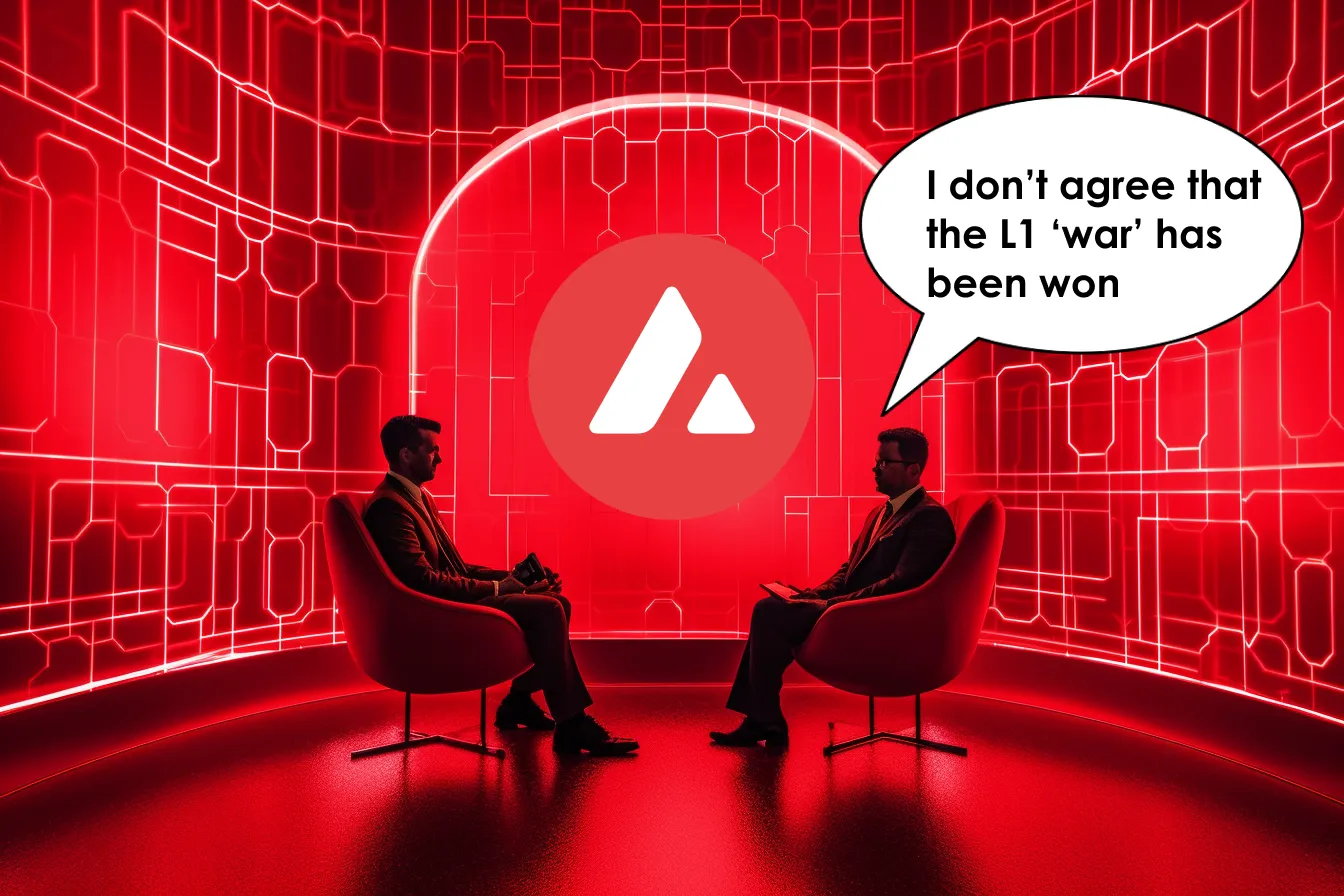
I disagree that Ethereum has won the L1 battle, especially when there are so few on-chain assets and real use cases. Moreover, a blockchain world dominated by only one L1 does not reflect the full benefits of decentralization.
If all activities in the future blockchain world are carried out on Ethereum L2s or even L3s, and all settlements are made to Ethereum, then users and developers will face a great risk of centralization. Because, any bug/attack on Ethereum L1 will affect all L2s and L3s systems and assets.
Therefore, providing multiple L1s with different attributes as options for developers and users can make the entire industry more fault-tolerant, lower risk of centralization, and also enable new competition and innovation at the L1 level.
The value proposition of the Avalanche C-chain is different from other systems, which I will explain in a later question.
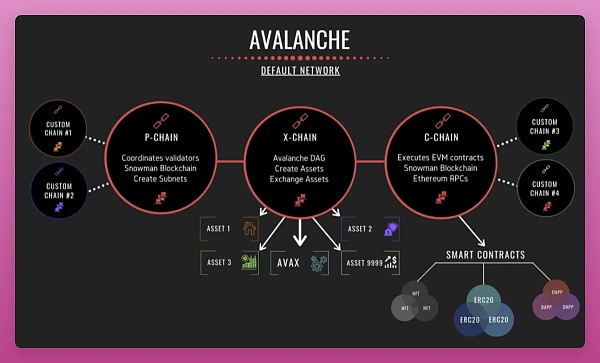
Avalanche consists of a main network composed of X chain, P chain and C chain, and subnets. C-Chain has by far the highest adoption rate in DeFi and NFT. Why is the structure of the main network three chains? Why not just focus on one solution, what are the main differences between the three chains?
The mainnet can be thought of as a "special subnet" because validators of the mainnet can then validate the subnet. Architecturally, this is somewhere between Cosmos and Polkadot. The main differences between the three chains are as follows:
C chain - an EVM compatible chain dedicated to smart contracts, allowing developers to quickly complete the deployment of smart contracts
P chain - responsible for coordinating validators, creating subnetworks
X Chain - responsible for creating, managing and trading digital assets for sending and receiving funds
Avalanche addresses scalability, security, and decentralization through its modular design. Subnets are a central part of this. What is the vision for the subnet? What is their role in the L2s era?
The vision of subnets is to allow anyone to build their own blockchain, and it can be customized in many ways, for example, they can have different virtual machines (WASM, MOVE, EVM, etc.), with different rules. Even in terms of compliance, the verifier must pass the KYC check, or hold a certain license.
In my opinion, the future development of Web3 is not only on the public blockchain. As we have seen with TSM, Dexalot, dYdX, etc., many developers will want their own Lisk.
In addition, subnets can also isolate performance. For example, we create a subnet called "Pikachu", which is a Pikachu-themed game where you can train your own Pikachu NFT, which will grow, level up, and eventually interact with Other players fight. The more you play, the more bonus tokens you earn. Now, let's assume that this subnet attracts 10% of the Pokemon users, or about 10 million people, to the game. Then this game is not suitable for deployment on Ethereum, Polygon, Avalanche C chain, Solana, because the player does not want to give up his NFT due to higher Gas fees and slower confirmation times. Hence, the Pikachu subnet, created for isolation performance.
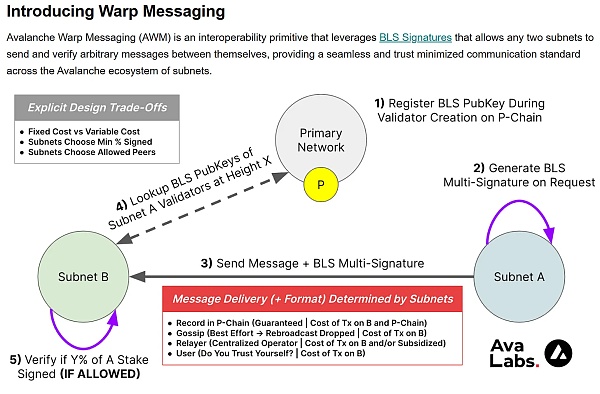
All in all, Avalanche's subnet will be a "universe" composed of many blockchains, all of which can communicate with each other locally through Avalanche Warp Messaging. (Avalanche Warp Messaging is Avalanche's subnet communication protocol, referred to as AWM, allowing any message to be sent and verified between any two subnets)
What is the ultimate goal of Avalanche? How to compete with Ethereum and other L1s?
The ultimate goal of Avalanche is to become an infrastructure on which anyone can seamlessly build blockchains.
And in terms of competition with Ethereum and other L1s, I think that's the wrong mindset. Because we were building something different than them, the market obviously took notice.
We now have subnets from SK Planet, TSM, Bowlero, Gunzilla, and many more enterprises and institutions that require enterprise-grade infrastructure.
We also have many native subnets such as Dexalot, Hubble, and Defi kingdoms.
As it stands, Ethereum is not close to native communication between L2s, which I believe will lead to developer tradeoffs and may not be suitable for some developer purposes.
Why would a dApp choose to build a subnet on Avalanche instead of L2, or even Arbitrum's upcoming L3?
L3 and L2 lack composability. Their goal is to eventually use a shared sorter, but this is not suitable for many use cases as there are many entities that want to run their own sorter or validator.
There's no reason why you can't deploy L2 as an Avalanche subnet, have the validators run the sequencers, and immediately be able to communicate with other subnets using AWM. In my opinion, this is actually a cleaner design. You build a subnet because it's customizable, has a built-in inter-subnet communication protocol, and is more tested.
At Avalanche, we pursue the goal of making Lisk deployment as easy as possible.
AvaCloud is a new product from Ava Labs that facilitates no-code deployment of application chains that developers can bring to market faster, cheaper and with less risk.
Do you have any vision for the future of Avalanche C chain?
The C-chain is the liquidity hub of Avalanche. During the DeFi boom, the TVL once reached 12 billion US dollars.
As the subnet grows, all native assets, DApps, etc. on the C chain will be fully utilized through AWM.
According to the "Notice on Further Preventing and Dealing with the Risk of Hype in Virtual Currency Transactions" issued by the central bank and other departments, the content of this article is only for information sharing, and does not promote or endorse any operation and investment behavior. Participate in any illegal financial practice.
risk warning:
According to the "Notice on Further Preventing and Dealing with the Risk of Hype in Virtual Currency Transactions" issued by the central bank and other departments, the content of this article is only for information sharing, and does not promote or endorse any operation and investment behavior. Participate in any illegal financial practice.