


11 Votes Short: CLARITY Act Fails Key Senate Vote—Can the Bitcoin Regulatory Tailwind Still Materialize?

The US crypto market waited a long time for a regulatory bill, only to see it fall at the final procedural hurdle in the Senate.
On September 15, the US Senate failed to advance the Digital Asset Market Structure Clarification Act in a procedural motion, with 49 votes in favor and 50 against. The bill needed at least 60 votes to move to the next stage, falling 11 votes short of the threshold.
After the news broke, market data from BiyaPay, a global one-stop asset allocation platform, showed that Bitcoin briefly fell below $76,000, with crypto-related stocks weakening in tandem. The regulatory catalyst the market had been anticipating failed to materialize, and short-term capital began reassessing the policy premium on crypto assets.
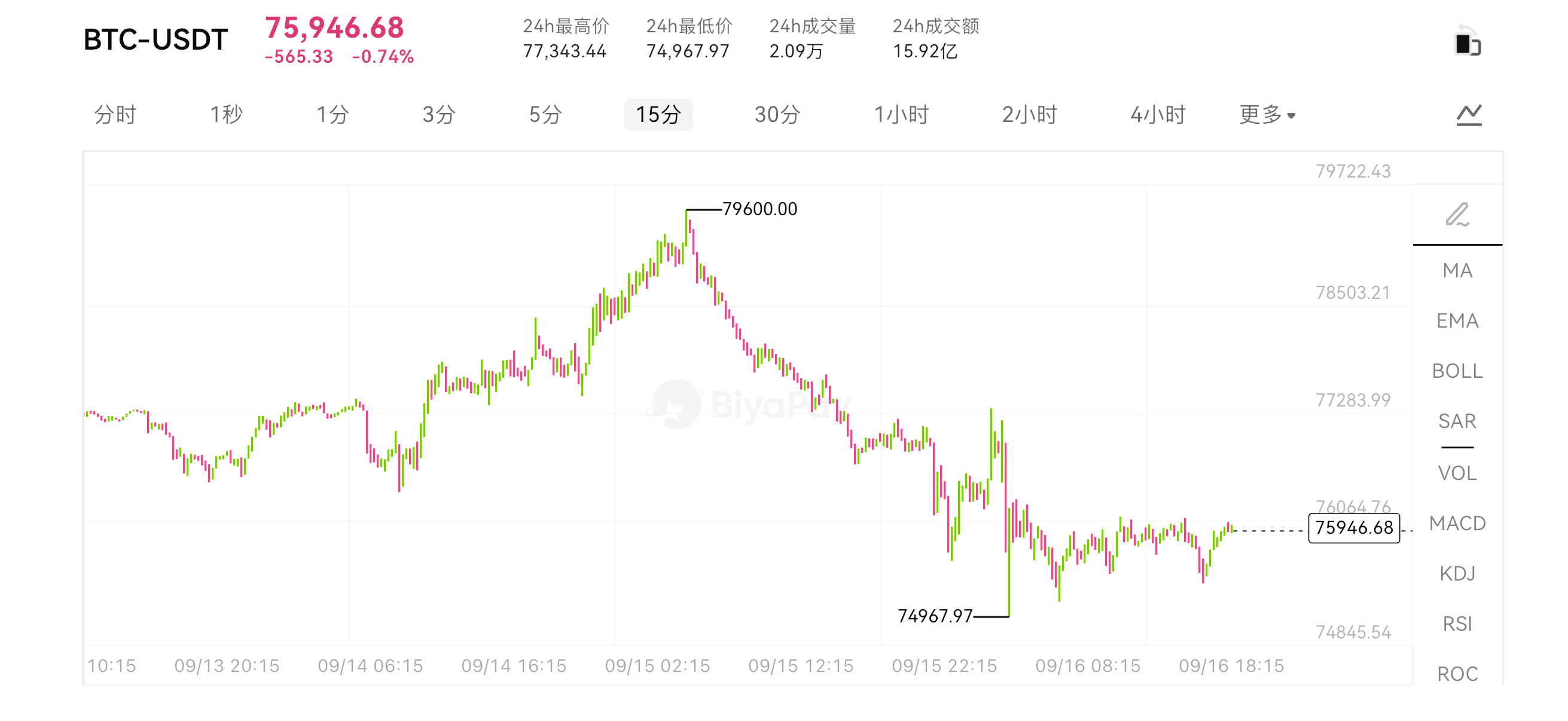
However, one concept needs to be clarified first. This vote was not a formal vote on the final text of the bill, nor does it mean the CLARITY Act has been permanently terminated in a legal sense. More precisely, the current version failed to secure enough procedural support, and the difficulty of advancing the bill in the short term has clearly increased.
From a Landslide House Passage to an 11-Vote Shortfall in the Senate
The full name of the CLARITY Act is the Digital Asset Market Structure Clarification Act, and its core goal is to establish a clearer regulatory framework for the US digital asset market.
In July 2025, the bill passed the US House of Representatives by 294 votes to 134, securing a degree of bipartisan support. In May 2026, the Senate Banking Committee passed the related text by 15 votes to 9, and the bill was once considered close to entering full Senate consideration.
But committee approval does not mean it can ultimately secure enough support in the Senate.
A full Senate vote requires 60 votes to advance. The final result was 49 in favor and 50 against, with some Republican senators also voting no. The bill was not blocked at the committee stage; rather, it lost the conditions to move forward in the full Senate procedural vote.
This is also why the market reaction was so strong. Previously, trading platforms, crypto companies, and some investors had treated "a regulatory framework about to land" as an important expectation. Now that the expectation has fallen through, prices naturally reflect the rise in policy uncertainty first.

Where the Bill Is Actually Stuck
On the surface, the CLARITY Act is about how the US Securities and Exchange Commission and the Commodity Futures Trading Commission should divide regulatory authority, which digital assets are securities, and which digital assets should be regulated as commodities.
But what truly blocked negotiations is not just the division of authority between regulators. At least two other categories of disputes remain unresolved.
The first category concerns political ethics.
Some Democratic lawmakers believe the bill does not sufficiently restrict potential conflicts of interest arising from the president and his family's involvement in crypto businesses. They demanded stricter ethics provisions to prevent public officials from using policy influence to profit from related digital asset projects.
Republicans had added new restrictions before the vote, including constraints on public officials holding or participating in related crypto businesses, but Democrats considered the existing arrangements still insufficient. The two sides failed to reach agreement at the last moment, causing negotiations that had already been very close to fall back into deadlock.
The second category concerns stablecoin yields and bank deposits.
US banking groups worry that if trading platforms or digital wallets can offer users rewards based on stablecoin balances and holding periods, such products could functionally resemble bank deposit interest. If users move funds from traditional banks to stablecoin platforms, the deposit sources and lending capacity of community banks could be affected.
Institutions including the American Bankers Association, the Independent Community Bankers of America, and multiple state bankers associations have all called for further tightening of the relevant provisions. They worry that stablecoin reward mechanisms will create a path to attract funds that bypasses traditional bank regulation.
This is also why the bill is difficult to pass quickly. It involves not only the digital asset industry, but also bank deposits, consumer protection, financial stability, and political issues such as the president's family's conflicts of interest.
What It Means for Bitcoin and the Crypto Market
First, it is necessary to clarify what has not changed.
Spot Bitcoin ETFs can still operate normally, and the stablecoin regulatory framework that has already been implemented will not automatically become invalid because the CLARITY Act was procedurally blocked. The operating mechanism of the Bitcoin network itself will not change because a US market structure bill did not advance.
What has truly changed is the institutional expectation for the coming years.
If the CLARITY Act had passed, trading platforms could expect a clearer regulatory path, and some digital assets could receive clearer regulatory classifications based on maturity, function, and degree of decentralization. Exchange token listings, institutional participation in the digital asset market, and decentralized protocols conducting business could all gain more stable legal expectations.
But after the bill was blocked, these arrangements have not yet become law. Trading platforms still need to grapple with issues such as token classification, securities status, and state-level regulation. For institutions, unclear regulatory boundaries mean legal costs and business risks still need to be assessed separately.
This is also why the share prices of trading platforms and crypto financial companies usually react more sharply than Bitcoin itself. Their valuations are related not only to the BTC price, but also directly to trading volume, asset listings, custody business, and the regulatory environment.
When observing this kind of policy-driven market, I use BiyaPay to simultaneously check price changes in BTC, ETH, and assets such as US and Hong Kong stocks, then combine that with US Treasury yields, the dollar, and Federal Reserve policy to judge what the market is trading. The platform covers multiple asset scenarios including digital assets, US stocks, Hong Kong stocks, and fiat currency exchange, enabling real-time trading of US stocks, Hong Kong stocks, BTC, ETH, and other digital currencies. At this stage, putting different markets into the same observation framework makes it easier to distinguish between regulatory expectation shocks and changes in macroeconomic liquidity.
Why the BTC Drop Cannot Be Blamed on the Bill Alone
The failure of the CLARITY Act's procedural vote was indeed an important trigger for Bitcoin's decline, but it was not the whole reason.
During the same period, the 10-year US Treasury yield briefly broke above 5%, the Federal Reserve's September meeting was approaching, and market expectations for rate hikes were heating up. High interest rates, a strong dollar, and declining risk appetite were themselves pressuring digital assets.
In such an environment, policy headwinds and macroeconomic pressure amplify each other. When regulatory expectations fall through, short-term capital reduces risk exposure; when US Treasury yields rise, the market's capacity to absorb highly volatile assets declines.
Therefore, this adjustment can be understood as the overlap of two lines. At the policy level, the market withdrew part of its regulatory optimism; at the macroeconomic level, the liquidity environment is tightening. The former affects sentiment, while the latter affects valuations and funding capacity.
If the Federal Reserve subsequently sends stronger hawkish signals, even if the CLARITY Act re-enters negotiations, Bitcoin may not immediately resume its rise. Conversely, if interest rate pressure eases and regulatory negotiations restart, policy expectations may once again strengthen their support for the market.
Will the Bill Be Revived
From a legal procedural perspective, the CLARITY Act has not completely disappeared, but the difficulty of reviving it in the short term has clearly increased.
The US Congress is about to enter the recess period before the midterm elections, and both the Senate and the House need to face election arrangements. To negotiate a text before the end of the year that satisfies both parties, the banking industry, and the crypto industry at the same time, time is not generous.
In addition, the crypto industry has continued to increase its political lobbying efforts over the past few years. Fairshake and its affiliated political organizations have raised more than $100 million in the 2026 election cycle and retained a relatively large cash position. After the midterm elections, congressional seats and committee composition may change, and crypto regulatory legislation may once again become a negotiating topic.
But whether the next version will still be called the CLARITY Act, whether it will retain the existing regulatory classifications, and how it will handle stablecoin rewards and political ethics all remain uncertain.
So what the market should focus on now is not "whether the bill is completely dead," but whether the United States can form a continuous digital asset regulatory framework.
Rules Can Wait, but Markets Do Not Pause
This vote result shows that digital asset regulation has entered a more complex stage of political bargaining.
Crypto companies want clear rules as soon as possible, traditional banks worry that stablecoins will divert deposits, Democrats demand stronger consumer protection and ethics constraints, and Republicans want to promote the United States as a digital asset hub. With different interest demands stacked together, the bill's advancement naturally will not be as smooth as the market previously expected.
For Bitcoin, regulatory upside still exists, but the timeline for realizing it has been delayed. In the short term, prices still face the combined influence of Federal Reserve policy, dollar liquidity, ETF flows, and market positioning.
Three signals are worth watching going forward. First, whether BTC can gradually stabilize amid the policy disappointment and high interest rate environment. Second, whether trading platforms, miners, and crypto-related stocks can stop falling. Finally, whether the Senate restarts bipartisan negotiations and makes substantive changes to the ethics and stablecoin provisions.
The CLARITY Act's failure to pass the key procedural vote means the regulatory catalyst the crypto market was hoping for has temporarily gone out. But this does not mean the United States will abandon digital asset regulation, nor does it mean Bitcoin's long-term logic has been invalidated.
The real test is whether policy can move from political slogans to stable, clear, and enforceable institutional arrangements.