


BiyaPay Market Watch: BCH Surges, UNI Breaks Above $10 — Is the Altcoin Rally Back?

Bitcoin moved first, and altcoins followed.
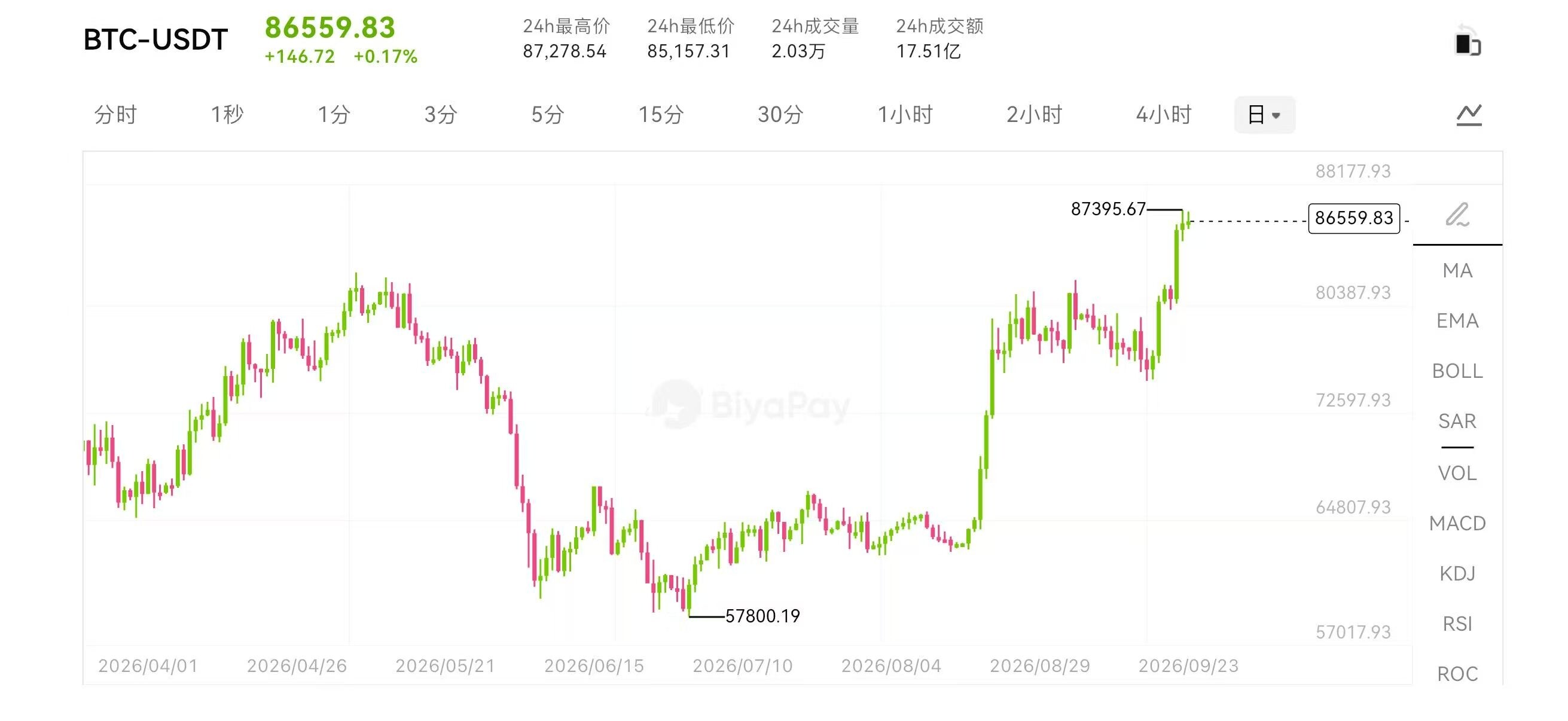
According to market data from BiyaPay, a global one-stop asset allocation platform, Bitcoin briefly broke above $87,000 on September 21, hitting a new high since late January this year. Subsequently, capital began to spread toward assets with higher beta, with BCH posting notably amplified gains and UNI returning to around the $10 level. On September 22, CME announced plans to launch Bitcoin Cash (BCH) and Uniswap (UNI) futures contracts on October 19, though the final listing still requires regulatory review.
With several factors overlapping, BCH and UNI quickly became the market's focal point. The question then arises: why were both tokens sought after by capital at the same time? Does this signal a restart of the altcoin rally, or is it merely a short-term spillover driven by BTC's breakout, derivatives news, and short covering?
What signal is CME sending to the market?
What CME plans to launch this time are not spot products, but standard futures and Micro futures. Among them, the BCH standard contract corresponds to 250 BCH, and the Micro contract corresponds to 25; the UNI standard contract corresponds to 10,000 UNI, and the Micro contract corresponds to 1,000. CME stated that these products are primarily intended for price discovery, risk management, and providing market participants with a richer set of institutional-grade trading tools.
This means that what the market is really trading is not "how much BCH or UNI CME will buy," but rather that these two assets are entering a more standardized derivatives trading system. Futures allow institutions to participate through hedging, directional trading, and cross-market arbitrage, but they do not automatically bring an equivalent amount of spot buying.
From this perspective, CME's move is more like adding a new channel for trading and risk management to the market. In the past, institutional derivatives in the crypto market were mainly concentrated in assets such as BTC and ETH. Now, more highly liquid altcoins are beginning to enter this system, indicating that the ways institutions participate in the crypto market are still expanding.
But a boundary needs to be noted here: a planned launch does not equal an official listing, and a futures listing does not necessarily mean spot demand will increase. What is truly worth watching going forward is whether the contracts can launch on schedule, and the trading volume, open interest, and spot market performance after listing.
BCH's sharper rally this time is also related to its own market structure. Compared with BTC, BCH has a smaller market size and trading depth, so under the stimulus of major news, its price beta tends to be higher. After CME announced plans to launch BCH futures, the market refocused on the availability of institutional trading and risk management tools for the asset, and this expectation can easily be amplified in short-term price action.
But this does not mean that BCH's fundamentals have undergone a fundamental change in a short period of time. Whether this gain can be converted into a sustained trend still depends on the real participation after the contracts eventually launch, and whether the spot market can continue to absorb capital.
The logic for UNI is different. UNI is the governance token of the Uniswap ecosystem, and its price is affected not only by the overall crypto market but also by factors such as DeFi activity, on-chain liquidity, protocol development, and market expectations. CME's plan to launch UNI futures means the market has gained a more mature price risk management tool, and it has also raised market attention to UNI's institutional trading and liquidity.
However, futures products themselves will not directly change the fundamentals of the Uniswap protocol, nor will they automatically enhance UNI's governance value. Therefore, this UNI rally is better understood against the backdrop of two overlapping factors: on one hand, the news catalyst brought by CME's product, and on the other hand, the improvement in overall risk appetite after BTC's breakout.

After BTC's breakout, capital began searching for higher beta
If you look only at BCH and UNI, it is easy to interpret this rally as being driven by a single piece of news. In fact, before altcoins became active, BTC had already completed a clear round of gains.
On September 21, Bitcoin briefly broke above $87,000 in intraday trading, hitting a new high since late January this year. During the same period, U.S. spot Bitcoin ETF flows also improved significantly, with single-day net inflows reaching about $999 million on September 21, one of the largest single-day net inflows since October 2025.
Institutional capital also made new moves. Strategy disclosed that as of September 20, the company had purchased an additional 950 BTC, bringing its holdings to 846,000 BTC. Based on the announcement data, the purchase amount was approximately $75.7 million.
At the same time, BTC's rapid rise was accompanied by large-scale short liquidations. Relevant market statistics show that at the time, short liquidations in the crypto market approached $920 million, of which BTC short liquidations exceeded $550 million. Forced short covering creates additional buying, and when the market is already strong, it may further amplify the pace of gains.
As a result, this rally showed a relatively clear transmission path: BTC rose first, market risk appetite improved, capital began looking for assets with higher beta, and BCH and UNI happened to encounter the news catalyst of CME futures products, further amplifying their price reactions.
This is also why the recent gains in BCH and UNI cannot be fully understood as sudden major changes in the two projects themselves. Macro liquidity, BTC's trend, market positioning, and specific news are all jointly influencing prices.
Has the altcoin rally returned, or is this just a short-term spillover?
At present, this rally cannot simply be defined as a "full-scale return of altcoins."
More accurately, what we are seeing now is a sign of capital spreading toward high-beta assets after BTC's breakout, while the news that CME will launch BCH and UNI futures has further raised market attention. The combination of the two has made some altcoins post gains notably larger than BTC's.
What is truly worth watching next is not how much more BCH and UNI can rise, but whether prices can hold firm after the news热度 fades. If the gains are mainly driven by short-term leverage and sentiment, then once BTC weakens again, altcoins will usually see even greater volatility.
Whether the CME contracts can launch on schedule is also an important point to watch. The currently announced date is October 19, but it still needs to pass regulatory review. The real market impact will need to be verified after the products launch, through trading volume, open interest, and institutional participation.
Macro liquidity also cannot be ignored. The dollar, U.S. Treasury yields, U.S. spot Bitcoin ETF fund flows, and U.S. equity risk appetite will all affect the valuation environment of the entire crypto market. If liquidity tightens again, altcoins will usually be more prone to rapid drawdowns than BTC.
When observing this kind of cross-market行情, I check changes in BTC, ETH, as well as U.S. stocks, Hong Kong stocks, and fiat-related assets simultaneously through BiyaPay, and then combine ETF flows, interest rates, and risk appetite to find explanations. The platform uses USDT as its core funding entry point, connecting digital assets, U.S. and Hong Kong stocks, and fiat currency exchange through a single account. It also supports exchanging digital currencies such as BTC and USDT into fiat currencies like USD and HKD to bank accounts. Putting different markets under the same observation framework makes it easier to judge whether capital is continuing to spread toward high-beta assets, or whether this is just a short-term rotation after BTC's breakout.
Especially when Bitcoin, the dollar, U.S. Treasury yields, and tech stocks are fluctuating at the same time, looking at a single token in isolation can easily lead one to mistake macro liquidity changes for an independent trend in the project itself. The recent gains in BCH and UNI are a fairly typical example: there was both the news catalyst from CME derivatives products and the combined effects of BTC's breakout, short covering, and an overall improvement in risk appetite.
Final Thoughts
So, rather than rushing to judge that "the altcoin rally is back," it is better to first observe whether the capital spillover can continue.
If institutional trading channels such as CME gradually improve, BTC remains relatively strong, and spot capital is willing to continue spreading toward high-beta assets, then the altcoin market may gradually evolve from a rapid sentiment spillover into a more sustained market repricing. Conversely, if BTC weakens again, macro liquidity tightens, or trading volume drops significantly after the news catalyst ends, then this rally may also return to a BTC-led market structure.
From the current perspective, BCH and UNI look more like two representative samples in this round of market spillover. What they tell the market is that after BTC's rise, capital has begun searching again for trading opportunities with higher beta, and the institutional derivatives market is also gradually covering more altcoins.
As for whether this is a new full-scale altcoin rally, it still needs time and capital flows to verify.