

BiyaPay行情观察|Meta暴涨11%,Muse为何点燃市场?AI投入能否变成业绩?
The most talked-about stock over the past two days has undoubtedly been Meta.
Meta's AI personal assistant Muse, after launching on September 8, has surged to the top of the free app rankings on the US Apple App Store. Muse has accumulated approximately 2.5 million downloads, surpassing the related download performance of ChatGPT, Claude, and others on the Apple App Store.
Meanwhile, the market has also responded positively.
On September 21, according to market data from BiyaPay, a global one-stop asset allocation platform, Meta's stock price rose 11.34% in a single day, closing at $741.25, marking its most notable single-day gain in nearly a year. On September 22, the stock price fell 0.63%, closing at $736.60.
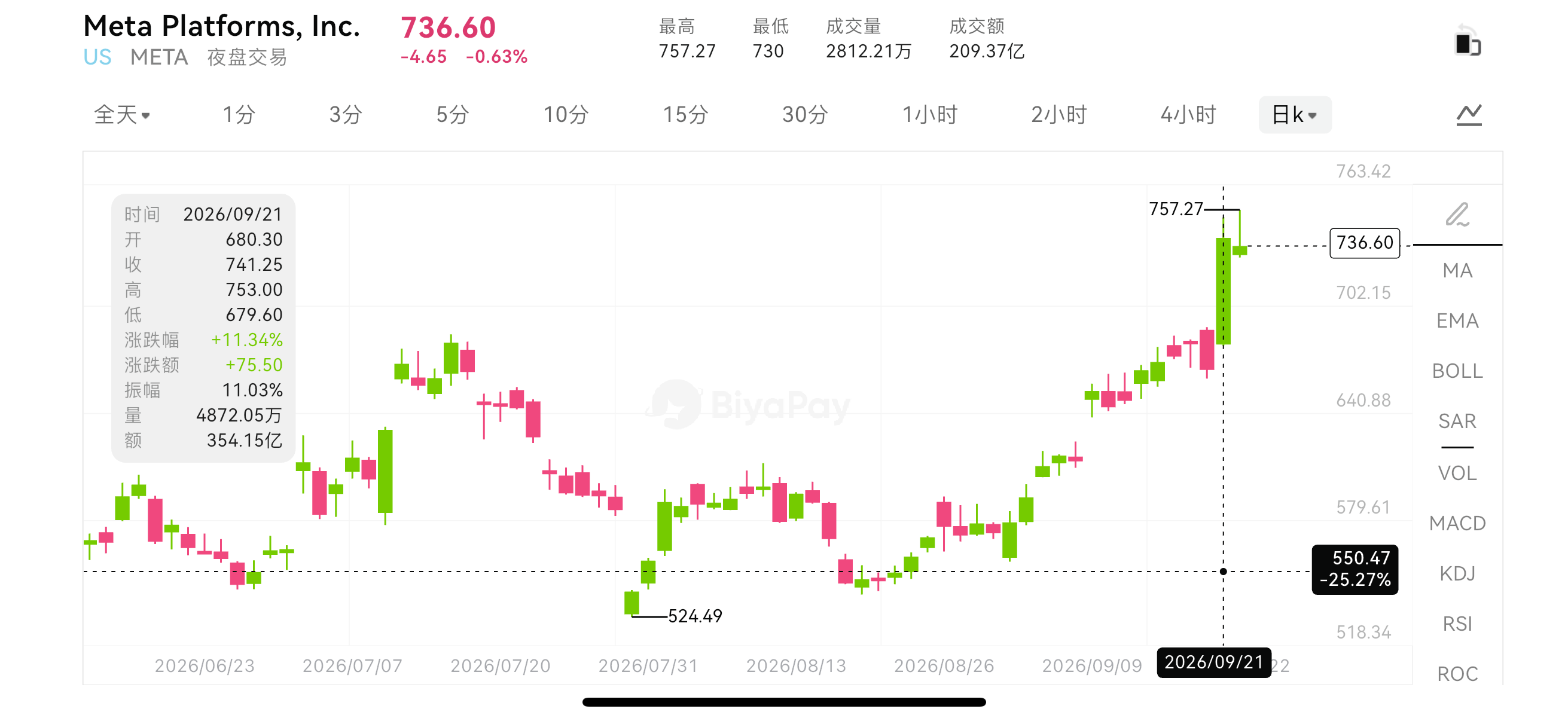
The direct factor driving this rally was precisely the early热度 following the launch of Meta's personal AI assistant Muse, as well as product expectations surrounding the upcoming Meta Connect conference.
This time, the market has begun to revisit a question: When will AI investment truly translate into performance?

Meta's Rise Is First a Rise in Product Confidence
For some time now, Meta has been continuously increasing its AI investment, but the market has always had a question: when will massive capital expenditures translate into user growth, advertising efficiency, and new revenue sources?
The emergence of Muse provides a relatively concrete subject for observing this question.
According to Meta's official introduction, Muse does not just answer questions—it can complete tasks within the scope of user authorization, browse web pages, fill out forms, book services, and integrate with products like WhatsApp. Its positioning is no longer that of a traditional chat tool, but rather a personal AI agent capable of understanding user goals and executing tasks.
According to market reports, Muse climbed to the top of the free app rankings on the US App Store after its launch. Wells Fargo subsequently raised its Meta target price from $640 to $796, believing that Muse's early performance gave Meta's AI product roadmap a clearer focal point.
This is markedly different from simply releasing models and announcing data center construction in the past. Infrastructure investment represents long-term expectations, while user downloads, usage, and feedback are closer to real demand. The core reason the market is willing to revalue Meta lies here: AI is beginning to move from an "investment story" to "product validation."
In Its Financials, Meta Is Still an Advertising Company
However, the attention Muse has received should not obscure Meta's most important current revenue foundation.
Meta's second-quarter revenue was $60.801 billion, up 28% year-over-year; advertising revenue was $59.363 billion. In June, the average daily active users across its app products reached 3.6 billion, up 3% year-over-year. Ad impressions grew 14%, and the average ad price rose 12%.
These figures show that Meta is still a company driven by its advertising business. AI's first layer of value for Meta is not immediately creating a separate massive revenue line, but rather improving content recommendation, ad matching, and user engagement efficiency, thereby enhancing the monetization capability of the advertising business.
What truly makes the market hesitant is the pace of investment. Meta's second-quarter capital expenditures reached $31.08 billion, and the company expects full-year 2026 capital expenditures of $130 billion to $145 billion. Total costs and expenses grew 55% year-over-year during the same period, while free cash flow was only $784 million, significantly lower than $8.549 billion in the same period last year.
This means Meta is not lacking profitability—rather, AI infrastructure construction is consuming large amounts of cash. The company's second-quarter cash flow from operating activities still reached $31.862 billion, but capital expenditures were close to the same level, ultimately leaving free cash flow significantly narrowed.
Therefore, what Meta needs to prove next is not "whether it has the capability to do AI," but whether AI investment can maintain a sufficiently high return rate. As long as advertising revenue, user activity, and new product usage rates continue to improve, the market will be willing to give it more time; if capital expenditures continue to rise while revenue and cash flow fail to keep pace, valuation pressure will re-emerge.
Can Muse Evolve from an App into a Platform?
Muse's true imaginative potential lies not in how many questions it can answer, but in whether it can connect to Meta's existing product ecosystem.
Meta owns high-frequency apps such as Facebook, Instagram, WhatsApp, Messenger, and Threads, as well as hardware entry points like smart glasses. If Muse can gradually integrate into these products, AI will no longer be just a standalone app, but could become an operating layer connecting social, content, advertising, shopping, and hardware.
This is also why the market is watching Meta Connect. Scheduled for September 23-24, Meta Connect is expected to continue showcasing Meta's progress in AI products, AI glasses, and virtual reality devices. What the market cares more about is not how many features are added at the launch event, but whether Muse can enter larger user scenarios.
If Muse can help users complete shopping, bookings, content creation, and information management, Meta may in the future achieve commercialization through ad recommendations, transaction commissions, subscription services, and developer connections.
But this path is not simple either. Amazon has already restricted Muse from accessing and purchasing products on its platform, indicating that once AI agents enter real transaction scenarios, they will face issues involving platform interfaces, data permissions, liability boundaries, and commercial revenue sharing.
Users being willing to download does not equal being willing to authorize long-term; being willing to use does not equal being willing to pay for the service. Whether Muse can form a stable retention rate still needs time to verify.

In BiyaPay Market Data, What Changes Should We Watch for Meta?
When organizing this type of US tech stock market data, I do not just look at Meta's single-day gains and losses, but also observe changes in the Nasdaq index, the AI industry chain, the dollar, and US Treasury yields. As a global one-stop asset allocation platform, BiyaPay covers multi-asset scenarios including digital assets, US stocks, Hong Kong stocks, and fiat currency exchange, allowing users to simultaneously view price changes of META and other market assets on its market page. At the same time, users can directly deposit digital currencies to exchange for US dollars without an offshore account and trade US stocks in real time with zero commission.
If Meta's stock price rises while advertising business data, Muse usage, and market risk appetite improve simultaneously, it indicates that capital is trading on product implementation and profitability expectations. If the stock price is mainly driven by analysts raising target prices and launch event expectations, but free cash flow continues to decline and capital expenditures keep rising, then the rally more reflects valuation repair, and subsequent financial data will still be needed to sustain it.
For Meta, the most important indicators to watch include user activity, ad impressions and pricing, AI product usage rates, capital expenditures, free cash flow, and whether AI features can generate new commercial revenue.
After This Rally, What Else Does Meta Need to Answer?
First is whether Muse can retain users. Short-term download numbers can bring attention, but what truly matters is daily active users, usage frequency, and task completion rate. Only when users treat Muse as a daily tool can Meta potentially build a further business model.
Second is whether AI can improve the advertising business. Meta already has a massive advertising system. If AI merely increases computing costs without improving ad conversion and advertiser投放 efficiency, the return on capital expenditures will be questioned.
Third is whether cash flow can recover. Meta's second-quarter free cash flow declined sharply, indicating that the current investment intensity has already affected financial performance. The market can accept short-term cash flow pressure, but needs to see subsequent revenue growth and margin improvement gradually cover this expenditure.
Finally is whether the valuation can digest new expectations. After Meta's stock price surged on September 21, the market has already priced in some of the positive factors from Muse and Meta Connect in advance. If product data falls short of expectations going forward, the stock price could also experience significant volatility.
Conclusion
Meta's stock price rising 11% in a single day is not just the market chasing AI concepts again—it is more like investors finally seeing a relatively clear validation path.
In the past, what the market saw was data centers, chips, and capital expenditures. Recently, it has begun to see consumer-level products like Muse. The former represents how much Meta is willing to invest; the latter begins to answer whether users are truly willing to use it.
But a product gaining attention cannot be directly equated with commercialization success. Meta needs to continue proving that Muse can improve user stickiness, enhance advertising efficiency, connect more apps and hardware, and ultimately provide more stable cash returns for its massive AI investment.
Therefore, this rally sends a positive signal, but what truly determines Meta's subsequent performance remains product retention, advertising monetization, capital expenditures, and free cash flow. Launch events are responsible for creating expectations; data is responsible for validating them.