

BiyaPay Market Watch: The Fed Hikes Rates for the First Time in Over Three Years—Why Are US Stocks, Gold, and Bitcoin Under Pressure?

Kevin Warsh delivered his first rate hike decision since taking office.
At 2 p.m. Eastern Time on September 16, the Federal Reserve voted unanimously, 12-0, to raise rates by 25 basis points, lifting the target range for the federal funds rate to 3.75%–4.00%. This was the Fed's first rate hike since July 2023, ending a pause of more than three years.
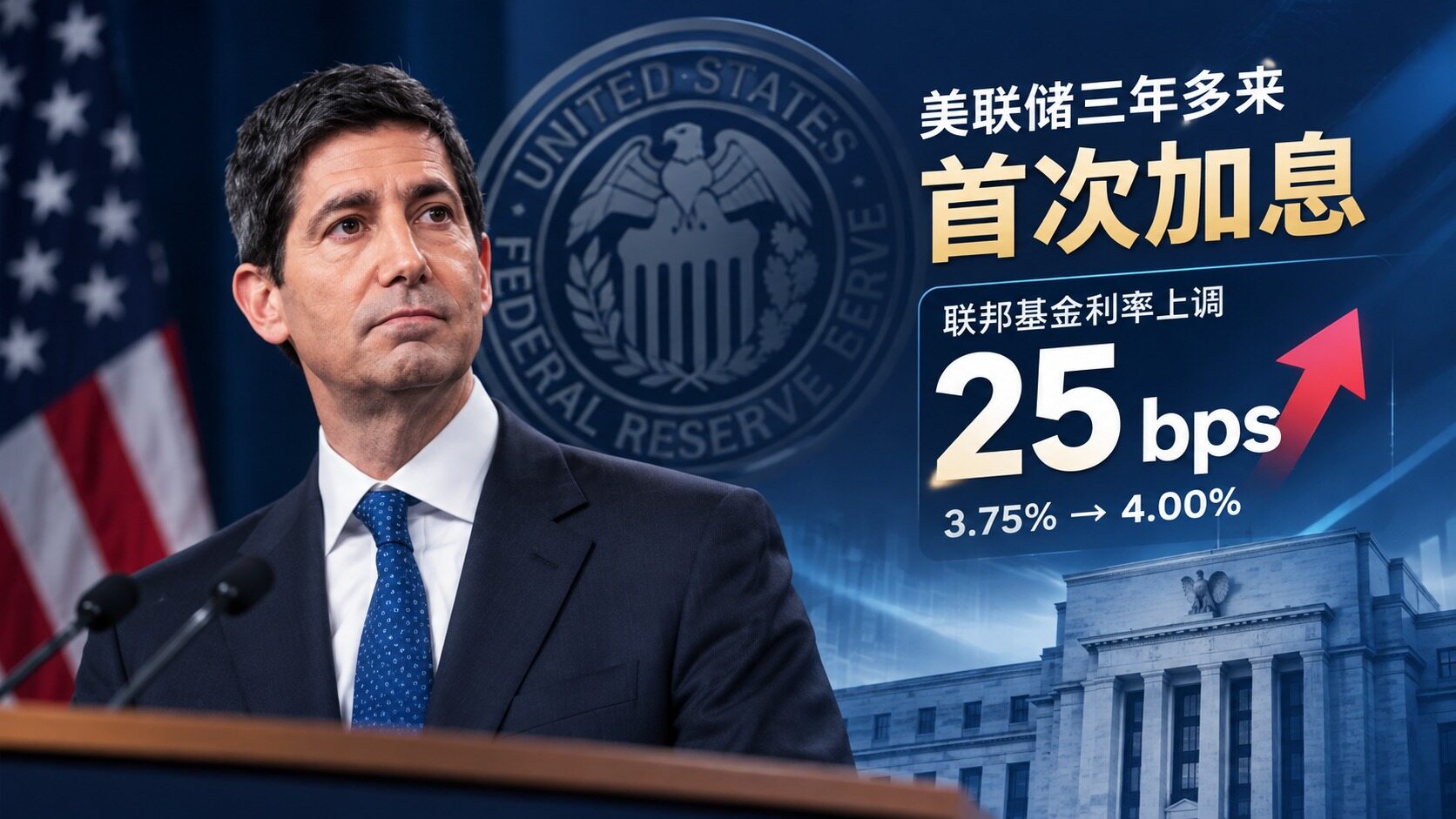
The market had already fully priced in this 25-basis-point move. Ahead of the meeting, CME FedWatch showed the probability of a hike had reached around 90%. What truly shifted market expectations was the dot plot released afterward, along with Warsh's remarks on inflation, the economy, and the future rate path at the press conference.
In its statement, the Fed said U.S. economic activity continues to expand at a solid pace, household spending remains resilient, productivity growth and capital investment stay strong, job gains and labor force size are broadly matched, and the unemployment rate has changed little. At the same time, however, inflation remains elevated, and the Fed's longer-run inflation goal remains 2%.
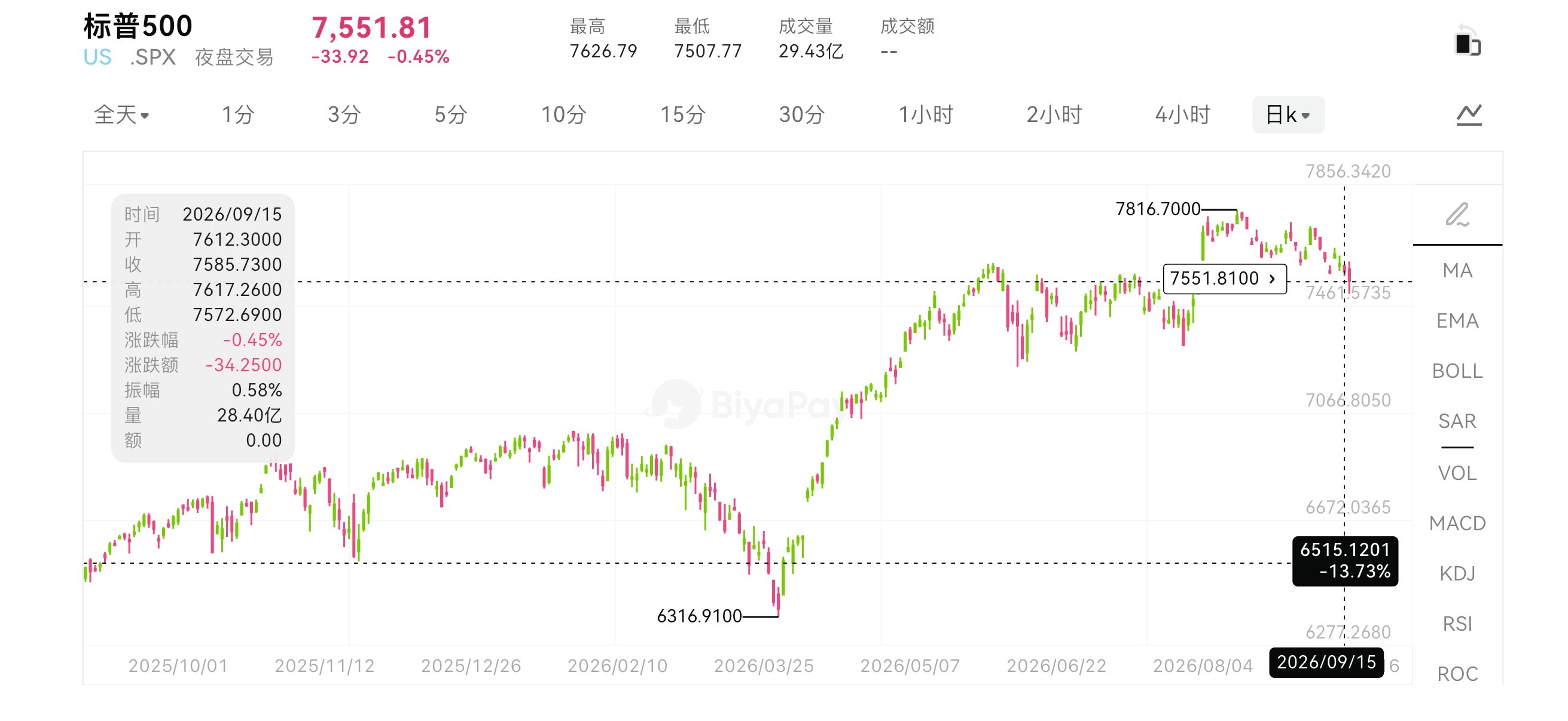
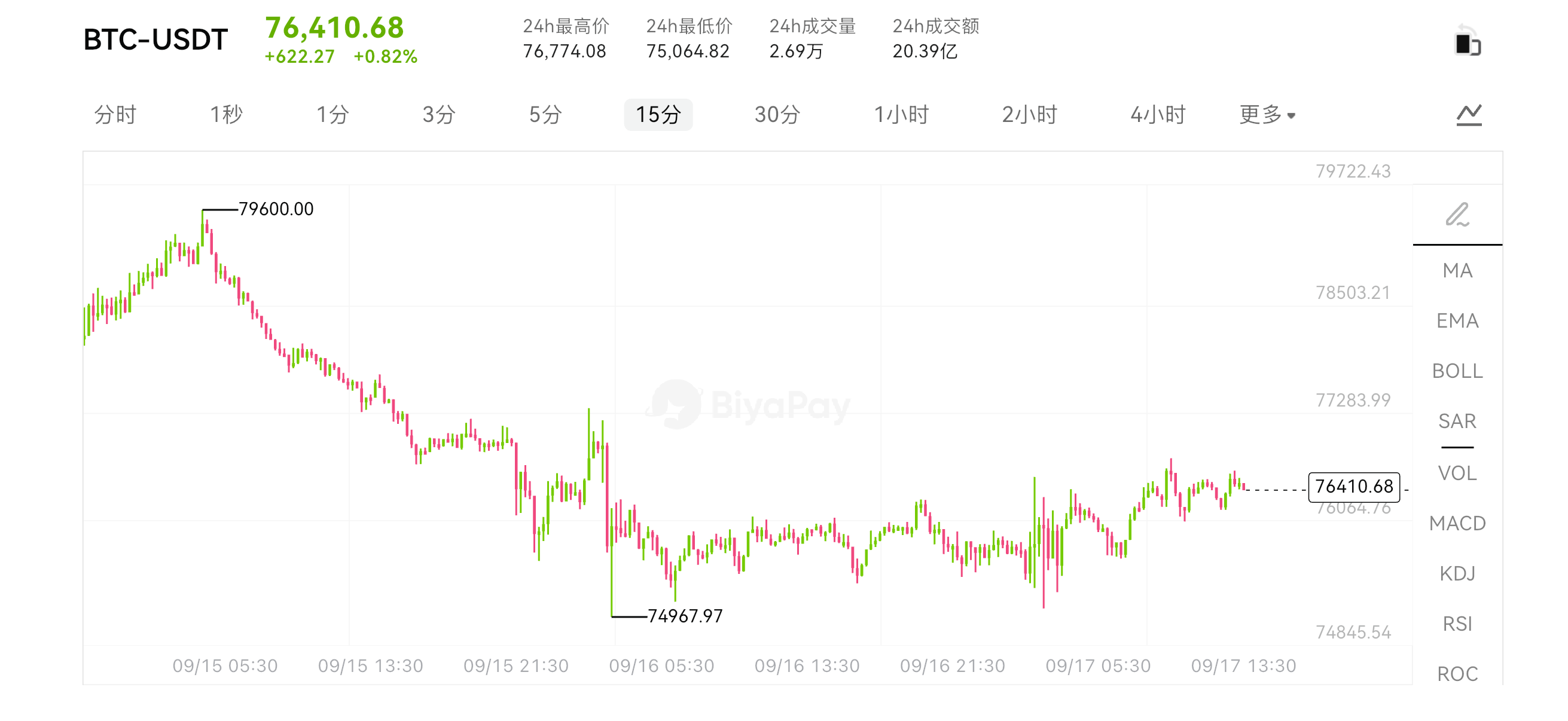
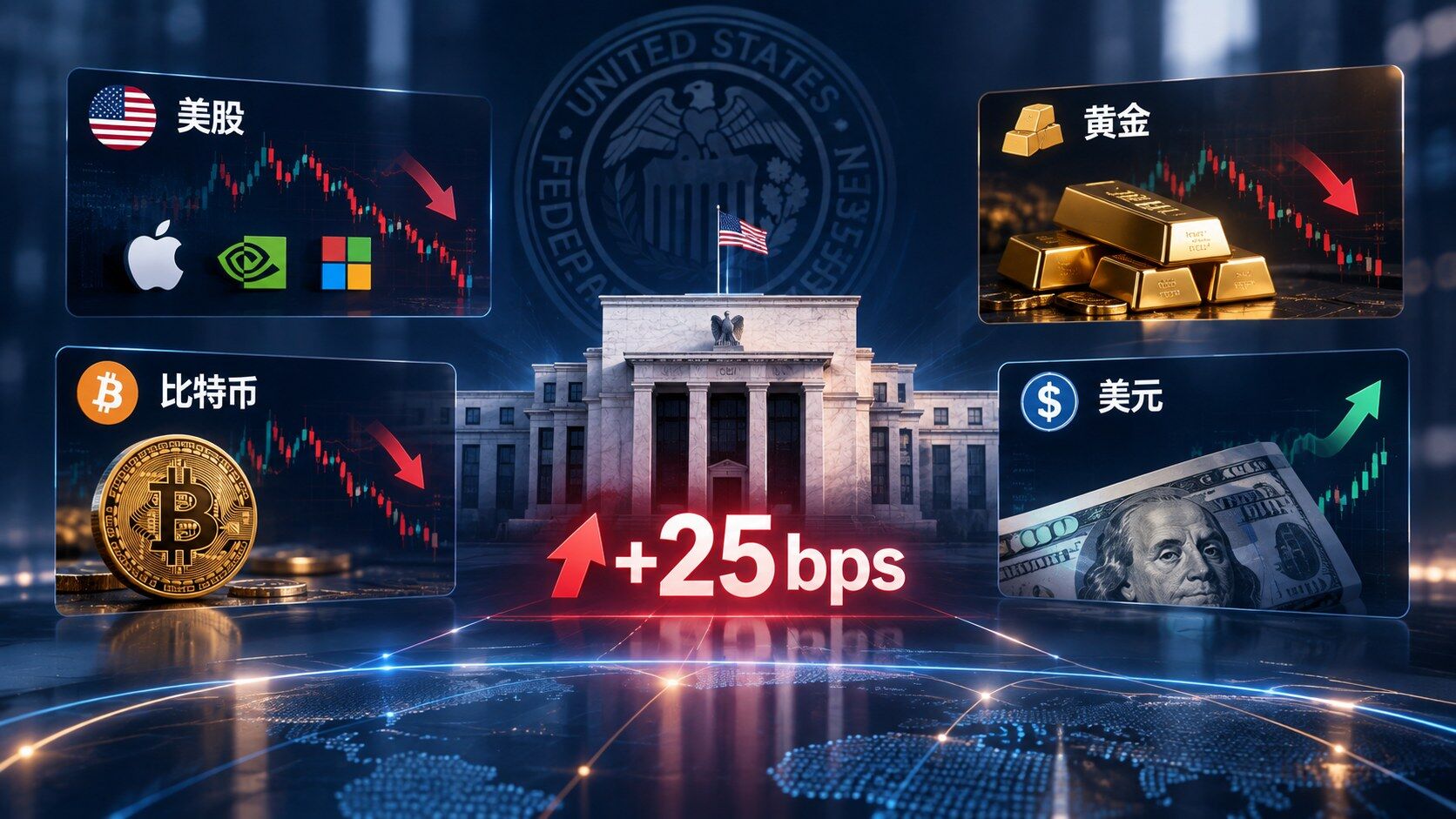
After the rate decision was announced, data from the market page of BiyaPay, a global one-stop asset allocation platform, showed U.S. stocks turning from gains to losses. The S&P 500 fell 0.4%, the Dow Jones Industrial Average dropped 1.2%, and the Nasdaq declined less than 0.1%. The dollar strengthened, gold pulled back, and Bitcoin fluctuated near $75,000 at one point.
25 Basis Points Already Priced In: What the Market Is Really Worried About
This rate hike had already been priced in by the market in advance, so the rate decision itself did not come as much of a surprise.
What truly prompted the market to readjust expectations was the Fed's assessment of economic performance. The statement did not notably emphasize that the economy is deteriorating rapidly; instead, it suggested that household consumption, productivity, and capital investment remain resilient. This means the U.S. economy can still withstand higher rates for now, and controlling inflation remains the current priority.
The latest economic projections are similarly cautious. Fed officials' median forecast for the 2026 personal consumption expenditures price index is 3.7%, well above the 2% longer-run target; the median year-end federal funds rate is 4.1%, higher than the 3.8% projected in June.
This is not a commitment about future rates, but it indicates that some officials still see a need for further tightening within the year.
Therefore, what the market really needs to watch next is not "whether the hiking cycle is over," but whether the Fed will raise rates once more after this hike or enter a period of observation.
Warsh Gave No Answer, Leaving Traders to Do Their Own Math
This was Warsh's first rate hike decision as Fed Chair, and the market is also watching how he handles the relationship between inflation and economic growth.
Judging from his remarks at the press conference, Warsh did not give the market clear guidance for the next meeting, instead emphasizing that rates need to be adjusted based on inflation, employment, and economic data. Compared with the forward guidance the market was familiar with in the past, this communication style makes every meeting more important.
Warsh's focus on inflation was also relatively prominent. He repeatedly stressed that inflation remains elevated, while noting that U.S. economic performance is strengthening. In other words, the Fed is not currently describing the U.S. economy as being in a state that requires a rapid shift toward easing.
If the economy were clearly weak, a rate hike would easily be interpreted by the market as excessive tightening. But the U.S. economy currently shows no signs of rapid stalling, while inflation remains above target, giving the Fed reason to keep rates high.
The market is no longer just concerned about how much rates are raised today, but whether there will be another hike in the future.
The Short End Moves First, the Long End May Not Follow
After a rate hike, 2-year U.S. Treasury yields typically reflect subsequent rate expectations more quickly, because they are more closely tied to the next few Fed meetings.
The 10-year and 30-year Treasuries are more complex. Beyond short-term rates, they also depend on economic growth, fiscal financing, Treasury supply, and long-term inflation expectations.
If the market believes continued rate hikes will weigh on future growth, short-end yields may rise while long-end yields gain only modestly, flattening the yield curve. Conversely, if investors believe inflation and fiscal pressures will persist over the long term, long-end yields could continue to climb.
This distinction matters. Looking only at the words "Fed rate hike" cannot explain price changes across all assets. The short end reflects the next few meetings, while the long end reflects longer-term funding costs and economic expectations.
U.S. Stocks Under Pressure First, but History Is Not Necessarily Pessimistic
The most direct impact of a rate hike on U.S. stocks is to raise the risk-free rate and compress valuations.
When Treasury yields and the federal funds rate rise, the discounted value of future earnings declines, and the market's tolerance for highly valued companies also decreases. Tech stocks, AI, cloud computing, and software sectors typically rely more on long-term earnings expectations, making them more sensitive to rate changes.
However, short-term volatility after a rate hike does not necessarily mean stocks will continue to weaken afterward. Historically, after the first rate hike or a single hike is delivered, the market often goes through a valuation adjustment first, then reprices based on economic growth and corporate earnings.
This is why, for U.S. stocks right now, what matters is not single-day gains or losses, but whether corporate earnings can offset rising funding costs.
For the AI supply chain, data centers, chips, and cloud services still have long-term demand, but companies must prove that capital expenditures can translate into revenue, profit, and cash flow.
Market attention on AI will shift from "growth story" to "growth quality." Order fulfillment, gross margins, capital expenditures, and free cash flow will matter more than pure AI narratives.
The Dollar Has the Edge, While Gold and BTC Each Have Their Own Ledger
A Fed rate hike typically increases the yield appeal of dollar assets, and a stronger dollar also tightens global financial conditions.
After the dollar rises, assets denominated in other currencies face certain pressure. Emerging market financing costs rise, commodities are affected by dollar denomination, and digital assets are more easily dragged down by declining risk appetite.
Gold's short-term pressure mainly comes from real interest rates. If Treasury yields rise faster than inflation expectations, the opportunity cost of holding gold increases, and gold prices tend to pull back. In overnight trading, gold fell about 1% at one point, reflecting exactly this logic.
But gold is not affected only by interest rates. If fiscal deficits, geopolitical conflicts, and inflation concerns continue to intensify, gold may still find safe-haven demand. Therefore, gold's subsequent trajectory cannot be judged solely by Fed rate hikes; it also requires watching changes in real rates, the dollar, and global risk events.
Bitcoin and Ethereum's short-term performance, meanwhile, depends more on liquidity. Bitcoin fluctuated near $75,000 overnight, with a relatively restrained market reaction, but it had already been affected by both stalled progress on crypto legislation and high-rate expectations.
When I compile this kind of cross-market data, I use BiyaPay to simultaneously check price changes in U.S. stocks, Hong Kong stocks, BTC, ETH, and fiat-related markets, then combine them with Treasury yields and dollar trends to find explanations. As a global one-stop asset allocation platform, it not only supports exchanges between digital currencies and assets such as the U.S. dollar and Hong Kong dollar, but also supports trading in U.S. stocks, Hong Kong stocks, BTC, and other digital currencies. Putting different markets under the same observation framework makes it easier to judge whether capital is trading interest rate changes, liquidity, or a shift in risk appetite.
For digital assets, an improved regulatory environment can reduce industry uncertainty, but it cannot fully offset the liquidity pressure brought by a stronger dollar and rising rates. Whether BTC and ETH can stabilize afterward still depends on whether capital flows, market positioning, and risk appetite improve again.
What to Watch Next Is Not the Words "Rate Cut"
Over the next few months, the market needs to focus on four categories of data.
The first is inflation data, especially whether CPI and PCE can continue to decline. The second is employment data, to observe whether high rates are starting to noticeably affect the job market. The third is oil prices; if energy prices remain elevated, inflation pressure could rise again. The fourth is Treasury yields, especially whether 10-year and 30-year Treasury yields can return to a more stable range.
If inflation continues to run above expectations, the dollar and Treasury yields may stay elevated, and high-valuation U.S. stock sectors and digital assets will also come under pressure.
If employment and economic activity weaken notably, the market may once again trade on a future pivot in rates. But with inflation still elevated, weakening economic data could also trigger recession fears, and asset prices may not benefit immediately.
Therefore, what this rate hike truly changed is the market's understanding of the future rate path. Inflation is still not fully resolved, and the economy is not yet weak enough to require a pivot to easing.
For U.S. stocks, the next question is whether earnings can offset valuation pressure; for gold, it is whether real rates or safe-haven demand prevails; for Bitcoin and Ethereum, it is whether dollar liquidity and risk appetite improve again.
This round of rate hikes is not the end of the market cycle, but it reminds the market that the phase of low-rate-driven valuation expansion is over. Next, global assets will need to contend with higher funding costs and a harder-to-predict rate path.