

The Fed Hikes Rates to 3.75%–4.00%, the First Time Since 2023: Dot Plot Signals One More Hike in 2026

Key Takeaways
The Federal Reserve raised the federal funds rate by 25 basis points to 3.75%–4.00% on September 16, 2026, its first hike since July 2023, approved unanimously by a 12-0 vote. The hike itself was priced in, but the dot plot was not: 16 of 18 officials now expect at least one more hike by year-end, and U.S. stocks reversed early gains to close sharply lower.
Key Information
- The Fed raised the target rate range by 25 basis points, from 3.50%–3.75% held since December 2025 to 3.75%–4.00%.
- The decision passed unanimously by a 12-0 vote. This was the first vote in favor of a rate hike during Chair Kevin Warsh's tenure.
- The median federal funds rate projection for end-2026 rose from 3.8% in June to 4.1%.
- 16 of 18 officials expect at least one more hike this year, with 4 expecting two more.
- The 2026 PCE inflation forecast rose from 3.6% to 3.7%, while the core PCE forecast rose from 3.3% to 3.4%.
- The 2026 unemployment rate forecast fell from 4.3% to 4.1%, and the GDP growth forecast was revised up from 2.2% to 2.3%.
- U.S. stocks rose before the decision was announced at 2 p.m. ET, but ultimately closed sharply lower: the Dow fell 730 points (−1.40%), the S&P 500 fell 0.76%, and the Nasdaq Composite fell 0.41%.
- The 10-year Treasury yield, already at its highest level since 2007, once again approached 5%.
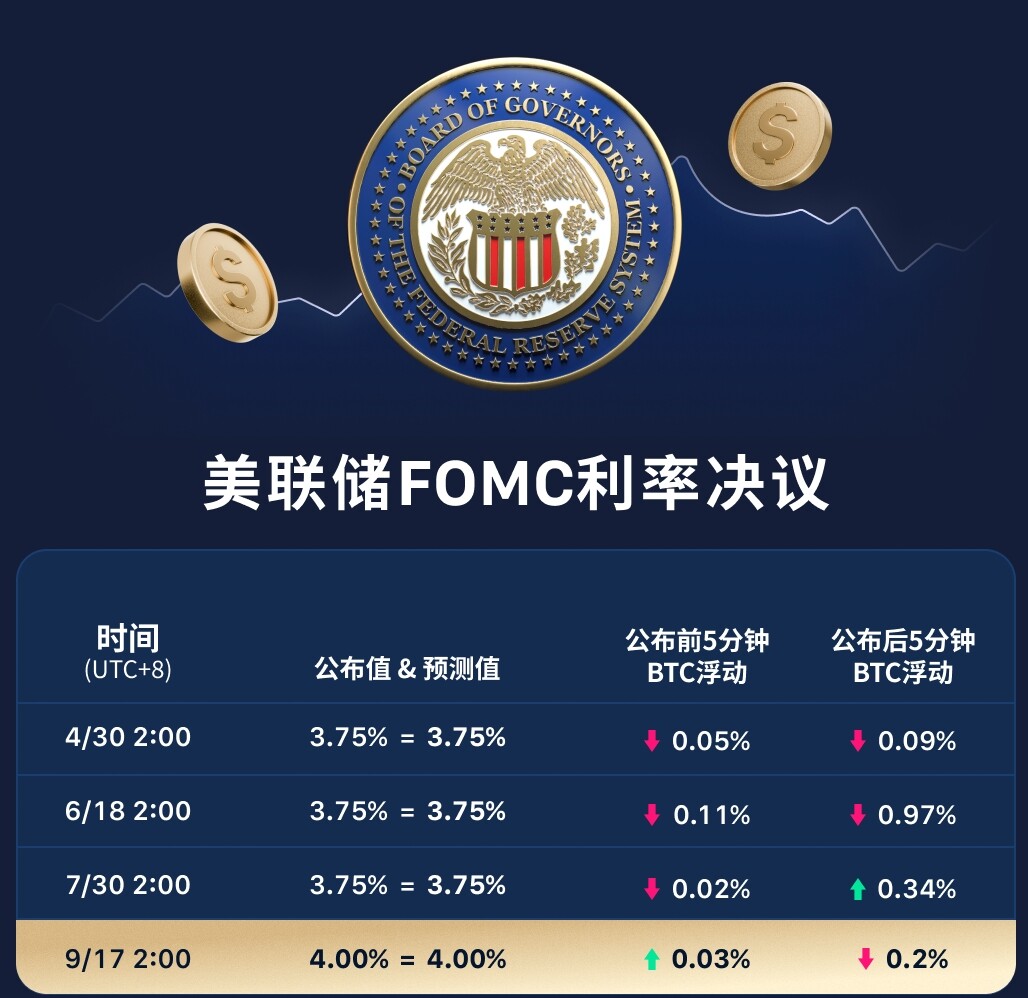
- Bitcoin held near $76,000, relatively stable before and after the decision; the previous day, the U.S. Senate failed to advance the CLARITY Act, which had already put downward pressure on it.
What decision did the Federal Reserve make on September 16, 2026?
The Federal Reserve raised the federal funds target rate range by 25 basis points to 3.75%–4.00% on September 16, 2026, its first rate hike since July 2023. The decision passed unanimously by a 12-0 vote. After the December 2025 rate cut, the rate range had been held at 3.50%–3.75%, with five consecutive holds earlier this year.
In its September FOMC statement, the Fed said economic activity continued to expand at a solid pace, supported by resilient domestic spending, strong productivity growth, and capital investment. Job gains remained in line with labor force growth, and the unemployment rate changed little. The statement also noted that inflation remained elevated.
It was this combination that allowed the Fed to act. The unanimous vote itself also mattered: concerns about rekindling inflation pressures spanned the entire committee, rather than being concentrated among a few hawkish officials. This meeting was the seventh on the 2026 FOMC calendar, leaving one rate decision remaining this year.
Why did the Fed hike after holding rates for a year?
The Fed raised rates because inflation remained above its 2% target while the economy continued to grow. At the press conference, Chair Kevin Warsh prioritized price stability over the employment goal of the dual mandate, stating that the action would support inflation "returning to the Committee's 2% objective in a timely manner," and adding that "one thing is clear: inflation is too high, and it has been for too long."
The mechanics are fairly straightforward. When inflation remains elevated but output and employment stay solid, the cost of tightening is low while the cost of waiting is high—inflation expectations could begin to drift, and once expectations become unanchored, the cost of reversing them later is far greater. This is precisely the trade-off the Fed made.
Warsh also spent part of the press conference explaining why long-term bond yields were rising, pointing to a strong economy, a surge in capital expenditure competing for funds, and geopolitical factors. He also repeatedly reaffirmed the Fed's independence, signaling that the tightening path is not open to political bargaining.
What exactly did the September dot plot show?
What truly drove the market repricing was not the 25 basis point hike, but the dot plot. According to the September Summary of Economic Projections, the median federal funds rate projection for end-2026 rose from 3.8% in June to 4.1%, implying another 25 basis point hike by year-end.
The distribution of projections was more concentrated than the median suggested. Of the 18 officials who submitted projections, 12 expected the year-end midpoint to be 4.125%, and another 4 expected 4.375%. Only two thought rates would remain at the current new midpoint of 3.875%. Put simply, 16 of 18 officials expect at least one more hike, with 4 expecting two more.
Other economic projections explained the shift in stance. The median 2026 PCE inflation forecast rose from 3.6% to 3.7%, and the core PCE forecast rose from 3.3% to 3.4%. Meanwhile, officials revised up their GDP growth forecast to 2.3% and lowered their unemployment rate forecast from 4.3% to 4.1%.
Taken together, this is a more hawkish combination: inflation is stickier than expected, and the economy is not weak enough to force the Fed to stop hiking.
How did U.S. stocks respond to the Fed rate hike?
U.S. stocks reversed course. On the morning of September 16, major indices edged higher, with the S&P 500 up about 0.4% and the Nasdaq up about 0.8%; but as traders digested the dot plot and Warsh's press conference, stocks sold off through the afternoon. According to Yahoo Finance's market coverage, the Dow closed at 51,363.01, down 730.10 points or 1.40%; the S&P 500 fell 0.76% to 7,527.80; and the Nasdaq Composite fell 0.41% to 25,875.21.
The divergence across indices is worth noting. The Nasdaq, which has the most rate-sensitive long-duration growth stocks, posted the smallest decline, largely cushioned by strength in semiconductors; the price-weighted Dow took the heaviest hit. If yields continue to rise, this ranking of declines could change.
As MEXC's guide on how macroeconomic data affects U.S. stocks explains, higher rates raise the discount rate applied to companies' future earnings, pressuring growth stock valuations, including companies with heavy weighting in the Nasdaq 100 and QQQ. However, this relationship is not mechanical. If earnings continue to grow, individual tech stocks can still withstand higher rates. The truly dangerous combination is persistent inflation, further policy tightening, and slowing corporate profit growth all at once.
Why do Treasury yields matter more than the rate hike itself?
The federal funds rate determines the cost of overnight funds, while long-term Treasury yields determine the discount rate for all risk assets, including equities, credit, and crypto—and Treasury yields moved first. The 10-year Treasury yield rose to its highest level since 2007 on September 15, the day before the decision, and approached 5% again after the hike.
This is the important policy transmission channel. Once a 25 basis point adjustment to short-term rates is priced in, its symbolic significance outweighs its actual impact; but if the 10-year yield remains at 5%, mortgage rates, corporate borrowing costs, and the return threshold that all speculative assets must clear will all be repriced. If yields can stabilize after a hawkish dot plot, the market will conclude that most tightening expectations are already priced in; if yields keep rising, pressure will continue to build.
What does the rate hike mean for Bitcoin and the crypto market?
Bitcoin barely moved around the decision, holding near $76,000 even as stocks fell, performing notably more steadily than equities. The reason is the timing gap: the crypto market had already come under pressure the previous day. At that time, the U.S. Senate failed to advance the CLARITY Act by a 49-50 vote, pulling BTC back from near $80,000. Other tokens led the decline, with XRP falling more than 7%, while Ethereum and Solana both dropped about 3% on September 16.
Regardless of how prices move on any single trading day, the structural logic still holds. Higher cash and Treasury yields raise the opportunity cost of holding non-yielding assets; tighter financial conditions also drain the leveraged capital that drives speculative rallies. Both effects take time to materialize, which is precisely why the first candle after a decision reveals very little.
Therefore, traders studying how to trade crypto around Fed rate decisions should focus on the policy path, the long end of the yield curve, and the dollar, rather than just the headline decision. The two factors that truly drove crypto markets on September 16 were the Senate vote and bond yields.
What should investors watch next?
The unresolved question is whether upcoming inflation data will support the second hike implied by the dot plot. PCE, CPI, wage growth, and energy prices will serve as evidence of whether inflation is broadening or beginning to cool. Jobs data still matters, but the Fed's downgrade of its unemployment rate forecast suggests policymakers currently believe the labor market can withstand tighter policy.
The bond market is the second and faster-moving signal. If short-term yields rise as the market prices in another hike, rate-sensitive stocks and crypto assets will come under pressure again. Stable yields would mean the market has already priced in much of the tightening.
Only one rate decision remains on the 2026 FOMC calendar. The market debate has already shifted from whether the Fed will resume hiking to how far this hiking cycle will go.
Frequently Asked Questions
How much did the Fed raise rates?
The Fed raised the target rate range by 25 basis points to 3.75%–4.00% on September 16, 2026, from 3.50%–3.75%. This was the first rate hike since July 2023, and it passed unanimously by a 12-0 vote.
Why did the Fed raise rates?
The Fed said inflation remained elevated while economic activity, consumer spending, productivity, and capital investment remained resilient. These conditions allowed policymakers to tighten without signaling fears of an immediate recession. Chair Kevin Warsh said the Committee's primary focus is currently price stability within its dual mandate.
Will the Fed raise rates again in 2026?
The September dot plot suggests another hike is possible. Of the 18 officials who submitted projections, 16 expect rates to be higher than the current range by year-end, and the median projection rose from 3.8% in June to 4.1%. One FOMC meeting remains in 2026.
Who is the current Fed Chair, and what did he say?
Kevin Warsh is the current Fed Chair, and September 2026 marked the first time he voted in favor of a rate hike as Chair. He said the action would support inflation "returning to the Committee's 2% objective in a timely manner," adding that "inflation is too high, and it has been for too long," while emphasizing the Fed's independence.
If the hike was already expected, why did U.S. stocks still fall?
The hike itself was priced in, but the subsequent rate path was not. U.S. stocks rose before the decision was announced at 2 p.m. ET, but the dot plot showing 16 of 18 officials expecting more hikes, combined with Warsh's hawkish signals, prompted a reversal. The Dow closed down 1.40%, the S&P 500 fell 0.76%, and the Nasdaq Composite fell 0.41%.
What does a Fed rate hike mean for tech stocks?
Higher rates reduce the present value of future earnings, pressuring highly valued growth stocks. However, the impact is uneven. On the day of the decision, the Nasdaq Composite's decline was smaller than the Dow's, supported by strength in semiconductors. For individual companies, corporate earnings and sector catalysts may outweigh the impact of rates.
What does the rate hike mean for Bitcoin and the crypto market?
Bitcoin held near $76,000 around the decision, performing more steadily than stocks, because the crypto market had already repriced the previous day after the Senate failed to pass a procedural vote on the CLARITY Act. Structurally, higher rates raise the return on cash and short-term government bonds and tighten the liquidity supporting speculative positions. This headwind typically takes weeks, not minutes, to fully materialize.
How do Treasury yields affect crypto markets after a Fed decision?
Long-term Treasury yields set the return threshold that all risk assets must compete against, making their role in transmitting monetary policy to crypto more direct than the overnight rate. The 10-year Treasury yield touched its highest level since 2007 around this meeting and approached 5% again after the hike. Rather than focusing solely on the decision itself, watch the long end of the yield curve and the dollar.