

Peter Thiel Interview: Five Decades of Stagnation—Is AI Civilization's Last Chance for Self-Rescue?

Original Author: Sleepy
Editor's Note
Interviewing Peter Thiel has never been a comfortable affair.
He never accommodates the interviewer's assumptions, nor does he deign to offer any cheap consolation. As all of Silicon Valley rushes to pick sides in the binary opposition between "accelerationism" and "doomerism," Peter Thiel sits across from Axel Springer CEO Mathias Döpfner, fitting the stagnation of the physical world, Goethe's Faustian pact, the embryonic emergence of global authoritarianism, and that almost offensive line—"99% of leaders are utterly incompetent"—seamlessly into a single cognitive framework.
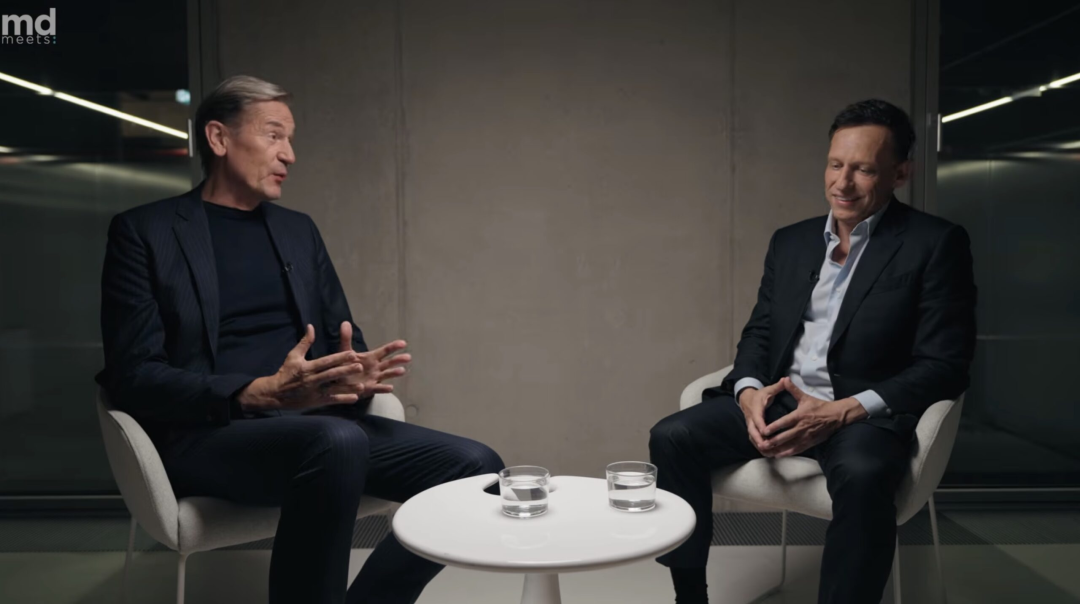
The conversation took place on Döpfner's high-end interview program "MDMeets." Döpfner presides over Europe's most powerful media conglomerate, which owns Bild, Welt, Politico, and Business Insider. But before Thiel, the dialogue felt more like a biopsy of the internal pathologies of Western civilization.
In the prevailing mainstream narrative, civilization is being swept forward by the roar of superintelligence. But in Thiel's coordinate system, the West has actually been standing still for the past fifty years. Bits race wildly through virtual space while atoms stagnate in the physical world. AI is not some ornamental technological miracle—it is civilization's last chance at self-rescue, the only way to break free from the zero-sum quagmire and prevent the collapse of the generational contract.
Following this thread, he launched a full-throated intellectual barrage.
The following is the interview transcript
The Stagnation Thesis
Q: You've been emphasizing for years that the West lacks sufficient technological breakthroughs, even using the word "stagnation." But today, public discourse has shifted to the opposite concern—people feel AI is accelerating too fast. Have you changed your mind, or do you still believe current technological progress is far from enough?
Peter Thiel: In some ways, I have changed my mind. But let me step back first, to the "stagnation thesis" I proposed twenty years ago.
Measuring technological development comprehensively is extremely difficult—the dimensions of science and technology are simply too vast. But the core logic is actually quite clear: since the 1970s, the overall pace of technological development has slowed across the board.
Computers, the internet, mobile connectivity, software—these represent our wild acceleration in the world of "bits," but in the world of "atoms," physical breakthroughs have been minimal.
Most engineering disciplines that deal with atoms are no longer even seen as paths to success for young people. Mechanical engineering, chemical engineering, aerospace—all in retreat. As for nuclear engineering, it was widely regarded as a terrible career choice as early as the 1980s.
For various reasons, this slowdown genuinely happened. In my view, it is precisely this comprehensive technological stagnation that has become the root cause of many systemic crises in modern society.
Take political polarization, for instance. When the economy loses its incremental growth, every winner's emergence means a loser's downfall. Society degenerates entirely into a zero-sum game, and the overall ecosystem deteriorates rapidly.
Looking at longer historical cycles, we have been trapped in the quagmire of stagnation for decades. The internet of the late 1990s was once a massive growth engine, surpassing everything that came before in magnitude, yet it still failed to push civilization into its next qualitative leap.
Perhaps today's AI is even bigger than the internet—at least it has the potential to reignite incremental growth, whether what follows is honey or poison.
But the reason I still defend the "stagnation thesis" is this: precisely because of AI's emergence, no one today bothers to come argue against my claim that "for the preceding decades, we were actually standing still."
Extinction Probability
Q: In recent weeks, Dario Amodei, Sam Altman, and Elon Musk jointly issued warnings that "this monster could spiral completely out of control." How do you view this wave of high-profile warnings? Is it some kind of PR tactic, expectation management ahead of trillion-dollar IPOs, or are they genuinely afraid of AI superseding human civilization?
Peter Thiel: The AI debate has extremely complex dimensions.
There are indeed scenarios that lean toward science fiction but carry a tinge of reality. If you build something far smarter than the human mind in every respect, could it completely derail and slip free of humanity's reins of control?
Everyone has seen wasteland sci-fi like The Matrix or The Terminator. Personally, I don't think the probability of such extreme catastrophe is very high. But looked at another way, even if the probability of destruction is only 5% or 10%, that's enough to send chills down your spine.
The most dangerous consequence of this public discussion is that it pushes social sentiment directly into an extremely defensive, even thoroughly conservative "precautionary" dead end.
Q: If we're really calculating probabilities, there was recently an experiment that posed the same question to six major large language models: "Does AI pose a risk of causing human extinction?" The models gave probabilities ranging from 1% to 10%. Is this merely the models absorbing humanity's projected pessimism, or is it a genuine existential crisis?
Peter Thiel: Let's assume for the sake of argument that this is a real existential crisis. No one can guarantee the probability is absolutely 0%.
But that absolutely does not mean we must permanently slam on the brakes and retreat into a precautionary bunker. Because if you do nothing in the name of absolute safety, allowing civilization to stop evolving in every dimension, this society will instantly disintegrate.
The only psychological pillar that allows the Western middle class to endure the present is the firm belief that the next generation will live better than they do. The most core generational contract of our society lies in incremental breakthroughs from one generation to the next—growth in material wealth, breakthroughs in healthcare, and upward mobility on the social ladder.
Once this contract is torn up, the entire society will descend into chaos in extremely distorted ways. The truth is absolutely not so.
Zero growth is never neutral, and time cannot flow backward.
Q: But if this danger truly exists, is putting the brakes on AI realistically achievable? If the US slows down while the other side races ahead at full speed, aren't we unilaterally ceding our advantage while solving nothing?
Peter Thiel: In theory, only through truly deep, seamless global coordination could you actually put the brakes on technology. But behind this lurks a terrifying prerequisite: you would need a single world government with absolute authority and enforcement power.
My classical liberalism instinctively reminds me that this is jumping out of the frying pan and into the fire—a remedy even more dangerous than the disease itself. The more likely outcome is that we cobble together a pseudo-global governance apparatus filled with endless transnational conferences and empty declarations.
There is also the risk that the West slows down unilaterally while the other side races ahead at full speed.
The Pope recently issued an encyclical on AI—an "anti-AI encyclical," to be precise. The rulers on the other side will never listen to the Pope, but thousands upon thousands of Westerners will take it seriously. The ultimate objective effect is nothing more than turning the Pope into a "useful idiot" for the opposing camp.
Q: I've spoken with founders of two leading AI platforms who insist they have evidence that adversaries are spreading anti-AI panic through American social platforms to steer public sentiment and expand their own advantage. Have you observed similar signs?
Peter Thiel: I haven't deeply researched the specific chain of evidence, but I tend to believe it's true. However, in my view, this is not the core driver of the situation. What truly drags us into this predicament is precisely what we ourselves are doing within the West.
I would love to simply attribute Greta Thunberg to being an agent sent by the opposing camp, but she is entirely a product bred from within our own Western society.
Q: But does Greta Thunberg really have such destructive impact on American social sentiment?
Peter Thiel: Her peak may have passed, but Western society has subjected itself to this kind of self-inflicted attrition far too many times.
I have always been a harsh critic of China, and we must confront this great-power rivalry with the utmost seriousness. But in many cases, dumping all of the West's own weaknesses and failures onto China is far too cheap and lazy.
Q: Then why is there such a strong anti-AI wave in the US right now? In Europe, as long as people feel they can participate, public attitudes are actually quite moderate or even positive. But in the US—widely seen as embracing technology—people are taking to the streets with protest signs. Where does this contrast come from?
Peter Thiel: Because the real qualitative technological shifts are happening in the US, and Europe has long been left behind.
In my coordinate system, Europe has fallen so far behind that it has even lost the possibility of catching up. In the US, domestic companies are under enormous anxiety to completely restructure their businesses through AI. Take our Palantir's business—sales growth to US enterprise clients is surging dramatically, with every company chased by the urgency of "accelerate or be eliminated."
In Europe, by contrast, bottomless inertia still shrouds everything. They think, "We can wait—what can be put off from tomorrow to the day after tomorrow shouldn't be done tomorrow."
Bad, Not Evil
Peter Thiel: The public no longer believes tomorrow will be better, and all interest contests degenerate into brutal zero-sum warfare.
AI is by no means a panacea. But if incremental growth cannot be reignited, those parties entrenched at the far left and far right of the political spectrum will only see their bases expand further.
Q: Should we stop moralizing new technologies? Technology is like a knife—it can chop vegetables or kill people. Why do the public and elites habitually sit in moral judgment over new technologies?
Peter Thiel: Our moral judgment of technology is truly excessive.
On the moral scale, the antonym of "Good" is "Evil." But on the functional scale, the opposite of "good" is merely "bad and incompetent."
A Ferrari is an "evil" car because its gas mileage is astonishingly terrible. But a Trabant (the dilapidated East German car) is a "bad" car because it can barely even drive on the road.
An evil person at least still possesses the ability to exercise will and achieve goals.
In Marlowe's Faust, the protagonist is a charlatan peddling pseudo-science who ultimately plunges into hell. But in Goethe's version, Faust, though he makes a pact with the devil, ends up enabling genuine creation and ultimately receives redemption.
Today's true societal collapse is filled with badness and incompetence. 99% of politicians, business titans, and corporate executives are not remotely evil—they are simply utterly incompetent. That is the elephant in the room we should truly confront.
Incompatible Freedoms
Peter Thiel: That was an essay I dashed off late one night for the Cato Institute's libertarian online publication. Two weeks after publication, I wrote a formal clarification.
What I was really calling for was a kind of "de-politicization" and "de-intensification" of public life. My criticism was aimed at those libertarian colleagues who bet all their chips on "transforming the world by winning elections."
Q: Are you worried about the continued polarization of global society and the systemic collapse of moderate leadership?
Today's moderate political elites underestimate the structural crises triggered by technological stagnation and the rupture of the generational contract. Look at the UK—seven prime ministers in a revolving door within a single decade, yet not one of them produced a real plan to reverse the social decline.
Q: In the Berlin election, Die Linke's overall vote share was 25%, but among voters aged 16 to 24, it reached 47%. How do you view this radicalization of the younger generation?
Peter Thiel: You must seriously confront the visceral survival struggles of the younger generation. In Berlin, rents are absurdly expensive, new housing construction is blocked at every turn, and young people find themselves with virtually no hope of upward mobility.
Germany and much of Europe have long degenerated into a gerontocracy dominated by the elderly and serving the elderly entirely. The reason extreme parties can capture votes is simply that they at least openly discuss the pain points that moderates pretend not to see—even if the prescriptions the extremists offer are utterly useless.
Q: And the other pole of the political spectrum, the AfD? Do you see it as an alternative form of conservatism, or equally worrisome?
Peter Thiel: The AfD's expansion essentially reflects the incompetence of establishment parties—they failed to develop an inclusive economic blueprint for Germany, and they don't even possess the basic ability to balance a budget.
On the diplomatic front, there should be thorough public debate around Ukraine, China, and Israel, but I believe the AfD's answers on all three core battlegrounds are entirely wrong.
Q: In 2016, you were one of the very few in Silicon Valley to publicly endorse Trump. Looking back today, how do you analyze the gains and losses of his past two terms?
Peter Thiel: Trump's emergence was essentially the inevitable product of traditional establishment elites delivering a pale failure on long-term growth stagnation, the aftermath of globalization, and the Middle East geopolitical quagmire.
His first administration was filled with endless bureaucratic factional infighting. By his second administration, he overcorrected, placing loyalty tests above all else, resulting in the selection of a batch of executives with severely inadequate professional competence.
Q: You were Vance's earliest supporter and mentor. What irreplaceable qualities did you initially see in him?
Peter Thiel: I have always had a fondness for genuinely brilliant minds. Vance is a person of deep thinking, open-mindedness, and immense personal charisma. He once worked at my Mithril fund, wrote Hillbilly Elegy, and when he ran for Senate in Ohio in 2022, I supported him.
Q: Looking ahead to 2028, who do you think will be the core contenders for both parties?
Rich Like Argentines
Q: What lessons can Argentina's Javier Milei offer to a Western world mired in crisis?
Peter Thiel: Argentina is a mirror, a complete demonstration of where a society heads after experiencing a century of "below-average mediocre growth." In 1900, "rich as an Argentine" was a popular saying.
What Milei confronts today is a life-or-death level problem. At the macro level, the Western world, mired in runaway deficits, has only three options: slash spending as boldly as Milei, endure socialist-style tax stagnation, or borrow to kick the debt down the road.
Typical moderate politicians like Germany's Friedrich Merz close their eyes and choose the third path.
Q: Since you repeatedly emphasize that you are an "unelectable politician," why do you still invest so much thought and energy into politics?
Peter Thiel: I have sufficient self-awareness to know that I am absolutely not someone who can run for public office. But the reality is that politics has seeped into every pore of society. It is toxic, yet it is the air we cannot help but breathe.
I have invested extensive thought into politics because I have been trying to isolate that toxic gas.
Q: In the geopolitical landscape of US-China rivalry, where should Europe position itself?
Peter Thiel: Europe should be a reliable ally of the United States. Restarting Europe's economic engine and maintaining a healthy commercial cycle is entirely in America's strategic interest.
Looking back at the late 1960s, Europe, by pouring effort into building the Concorde supersonic passenger jet, overtook others in high-end aviation in one stroke. But in today's AI battle, Europe's lag is even more severe than France's 1990s predicament of clinging to the Minitel local network.
Q: Why has Germany, known for engineering and manufacturing, never produced a globally established tech giant over decades?
Peter Thiel: Beyond the conservative culture of fearing failure, there is a more deeply rooted pathology here: "fear of success."
European entrepreneurs and capital have never dared to push a company's boundaries to the extreme, never dared to build disruptive mega-machines like Musk or Zuckerberg.
The data is more brutal. Among the 50 richest people in the US, 12 belong to Generation X or younger, and of those 12, nine are pure self-made entrepreneurs.
In Germany's richest 50, 20 are Gen X or younger, but every single one of those 20 is an inheritor of family wealth.
For decades, this soil has not produced even a single new, scaled trillion-dollar tech giant.
Outsider, Flesh, and the Antichrist
Q: You once said that intellectually you try to expel Germany from your mind, but emotionally you cannot fully erase it. Where does this sense of