

After losing tens of millions of dollars, Abstract reluctantly shuts down — is the L2 shakeout wave here?

Original | Odaily (@OdailyChina)
Author | Wenser (@wenser 2010)
On October 7, Igloo, the parent company of Pudgy Penguins, officially announced that its L2 project Abstract will shut down on December 15 of this year. The "consumer-grade L2 public chain" that was once highly anticipated by the Pudgy Penguins team and numerous NFT players has, after nearly 2 years of operation, still somewhat regrettably reached its final curtain call.
Following the announcement, market opinions have been sharply divided. One camp believes that the Pudgy Penguins team did not follow the path of some previous L2 teams in "launching a token for one last round of harvesting," and can be said to have ended on a proper note. But another camp strongly disagrees, arguing that the tens of millions of dollars in operating losses mentioned by Pudgy Penguins CEO Luca Netz in his lengthy announcement, as well as Abstract's previously launched badge system and other operations with a distinctly "PUA-style" flavor, were largely paid for by users; and before this, countless people had pinned their hopes on Abstract's token launch to recoup their losses—a hope that has now been completely dashed.
Behind Abstract's shutdown, the hype around Robinhood Chain's launch is gradually cooling, and Blast has also officially announced its closure. Following the wave of CEX shutdowns, perhaps more unsustainable L2s will face a wave of closures.
"Consumer-grade blockchain network" with no takers: DeFi, Meme, and institutional capital all fail to gain traction
Looking back at Abstract's development history, the positioning of "consumer-grade crypto blockchain network" may not have been a good business from the very start.

According to Abstract's official statements, the L2 network had previously attracted over 400,000 users and deployed more than 144 applications; Pudgy Penguins CEO Luca Netz also stated that Abstract had previously processed over 325 million on-chain transactions and launched Portal and AGW, attracting multiple global brands including Disney and Red Bull. From a data perspective, Abstract's performance was decent, but what truly pushed it into an "operational dead end" may share some similarities with Base's strategic miscalculation over the past two years in pursuing a "crypto social + on-chain consumer" strategy—it neither followed the grassroots approach of Solana and Robinhood Chain to develop its own Meme ecosystem, nor did it focus on institutional and whale demand to deepen DeFi, attract liquidity, and complete a self-sustaining business loop.
Main reasons for shutdown: insufficient DeFi ecosystem, lack of institutional participation, high operating costs, and unclear PMF
Based on Abstract's official statements and Pudgy Penguins CEO Luca Netz's posts, we can glimpse the "main causes of death" for this L2 network as follows:
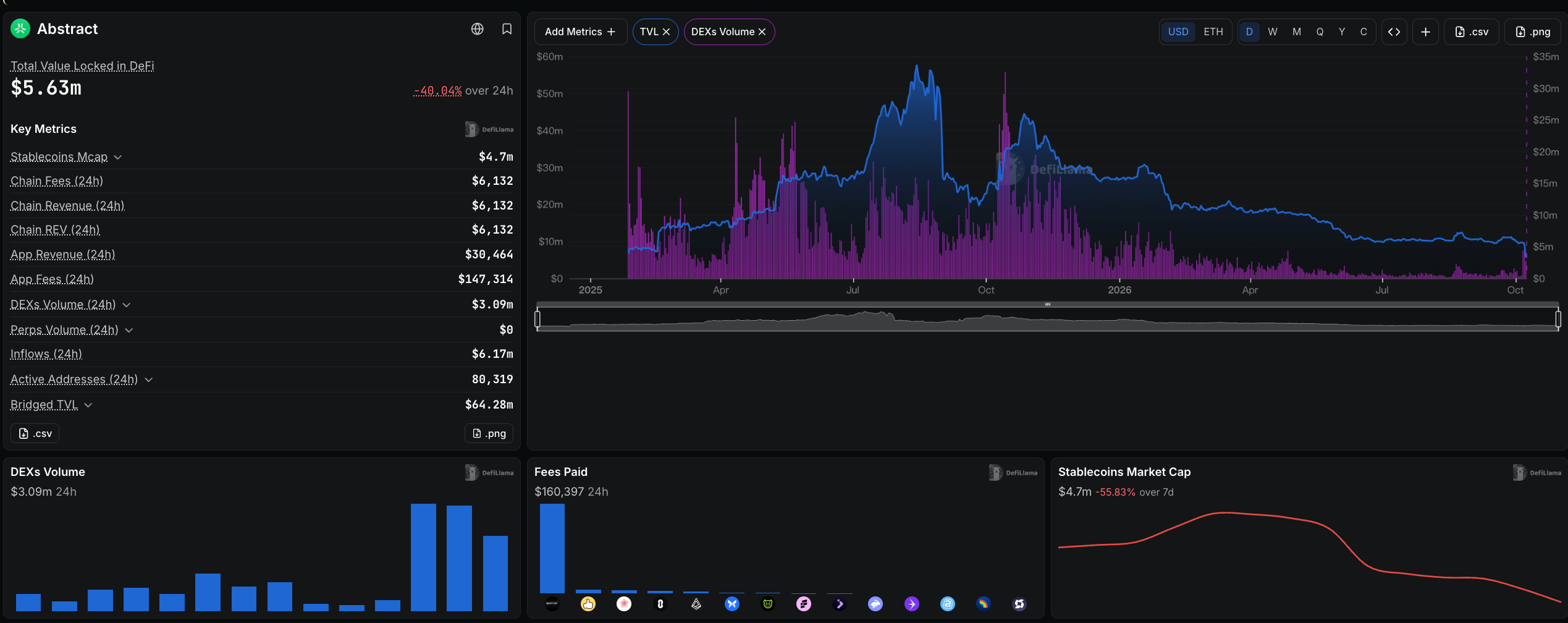
First, insufficient DeFi ecosystem; although Abstract officially claims DEX trading volume as high as $6 billion, given nearly 2 years of operation, this is hardly an impressive figure. According to DefiLlama data, Abstract's DeFi TVL currently stands at around $5.6 million, ranking 90th among major L1 and L2 networks, with a 24-hour decline of approximately 40%. Although heavily affected by the shutdown news, its DEX trading volume had long hovered between $300,000 and $1 million; the stablecoin market cap has dropped nearly 60% over 7 days and currently sits at only $4.7 million.
For an L2 network, if the DeFi ecosystem cannot develop, no matter how good other data looks, it almost certainly means limited ecosystem activity, limited real user numbers, and difficulty in generating revenue through fees to sustain operations.
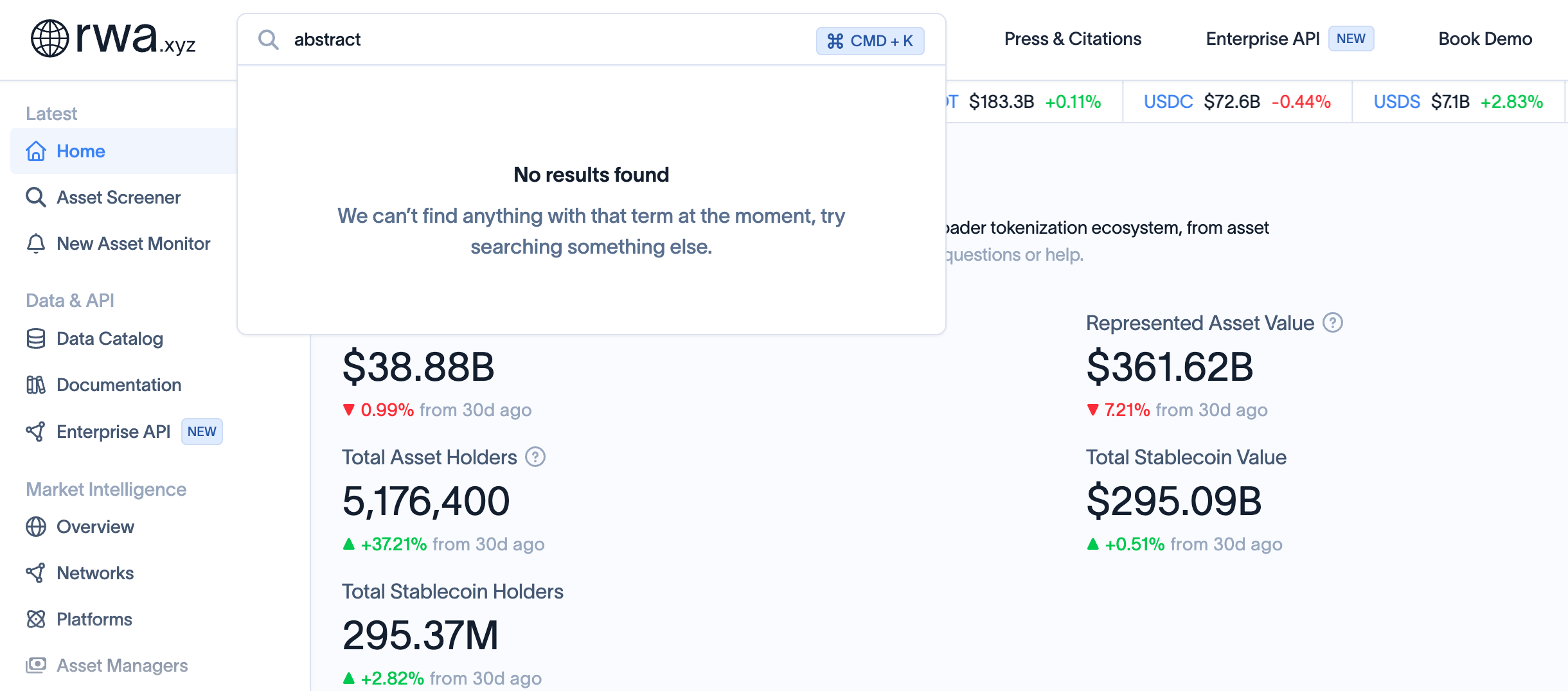
Second, low institutional participation and limited liquidity. This is one of the important reasons for Abstract's shutdown. Taking RWA asset data as an example, Abstract is practically "nonexistent" on the RWA asset TVL network rankings and has been almost entirely absent from the major transformation trends in both crypto and traditional finance over the past 2 years, including institutional investment channels, the RWA asset wave, and tokenized stock trading. From this perspective, it was an extremely serious strategic miscalculation.
Third, operating costs are too high. Apart from the fixed operating expenses of an L2 (Odaily note: including sequencer operations, ZK-related data availability and proof costs, bridge and frontend maintenance, infrastructure development, team operating costs, ecosystem incentives/developer support, etc.), Abstract's outreach to traditional brands, partnerships, and offline conference events all require substantial expenditure. The seemingly glamorous L2 path is not as low-cost as many imagine—early-stage technology development, mid-stage growth operations, and long-term ecosystem building all require continuous capital investment. Abstract's shutdown also carries a sense of cutting losses in time.
Fourth, declining demand for related products and unclear PMF. Unlike the great situation Pudgy Penguins previously won through its NFT community, physical toy IP, PENGU token launch, and the favorable timing of a crypto bull market, the current crypto market's demands on L2 networks and even L1 public chains are no longer limited to small-scale project prosperity, but rather require "ecosystem-level hubs" like Hyperliquid and Robinhood Chain that achieve early pricing of traditional financial assets and bring in traditional financial market liquidity and institutional capital, thereby reaping "fee harvesting" profits. This is precisely the market that Abstract and a host of other L2 networks are powerless to tap into.
Beyond the above reasons, the homogenized competition among L2 networks and the overly rapid bull-bear cycle shifts in the crypto market are also contributing factors to Abstract's reluctant shutdown. And regarding Abstract's closure, debates in the market have also emerged.
Praise and criticism in fierce debate: unintentional harvesting or "PUA to the end"?
After Abstract officially announced the shutdown, the crypto community engaged in heated discussion around this move. Below are some representative viewpoints:
Yuga Labs VP 0xQuit posted, "Abstract did a decent thing. They could have followed Blast's example and directly done a TGE for the project, raising huge amounts of money that way. But instead, they admitted failure and chose to gradually wind down the project without a TGE. Yes, everyone still lost money, but it could have been much worse. Respect for that."
Crypto community member Loki agreed, saying: "Abstract could have done a TGE at any point before the shutdown, just like countless L2 network projects with no users, but they didn't. Pudgy Penguins co-founder and CCO @chefgoyardi and CEO @LucaNetz bought the Pudgy Penguins project with their own money and never cashed out from the community, and this time through Abstract they once again demonstrated their integrity. The best news is: refocusing on the Pudgy Penguins project." Between the lines, this expressed continued optimism about the Pudgy Penguins team.
But others expressed extreme dissatisfaction, especially those users who had invested real money, time, and effort into participating in Abstract's ecosystem building and network interactions.
Abstract power user Micka posted on X, "I participated in @AbstractChain during the testnet period back in July 2024. I built the French community, published thousands of tweets about Abstract, and in 2025 accumulated over 1,500 hours of livestreaming Abstract mainnet-related content. I spent thousands of dollars over one year and ten months and accumulated 4 million Abstract interaction XP." And now, Abstract has fallen at the very first stage of its three-phase roadmap, leaving him "speechless" and saying he "will never trust Luca again."
Another community member Chris also harshly criticized: "I sold all the PENGU tokens I held. That Space livestream they used to announce the shutdown of Abstract's services was just terrible, like something hastily thrown together at the last minute without any prior discussion. I can somewhat understand their approach, because they didn't want to launch the ABS token via TGE and then shut down the project. But what I really don't like is the overall narrative framing of this matter—their response was a cold 'the badges were useless' and 'you were the one who supported our startup project.' And the most fatal blow was that when someone asked Luca whether any Abstract users would receive rewards from the Pudgy Penguins ecosystem, he immediately said no without even thinking, and basically indicated that the ecosystem content currently accessible to users was all there was. This dragged on far too long and was completely unnecessary. As a streamer and someone who once ground tokens down to zero to participate in events, I invested a tremendous amount of time and effort every week for six consecutive months and created a series of content around this vision. I'm extremely disappointed with how this has turned out."
Some even dug up an interview video of Luca himself from last year's Paris NFT Conference, where he was full of confidence about Abstract's future, saying "Abstract will become the largest L2 network in the future," and even telling everyone to stay tuned. And now, what many people got instead was the official notice of Abstract's shutdown.
The cruel slaps in the crypto market seem to keep happening. Many times, you can't predict that a project you've invested heavily in will definitely become a winner at the table, just as you can't guarantee that you'll reach the South Pole simply by continuing to walk.
Conclusion: After the CEX shutdown wave, the L2 shutdown wave has arrived
Having been in the space for several years, I've seen too many failure stories, including in sectors like NFT, GameFi, and SocialFi, as well as the CEX shutdown wave in recent months. Earlier still, I even interviewed Luca Netz around January 2025, when he was in a similar state as at the Paris NFT Conference—full of grand ambitions for the future development of Abstract, Pudgy Penguins, and Igloo Group, and placing high hopes on PENGU's future prospects.
But the development of things often does not proceed according to individual will. The success or failure of a crypto project depends on many factors—beyond the usual sector, strategy, and direction, there are also funding, business model, and ecosystem building, and it cannot do without the support of institutions, market makers, retail participants, and sometimes a little bit of time and luck.
Just as I wrote N articles last year discussing "L2 is a detour for Ethereum," the shutdowns of Abstract and Blast are by no means the end of the exit of this batch of "on-chain ghost town" L2s. At a time when many models and projects have been disproven, projects that cannot establish a relationship with traditional financial markets may all need to think about their future paths and development directions.