


Traders Bet on a Reversal: Long-Dated Treasuries and Rate-Sensitive Assets May Be Poised for a Violent Rally

Original author: Jin10
A trade with a clear directional bias is emerging in the U.S. options market: some investors are beginning to make large bets on a sudden pullback in long-term interest rates, positioning ahead of time through call options on long-duration Treasuries and utilities-sector ETFs. After the sharp rise in Treasury yields since September, such trades have clearly picked up, suggesting that expectations for a rate reversal are building in the market.
Dow Jones Market Data shows that call option volumes on the iShares 20+ Year Treasury Bond ETF (TLT) and the State Street Utilities Select Sector SPDR ETF have both risen significantly recently. The former is directly affected by long-duration Treasury prices, while the latter belongs to a traditionally rate-sensitive sector; both asset classes have been notably weighed down by the climb in long-end Treasury yields.
Steve Sosnick, chief strategist at Interactive Brokers, said that expanding call option volume typically indicates that investors hold a bullish view on the underlying asset. If the underlying is TLT, the signal is fairly direct, meaning that some traders are turning bullish on long-term bonds, essentially betting that long-term rates will fall.
Long-end Treasury yields rise to multi-decade highs
This pickup in options trading comes after U.S. long-term rates have already risen substantially.
As of press time, the U.S. 10-year Treasury yield stood at 5.335%, while the 30-year Treasury yield reached 5.713%, both at multi-decade highs. By comparison, the 2-year Treasury yield, which is more sensitive to monetary policy, stood at 4.814% that day, having also previously climbed to multi-year highs.
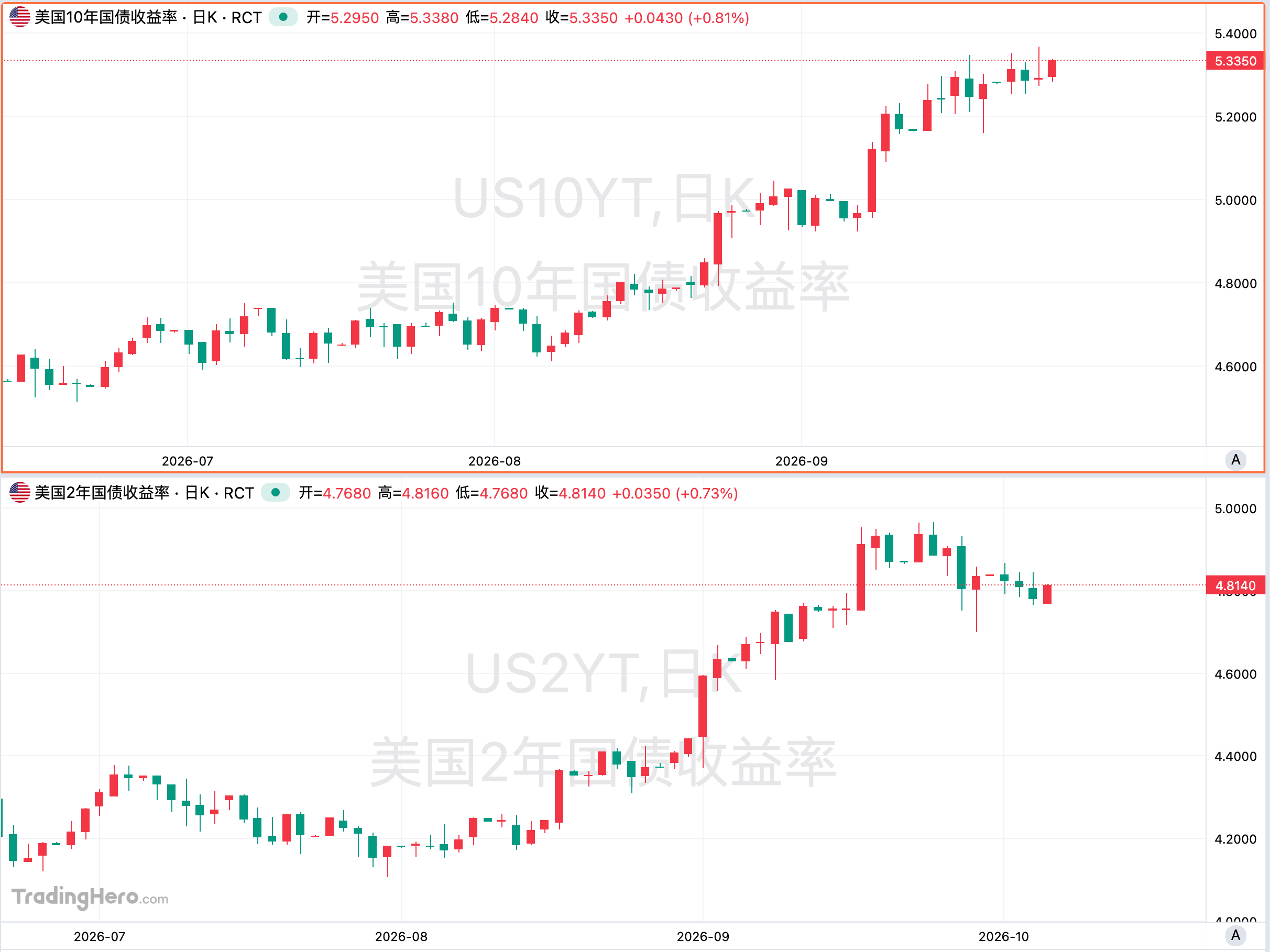
Bond prices and yields move inversely. The persistent rise in long-term yields has already caused notable losses for long-duration Treasury investors. FactSet data shows that TLT recorded its worst monthly total return performance since December 2024 in September, widening its cumulative third-quarter decline to nearly 9%.
On Wednesday, TLT fell another 0.2%, extending its year-to-date total return decline in 2026 to about 8.4%. After long-duration bond prices have already undergone a notable round of adjustment, the sudden increase in call option volume is equivalent to some investors beginning to bet that the previous uptrend in rates may reverse.
Over the past few years, similar market moves have appeared multiple times in the U.S. When Treasury yields retreat rapidly from highs, long-duration bonds are the first to rebound, and a group of assets highly sensitive to financing costs and discount rates also rise along with them, including utility stocks, homebuilders, and small-cap stocks.
Therefore, the bet being made through this options trade is not limited to a small adjustment in short-term policy rates by the Federal Reserve. TLT mainly holds U.S. Treasuries with maturities of more than 20 years, and its performance is more directly influenced by long-term rate expectations. Being bullish on TLT is essentially betting that long-end yields can fall significantly from current highs.
Bullish bets also appear in the utilities sector
Similar trades are appearing simultaneously in the utilities sector.
Traditionally, utility companies attract investors with relatively stable cash flows and dividends, making them highly sensitive to changes in bond yields. When the risk-free rate rises, bonds can offer higher yields, and the dividend appeal of utility stocks declines accordingly; when rates fall, that valuation pressure is usually eased.
The State Street Utilities Select Sector SPDR ETF edged down less than 0.1% on Wednesday, roughly flat, but it has fallen about 10% over the past three months and was still down 1.6% year-to-date as of Wednesday. Against this backdrop, the rise in its call option trading volume likewise reflects that some investors are beginning to bet on a sector rebound.
However, compared with TLT, the signal from utilities options is currently more complex.
Sosnick noted that the AI investment boom has already changed the original trading logic of some utility stocks. Data centers consume large amounts of electricity, and as technology companies rapidly expand AI infrastructure, power generation and electricity supply companies are gradually becoming indirect beneficiaries of AI capital expenditure. As a result, bullish trades in utilities ETFs may stem both from rate-cut expectations and from investors betting on growing electricity demand from AI.
This factor has been especially evident recently. Constellation Energy's shares rose sharply this week after the company reached a nuclear power supply agreement with Google parent Alphabet (GOOGL.O). As of Tuesday, Constellation Energy was also the second-largest holding in the State Street Utilities Select Sector SPDR ETF, with a weight of 7.6%.
Sosnick said that the optimism toward utility stocks shown in the options market may partly stem from investors' strong expectations for electricity demand driven by the expansion of AI infrastructure.
Stock and bond markets begin to wait for a rate reversal
Rising interest rates remain one of the most important sources of pressure in the U.S. financial market. The rapid climb in long-term yields has already hit rate-sensitive assets such as bonds and utility stocks, and has periodically weighed on the stock market.
On Wednesday, the three major U.S. stock indexes weakened overall, with the S&P 500 and Nasdaq Composite both pulling back from record closing highs set in the previous session. However, technology stocks and the AI investment boom are still supporting major indexes, preventing the stock market from trading entirely in line with the traditional high-rate logic.
This also makes the current changes in the options market more noteworthy. The increase in TLT call options provides a relatively pure trade on falling long-term rates, while utilities call options combine both the rate logic and the AI electricity demand logic.
After the 10-year Treasury yield has broken above 5.3% and the 30-year yield has risen above 5.7%, a group of options traders is positioning ahead of time for another market path: if long-term rates retreat rapidly from multi-decade highs, long-duration Treasuries and rate-sensitive assets that have been most pressured over the past few months could also become among the trades with the largest rebound potential.