

01 Exchange: Expand the boundaries of DeFi derivatives with "multiplier perpetual contracts"

Author | Qin Xiaofeng
Editor | Hao Fangzhou
Produced | Odaily

Author | Qin Xiaofeng
Editor | Hao Fangzhou
Produced | Odaily
Warren Buffett has described derivatives as “financial weapons of mass destruction.”
In the DeFi market, the derivatives track has always been regarded as a blue ocean, and many players are vying to enter. In particular, the tightening of supervision last year and the suppression of centralized trading platforms have also provided opportunities for the development of DeFi derivatives. Many rookies have emerged one after another, and 01 Exchange is one of them.
01 Exchange is a decentralized derivatives trading platform based on Solana. It focuses on "perpetual contracts" and "power perpetuals", which can support more than 100 currency transactions and 50 different currencies as margins. Supports cross-chain deposits; in addition, through integration with Serum, 01 Exchange users can use the order book to conduct transactions and obtain the same interactive experience as the centralized platform.
On January 27, 01 Exchange launched its mainnet and launched perpetual contracts with deep liquidity, including BTC, ETH, SOL, LUNA, APE, AVAX, NEAR, and SOL’s multiplier perpetual contracts. According to the official introduction, there are currently more than 6,000 cumulative trading users, and more than 400 weekly active trading users.
Recently, 01 Exchange completed a $2.2 million seed round of financing, led by Multicoin Capital and Alameda Research, with participation from Solana Ventures and Ledger Prime.
As a rising star, can 01 Exchange knock on the door to the new world of DeFi derivatives with the "Rich Square Perpetual Contract"?
secondary title
Fully decentralized DeFi derivatives platform
Whether it is traditional finance or encrypted finance, derivatives have always played an important role and are also one of the key elements of any mature financial system.
At present, encrypted derivatives are still dominated by centralized exchanges. However, due to the tightening of global regulatory policies, various centralized platforms have successively announced stricter review and restricted trading policies, making it even more difficult for users to obtain derivatives transactions.
With the rise of DeFi, DeFi derivatives, which have the advantages of anti-censorship, on-chain settlement, and ease of use, have become an optimal solution, and many people in the industry have high hopes for it, believing that it will become the next blue ocean. Replace centralized derivatives.
Although the current volume of DeFi derivatives is still not as good as that of centralized derivatives, and its strength is still very weak and in its infancy, but its vitality and potential are unlimited, which indicates the future development trend of the industry. In such a blue ocean, there will eventually be one or two DeFi derivatives platforms whose volume exceeds that of top CEXs such as Binance, and emerging projects have a large room for development.
In the view of 01 Exchange, the existing DeFi derivatives platforms mainly face the following problems, which hinder the development of DeFi derivatives:
First, from the perspective of the underlying architecture, most platforms choose to build on Ethereum. For futures contracts that require high-frequency interaction, Ethereum takes a long time to process orders and has high gas costs, which is not suitable for building financial derivatives. Therefore, 01 Exchange chooses to build based on the high-performance public chain Solana. Solana has high throughput and low handling fees, which can greatly meet the interaction needs of contracts.Second, from the perspective of interactive experience, it is currently difficult for DeFi derivatives to compete with centralized trading platforms. For example, the Perpetual protocol adopts the vAMM model, which essentially uses the same x*y=k constant product formula as Uniswap. The advantage of this model is that it supports leveraged trading, but its disadvantages are also obvious, such as high slippage.
The order book model represented by dYdX and Injective advocates off-chain matching and synchronizes assets and orders to the high-performance public chain. This model is highly praised by some users because it follows the trading habits of the centralized platform; however, in the early days of the project, some orders were mainly matched through their own servers, and they could not be executed on the chain. It is still semi-centralized Way.01 Exchange chose to integrate with Serum, a decentralized exchange on Solana, and used Serem's on-chain order book system, allowing traders to use limit order book transactions, which is in line with users' trading habits.
It is worth mentioning that DEXs on Solana, such as Raydium, are also using Serum's order book for transactions. "Building directly on the Serum order book means that 01 Exchange is completely decentralized from the beginning to the end, and can provide sufficient liquidity for contract transactions without slippage."
01 Exchange cooperates with the Wormhole protocol (Wormhole) to support users to realize cross-chain deposits.
in addition,Previously, users could only use Solana's native wallets (such as Phantom, Sollet, Slope, etc.) to interact with Dapps when conducting transactions on Solana; if they need to transfer assets from Ethereum, they also need to perform operations such as cross-chain and currency exchange.01 Exchange now allows traders to transfer assets from supported blockchains (e.g. Ethereum, Solana, Terra) directly into their margin accounts. Specifically, users can click on the Metamask wallet or Terra Station wallet to connect to 01 Exchange, and transfer their tokens from the Ethereum/Terra chain to the Solana chain without going through a centralized exchange.
For derivatives transactions on 01 Exchange, users can choose to use cross margin (cross-margin mode) and cross-mortgage—as long as the tokens supported by 01 Exchange can be used as collateral (each token has a different mortgage weight)
. According to the plan of the 01 Exchange team, in the future, contract transactions of 100 currencies will be supported, and more than 50 tokens will be supported as collateral (margin).
"Currently, on the DeFi derivatives track, there is still a lack of decentralized exchanges that can provide liquidity and be comparable to the experience of centralized exchanges, which is why 01 Exchange chose this track." Stratos, co-founder of 01 Exchange “The ultimate vision of the 01 Exchange team is to build a trading experience that does not compromise decentralization, while providing the same functionality as any centralized exchange.”
secondary titleThe Pathfinder of Multiplier Perpetual Contract
In the traditional derivatives market, in addition to futures, there are multiple categories such as options, swaps, and forwards; the current DeFi derivatives are mostly concentrated in the futures market, and there are many development directions that can be explored. 01 In addition to providing perpetual futures (contracts), Exchange also creatively launched a new product - "Power Perpetuals".
"Square perpetual contract" is a new type of financial derivative in the encrypted market. It was first proposed by Dave White, Dan Robinson and the Oypn team last year. The top investment institution Paradigm also released a paper introducing this product. Click to readBriefly introduce the "multiplier perpetual contract". From the perspective of pricing structure, futures is a linear function, Y=X; if the price of the underlying asset X increases by 10%, the price of the mapped asset Y will also increase by 10%; therefore, when the user uses five times leverage, the profit is 5 *10%=50%. The power perpetual contract is an exponential function, Y=X to the Nth power, if the price of the underlying asset X increases by 10%, the price of the mapped asset Y will also rise by 10% to the Nth power; the higher the price rises, the greater the change in the mapped asset bigger.
According to the official introduction,From a structural point of view, the power perpetual contract is somewhat similar to traditional options, both of which are convex functions, but there are obvious differences between the power perpetual contract and traditional options: traditional options need to determine the strike price, expiration date, etc., and users have a higher threshold for use; andThe product structure of the square perpetual contract is more pure. By using the capital fee mechanism of the perpetual contract, a product with asymmetric risk exposure similar to the option risk model is constructed. There are no additional links such as delivery period and exercise price. User operations The experience is basically the same as the perpetual contract, and the operation of the power perpetual contract will be relatively simpler.
According to the official introduction,
A major application direction of the power perpetual contract is to hedge the impermanent loss of the liquidity pool.
When users provide liquidity on platforms such as Atrix, Raydium, and Orca, they can establish a clear combination on 01 Exchange, pay the funding rate, and avoid impermanent losses. This process can also be simplified through automatic vaults.
Assuming that the current SOL price is $100, the price of the corresponding multiplier perpetual contract is: 100^2, which is $10,000; user Xiaoqin has a principal of $100, and chooses to go long with a full position; at this time, the position that Xiaoqin can buy is 100/10000 =0.01;
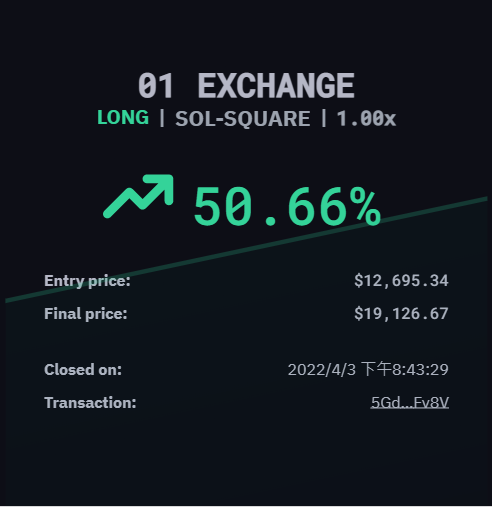
When the price of SOL doubles and rises to 200 US dollars, the corresponding power perpetual contract price is: 200^2, which is 40,000 US dollars; then Xiaoqin’s account assets at this time are: 0.01*40000=400 US dollars, and the net income is 400-100=300 Dollar.
And when the price of SOL drops by 50% to $50, the price of the corresponding multiplier perpetual contract is: 50^2, which is $2500; then Xiaoqin’s account assets at this time are: 0.01* 2500 = $25, and the net income is 25- 100= -$75.
(01 Exchange experience screenshot)
From the above case, it can be seen that the advantage of the SOL multiplier perpetual contract is that compared with the perpetual contract with 2 times leverage, it will earn more when it rises, and it will fall less when it falls. According to the official statement, even if the market falls sharply, there will be no risk of liquidation. Because of this, the funding rate of the power perpetual contract will be higher than that of the general perpetual contract, and its funding rate is: mark price - index price².
"The multiplication perpetual contract is a brand new product, and 01 Exchange is the first and only exchange that trades the multiplication perpetual contract on the order book. The uniqueness of the multiplication perpetual contract is that when it goes up, it will get more risk exposure, and the loss will be reduced due to the convexity of the profit curve when it falls. This means that leverage can be effectively used for trading without being liquidated. If leveraged trading is used in perpetual contracts, there will be The possibility of liquidation,” Stratos explained.
secondary title
Blessed by star institutions, new functions are constantly launched
As mentioned above, 01 Exchange has multiple advantages: based on the high-performance public chain Solana, it mainly focuses on square perpetual contracts and futures contracts, and supports order book transactions, cross-margin, cross-mortgage and cross-chain deposits.
Because of this, 01 Exchange is also valued and supported by many star institutions. Recently, 01 Exchange announced the completion of a $2.2 million seed round of financing, led by Multicoin Capital and Alameda Research, with participation from Solana Ventures and Ledger Prime.