

"DAO exists in name only"? Dig deep into the story behind the Arbitrum team

Original Author: Jaleel
Original editor: Jack
Over the weekend, the Arbitrum community's proposal on the allocation of DAO treasury tokens caused intense discussions. The team transferred the tokens to the wallets of the team and investment institutions before the community vote was passed or even ended (BlockBeats note, more about AIP -1 For the content of the proposal, please read "Token sale without governance process? Analyzing the Arbitrum Foundation's Controversial Operationsfirst level title
「Lab experiment」
Edward William Felten was born on March 25, 1963. Felten attended Caltech, where he earned a degree in physics in 1985. From 1986 to 1989, he worked as a programmer at Caltech on a parallel supercomputer project at Caltech. He then pursued graduate studies in computer science at the University of Washington. MS in 1991 and PhD in 1993 with a dissertation on the development of an automation protocol for communication between parallel processors.
image description
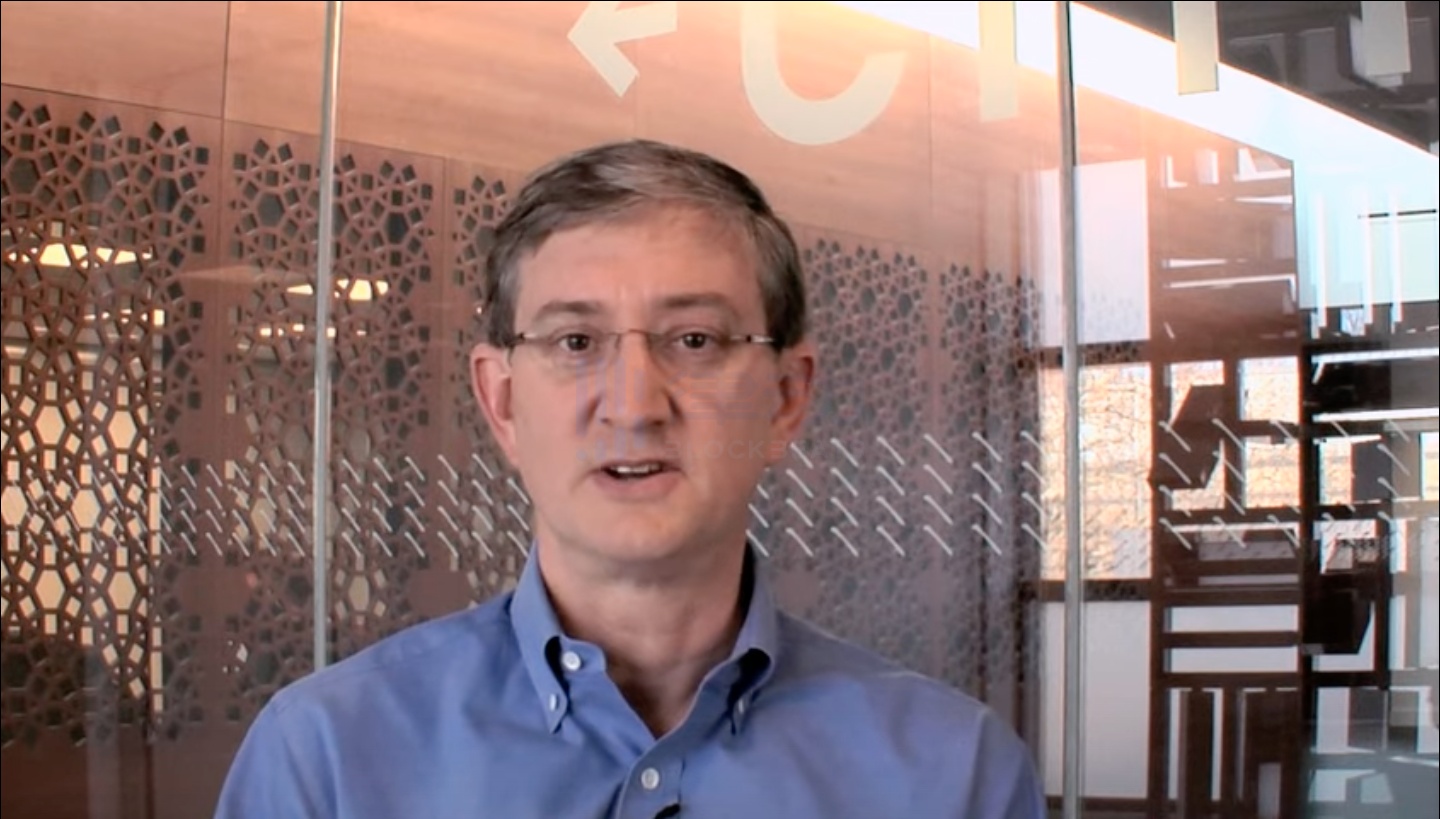
Ed Felten's video speech as director of CIPT, the source of the picture comes from the Internet
Between 2012 and 2013, Ed returned to his teaching position and began to contact and research Bitcoin and blockchain technology. Ed's research work on Bitcoin began with a thesis he wrote on the dynamics and stability of Bitcoin's mining mechanism. At that time, everyone believed that the Bitcoin system was stable. If everyone acted according to their own motives, the inevitable result was that everyone acted according to the rules of Bitcoin. But Ed Felten proved that this is not the case, there are infinitely many outcomes that are stable, but different from Bitcoin's written rules.
Since then, he has launched several Bitcoin-related projects. Such as building tools to track and diagnose the behavior of the peer-to-peer network that Bitcoin participants use to spread information about what is going on, studying the dynamics of mining pools, new types of double spend attacks and how participants should defend against them, and using Bitcoin The protocol designs a decentralized prediction market.
At the same time, a new concept called "Smart Contract" (Smart Contract) also attracted Ed's attention. For him who has been exposed to software and programming since he was a child, the concept of smart contracts reminded him of the surging Internet industry in the 1990s . "Smart contracts will become a new software platform," Ed told himself and his colleagues. Since then, he has started research on the future development of smart contracts. After seeing the potential congestion problem of the Bitcoin network, Ed decisively determined his own research direction-scalability solutions. Remember, there is no Ethereum in the blockchain world at this time.
In 2014, IFP technology (Interactive Fraud Proof) provided a new possibility for the scalability of the blockchain: a side chain (Side-Chain) or a second-layer chain (L2-Chain) can enjoy the security of the underlying chain In extreme cases, all computing links are moved off-chain to complete, which greatly improves the operational efficiency of the blockchain.
Ed in this school year stayed in his office all day long, drawing various diagrams and threads on the IFP technology stack against the whiteboard with banknotes in his hand. In the fall semester, one of Ed's professor colleagues taught a blockchain course, and the final assignment was to design a blockchain-based project in groups. Not long after, a group of 6 found Ed and began to learn and discuss with him how to build an "expansion chain" on the underlying chain.
image description
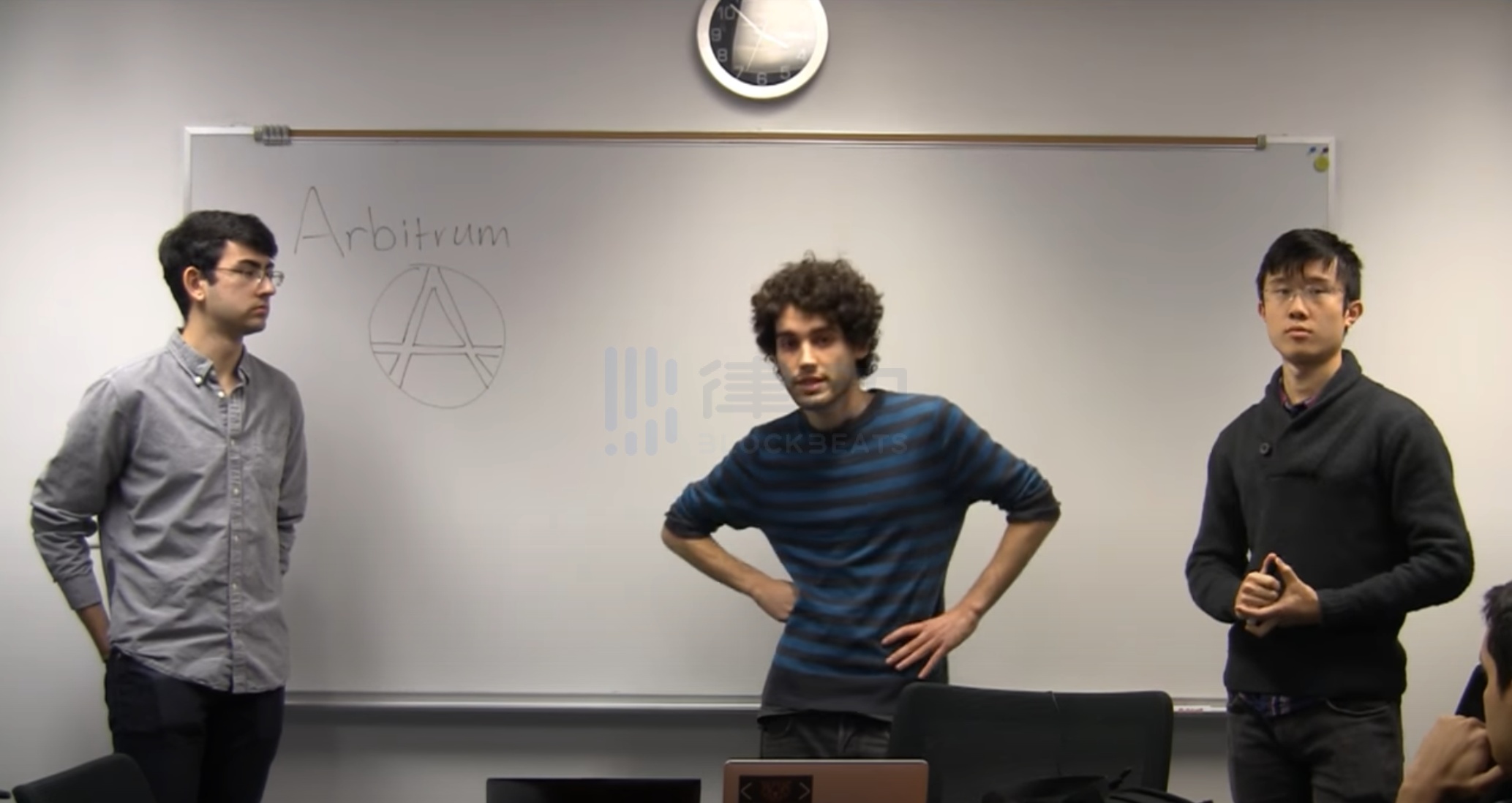
Arbitrum's end-of-course display, the source of the picture comes from the Internet
Like most of the students present, Ed is very satisfied with this end-of-course assignment, and intends to use Arbitrum as a starting point to take a closer look at the future of Roll-Up technology. But unexpectedly, Ed, who was about to start showing his skills, suddenly received a call from the White House, inviting him to assist in technical security work.
image description
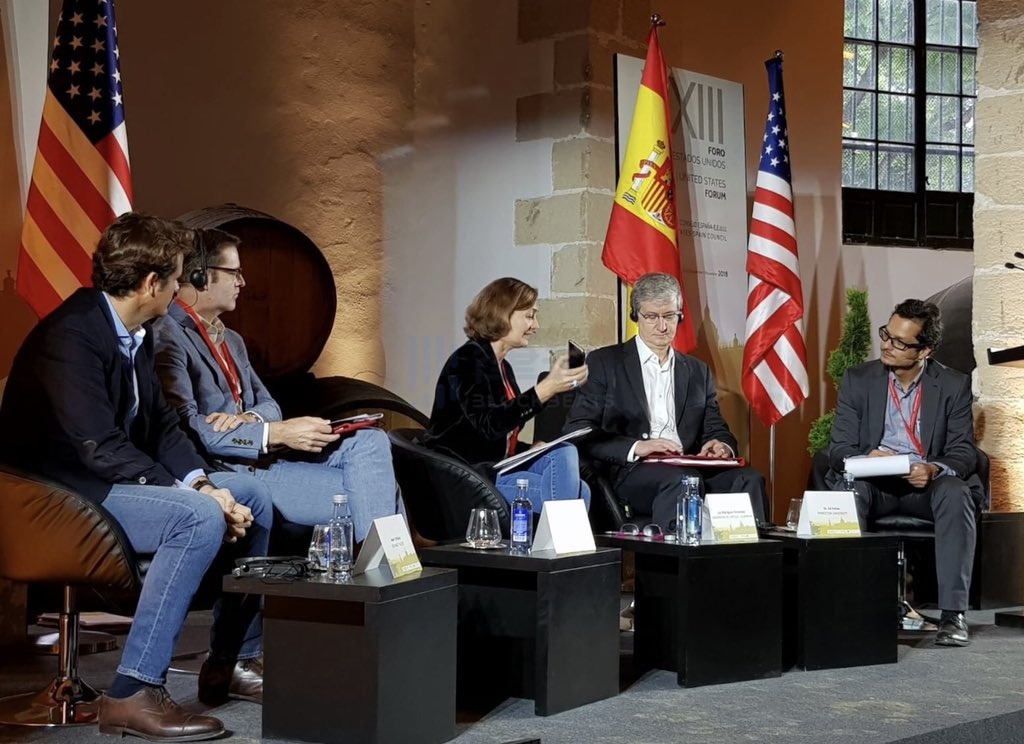
Ed Felten, the deputy chief technology officer at the White House, the source of the picture comes from the Internet
image description
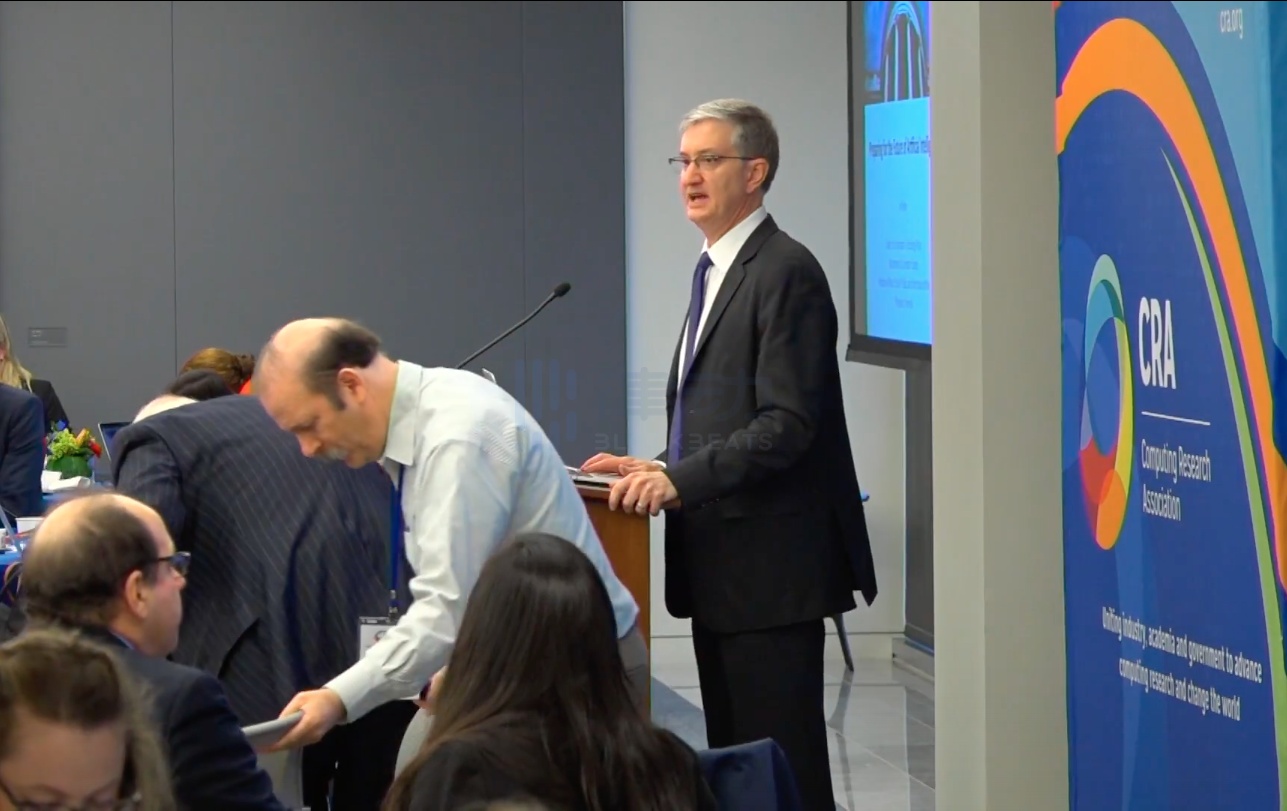
In 2018, Ed Felten delivered a speech on AI technology at the Computing Research Association Summit, the source of the picture comes from the Internet
A few months later, two of Ed's PhD students, Steven Goldfeder and Harry Kalodner, approached him with an offer: "Hey , remember that thing called Arbitrum, let's make another one." "Sure!" Just like that, Ed accepted his student's invitation without thinking.
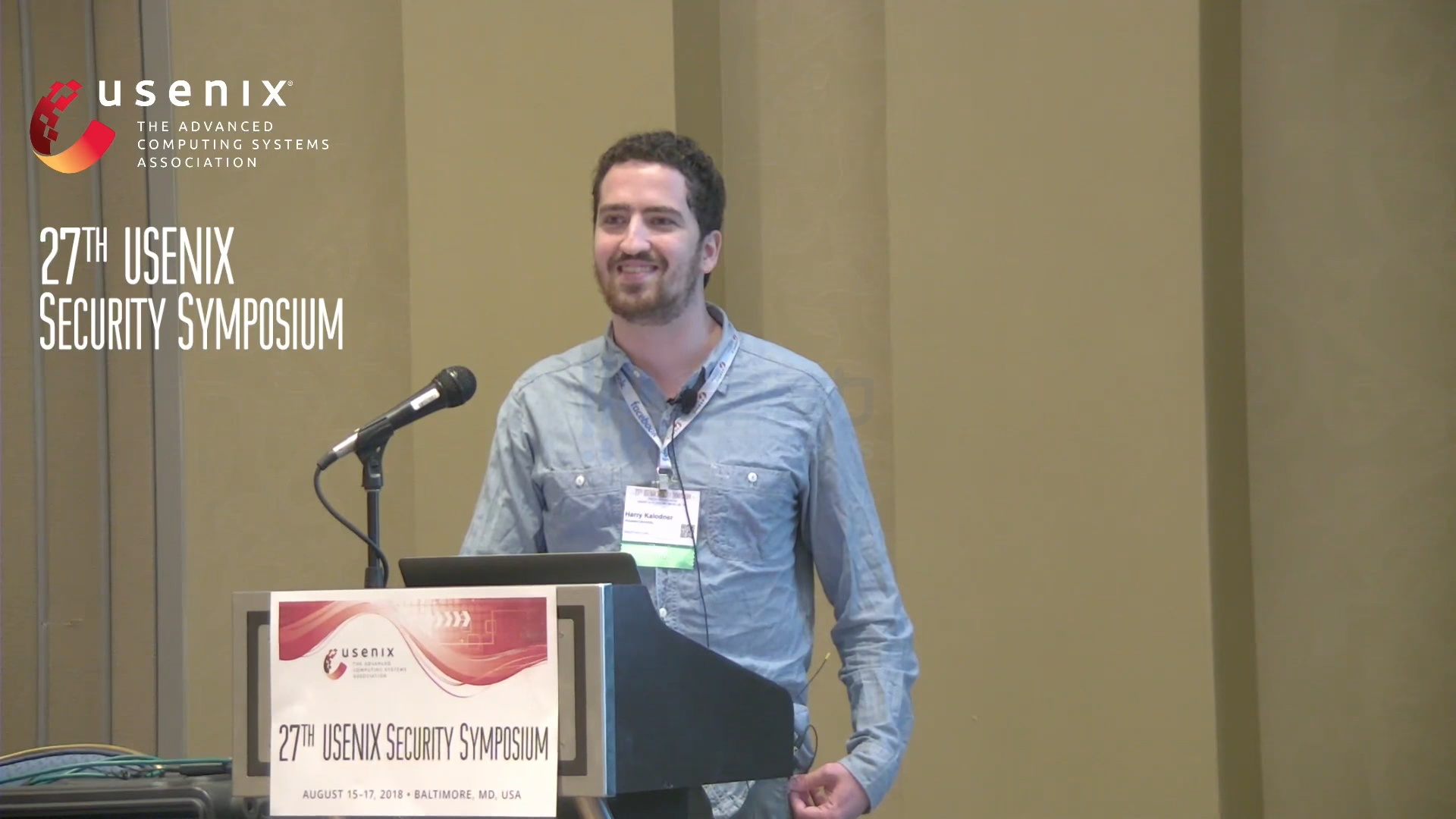
In August 2018, Harry Kalodner published an academic work jointly completed by the three on the 27th USENIX Security, titled "Arbitrum: Scalable, private smart contracts". The problem of scaling Ethereum in the absence of radicality. In the same year, the three jointly founded Offchain Labs, and Arbitrum officially launched the project.
first level title
Brief Chronicle of Arbitrum
We all know that, as Ethereum's Layer 2 scaling solution, Arbitrum has successfully overcome many initial challenges and experienced a series of developments and developments since its launch in 2020. Before talking about the recently hotly discussed "DAO incident" and (AIP-1) proposal, let's briefly review the important development experience of Arbitrum.
In February 2020, the first version of Arbitrum's testnet was launched, which only supports DAC-specific application chains and no contract deployment. In October 2020, Arbitrum will launch a new round of testnet and general contract deployment.
In January 2021, OffchainLabs launched a batch of demo products for the DeFi ecosystem on the Arbitrum testnet. In May of the same year, the company deployed the Arbitrum One test network, and more than 250 teams applied for access. In September, Arbitrum launched its mainnet, Arbitrum One, and announced the completion of a $120 million Series B funding round.
In June 2022, Arbitrum launched the Odyssey Odyssey project, allowing users to earn rewards by participating in Odyssey NFT promotions or using the Arbitrum ecosystem. Project Odyssey, which was supposed to run for eight weeks, was suspended after the first week. The root cause of the suspension was that a large number of new users congested the network, causing the gas fee to be too high, even exceeding the gas fee of the Ethereum mainnet. This also made them drastically release the Nitro mainnet based on the WASM architecture.
In July 2022, Arbitrum announced the construction of a new chain "Arbitrum Nova", and then announced on September 1 that it had successfully upgraded Arbitrum One to the Nitro version, improving network speed and reducing transaction costs, and greatly improved the transaction volume and daily active users. Far ahead of Optimism, the market share is as high as 52.5%.
On February 7, 2023, the Offchain Labs development team announced that it will launch a next-generation programming environment, Stylus, for Arbitrum One and Arbitrum Nova this year. Stylus is an order of magnitude faster, can cut costs, and is fully interoperable with the Ethereum Virtual Machine , and even known as an upgraded version of the Ethereum virtual machine "EVM+".
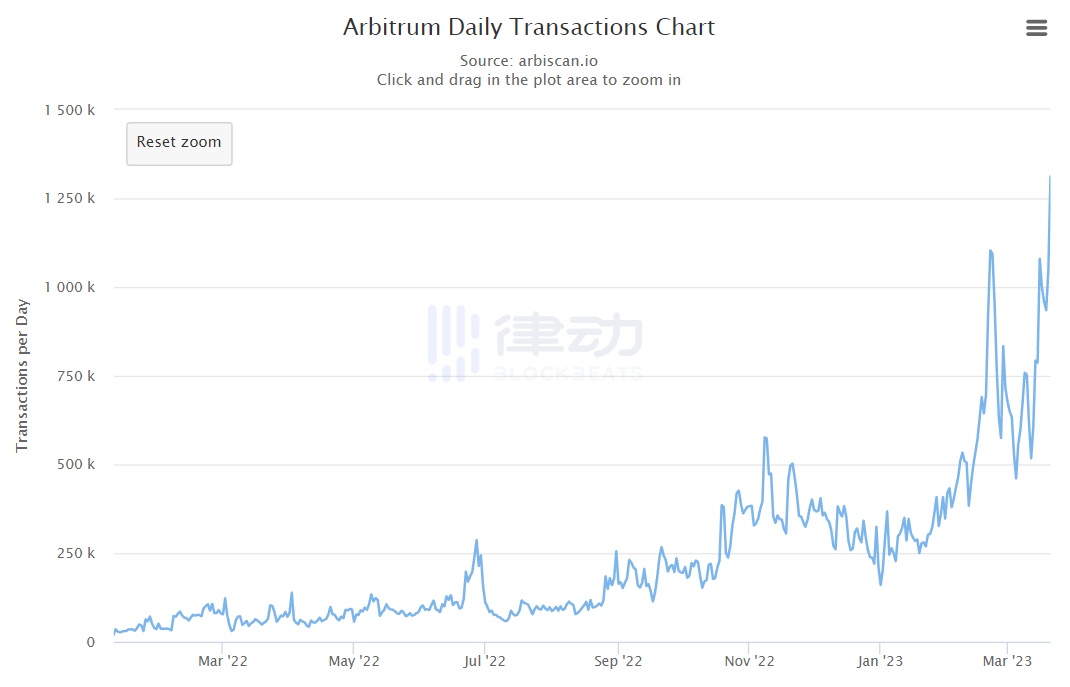
Since its launch, Arbitrum has undergone a series of developments, including deploying a test network, launching the Odyssey project, and releasing Nitro. The recent Nitro upgrade and the upcoming Stylus programming environment demonstrate the platform's commitment to providing Ethereum users with fast, efficient and low-cost solutions. Even on March 23, Arbitrum’s daily transaction volume hit an all-time high of 1.3 million, compared to 1.08 million on the Ethereum mainnet.
first level title
AIP-1 "Rollover Case"
On March 28, the Arbitrum community launched a vote on the Arbitrum Improvement Proposal 1 (AIP-1) proposal on Snapshot. The content of the proposal is to introduce ArbitrumDAO, a decentralized autonomous organization structure managed by ARB holders. The Arbitrum Foundation will also support ArbitrumDAO Community service and governed by it.
However, the voting has not yet concluded and the AIP-1 proposal has not yet passed. But it was revealed by Patrick McCorry's blog post that the Arbitrum Foundation had already created a multi-signature wallet with the address "Arbitrum DAO Treasury 2", received nearly 700 million ARB Tokens, and sold ARB Tokens in advance in exchange for Stable currency, which immediately aroused heated discussions in the community and caused dissatisfaction among holders.
The community and some partners are extremely disappointed with the Arbitrum team and the so-called governance, thinking that AIP-1 is not a real vote, but throws the DAO principles directly out the window. What is the point of voting if the content of the proposal has been implemented without the consent of the community?
Under repeated pressure, on April 3rd, Arbitrum officials responded to this matter on social media several times. Arbitrum's decentralized governance is proceeding according to the original plan, but many decisions must be made before the official launch of the DAO. make. The goal of the AIP-1 proposal is to involve the community in the initial decision-making, and ultimately allow Token holders to approve the initial decision-making and framework through DAO voting. On an important point of controversy, Arbitrum denied that the fund did not sell 50 million ARBs before the AIP-1 proposal was not voted through. Among them, 40 million ARBs have been distributed as loans to mature participants in the financial market field, and the remaining 10 million ARBs have been converted into legal tender to pay for operating costs.
With the public opposition of Blockworks Research and TreasureDAO, the largest governance representative of the Arbitrum ecosystem, the impact of the "DAO event" has escalated again.
Blockworks Research publicly stated that it voted against this proposal, and denounced AIP-1 as a regression of the current state of community governance. Subsequently, TreasureDAO also stated that it had voted against the AIP-1 proposal proposed by the Arbitrum Foundation, and asked Arbitrum to resubmit a proposal, which needed to clarify the scope of the special grant program and split the AIP-1 proposal. In response, Arbitrum promised to address the feedback it received from the community and rework each part of the proposal this week.
As of the time of writing, at 11:15 on April 3, according to the latest voting data from Snapshot, the comprehensive governance package Arbitrum Improvement Proposal (AIP-1) initiated by the Arbitrum Foundation has reversed from the initial 81.7% in favor to the current 82.58% against .
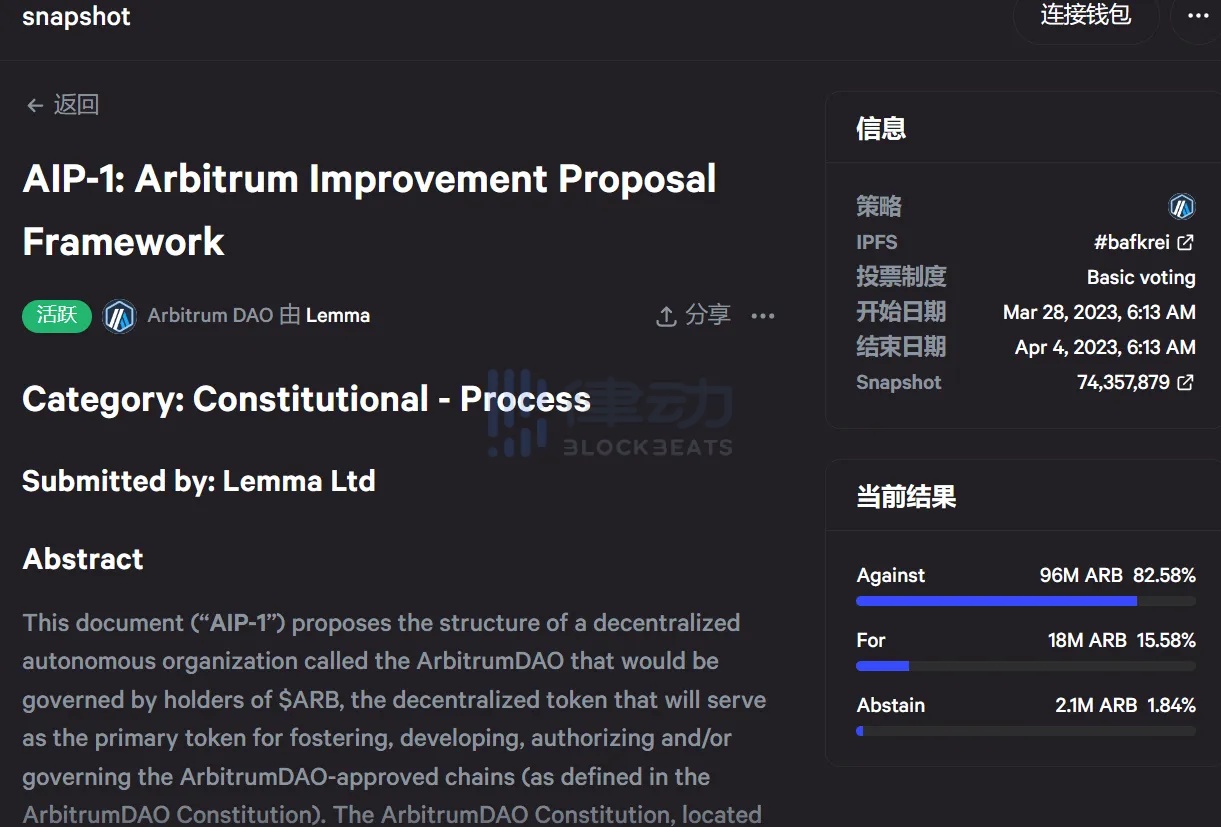
The voting on the AIP-1 proposal will end at 6:13 on April 4, Beijing time. Under such pressure from public opinion, the possibility of passing the AIP-1 proposal is extremely small, so how will Arbitrum end? Everyone in the community is curious to know, and BlockBeats will continue to follow.