

Nvidia Earnings Preview: The Market No Longer Expects It to Beat Expectations

After the US stock market closes on Wednesday, Jensen Huang will pick up the microphone.
The average analyst estimate is Q2 revenue of $92.18 billion, nearly doubling year-over-year—the fastest growth in seven quarters, driven by more than double-digit growth in the data center business. This $5 trillion company has beaten analyst expectations for 14 consecutive quarters—last quarter, net profit grew 210% year-over-year, while Wall Street had predicted 126%, missing the mark by nearly double.
By all accounts, this should be a nerve-wracking evening.
But the options market is pricing in something different.
What are the options saying?
Traders are pricing in a 5.4% move for the day after earnings, corresponding to a market cap swing of roughly $280 billion—larger than the entire market cap of 90% of the S&P 500's individual components.
Sounds scary, but consider the frame of reference: before the May earnings report, the market priced in a 6.5% move; over the past 12 quarters, the actual average post-earnings move was 7.4%. In other words, this is the calmest expectation in two years.
Matt Amberson, founder of options analytics firm ORATS, put it bluntly: "This shows a certain complacency toward Nvidia, and it also means the company has become more predictable."
Chris Murphy, co-head of derivatives strategy at market maker Susquehanna, put it even more starkly: "At the beginning of the AI era, Nvidia could always surprise everyone, with moves of 10%, 15%, 20% right out of the gate—that phase is essentially over. Not many people in the market really think they're going to hit everyone with a massive beat and send the stock soaring."
One piece of supporting evidence is the stock's performance this year.
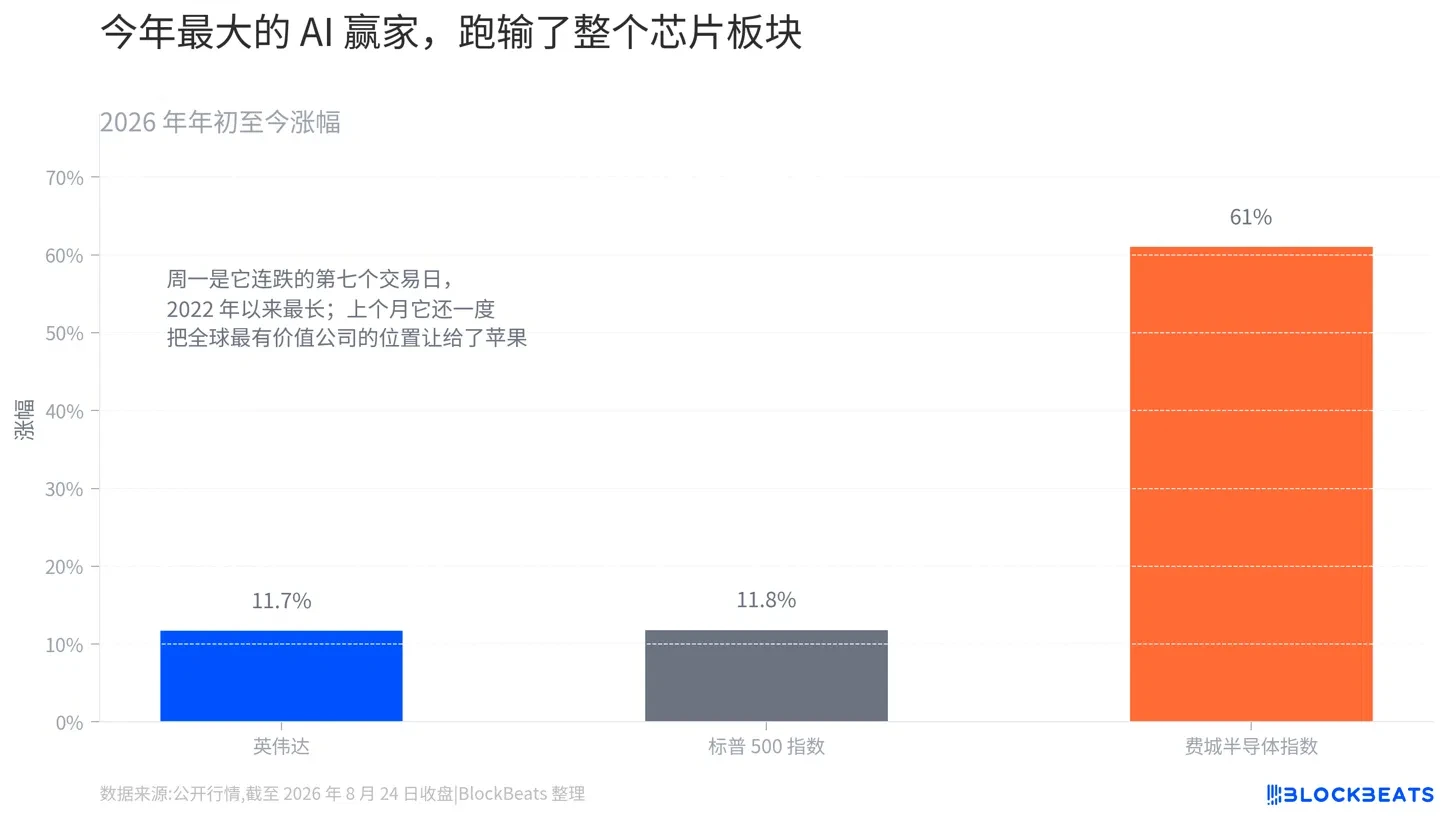
Year-to-date, Nvidia is up 11.7%, while the S&P 500 is up 11.8%—it has underperformed the broader index by a hair. Meanwhile, the Philadelphia Semiconductor Index is up 61%. The biggest pick-and-shovel seller in the entire AI buildout has underperformed the entire shovel industry this year. On Monday, it closed out its seventh straight losing session, its longest streak since 2022.
Last month, it briefly ceded the title of "world's most valuable company" to Apple.
It rebounded about 1% in pre-market trading on Tuesday, potentially ending the losing streak. But the driver of this rebound was less about the company itself and more about Brent crude falling to around $89. Kathleen Brooks, research director at XTB, put it this way: "The shift in sentiment is thanks to lower oil prices."
So what exactly is the market waiting for?
Sara Araghi, portfolio manager at Franklin Equity, part of Franklin Templeton, made the requirement clear on Bloomberg TV Tuesday: Nvidia needs not just a strong earnings report, but specifics on how it plans to deploy capital and maintain its spending plans.
"More detail on these investments, the value of these investments—I think the market needs to see that."
She pointed to a divergence: Nvidia's forward P/E ratio for the next 12 months is now around 21x, which doesn't match its expected revenue and earnings growth at all. That multiple suggests the market is already pricing in a slowdown in growth.
"This (growth) is extraordinary," she said, "but deceleration is coming, and unfortunately, the market is looking at next year."
She also flagged two specific checkpoints.
First, gross margin. Nvidia's roughly 75% gross margin is highly unusual for a hardware company and will be scrutinized word by word amid rising raw material costs. To hedge against higher memory costs, Nvidia has already raised prices: for early 2027 servers based on the Vera Rubin and Grace Blackwell architectures, quotes to major customers will rise by more than 15%.
Second, the use of that cash. Earnings growth matters because it convinces Wall Street that "the free cash flow they generate is sufficient to fund the investments they need to make." She added: "And they have to use that cash to buy back stock."
Bloomberg Intelligence analysts issued the same warning: a routine "beat and raise" may no longer be enough to lift sentiment.
Where is the money actually flowing?
That's the real question for this earnings report. Over the past month, Nvidia has been doing things that go beyond the scope of a chip company:
It teamed up with six of Wall Street's largest financial institutions to arrange a $500 billion AI financing program, pledging to backstop loans for customers who can't afford its chips.
Last week, it agreed to provide up to $105 billion in guarantees for OpenAI's lease of a massive data center in Ohio, with a 20-year term—one of its largest AI financing commitments to date.
Also last week, it took an equity stake in Cloverleaf Infrastructure, a company that specializes in securing electricity for data centers.
It also struck a $6 billion deal with startup Poolside, aiming to develop a powerful open-weight AI model.
Brian Mulberry, chief market strategist at Zacks Investment Management, gave this suite of moves a name: "It makes them a kind of central bank in the AI space." He holds Nvidia stock but also noted the risk: "The real risk is being fully exposed to AI without any diversification. For this to succeed, the key is that adoption of AI tools has to keep growing."
"Circular trading" is the core criticism here: If I lend you money to buy my chips, is my revenue actually demand, or is it something I created myself?
Jensen Huang's defense is straightforward: the logic is simple—the company has ample cash and can use it to support customers that are growing fast but still losing money to build out their infrastructure. He said the Ohio backstop does not constitute circular financing.
For that argument to hold, those customers ultimately need to actually make money. And on that front, recent signals are not encouraging: OpenAI recently told investors its Q2 revenue grew only 18%, and losses are widening.
Tonight, Jensen Huang isn't just facing himself
Nvidia's earnings report lands against a very unfriendly backdrop.
The political backlash against AI is expanding. More than 500 towns and cities across the US have restricted data center construction. The bond selloff has pushed borrowing costs to multi-year highs, with the 30-year Treasury yield hitting a 19-year high last week. The former money printers—hyperscale cloud providers—are increasingly relying on debt to fund construction, and data center spending by big tech companies is projected to exceed $730 billion this year.
Mulberry of Zacks used a metaphor to describe the weight of this earnings report: "This increasingly feels like a World Cup final rather than the Super Bowl. It's just gotten that big."
The answer investors are looking for is really just one: How fast can the transition from Blackwell to Vera Rubin be, with shipments expected to begin this fall?
Russ Mould, investment director at AJ Bell, put it in the starkest terms: "Nvidia's upcoming results have the power to push the entire market up or down. The clue investors are looking for is—whether AI demand is losing momentum."